
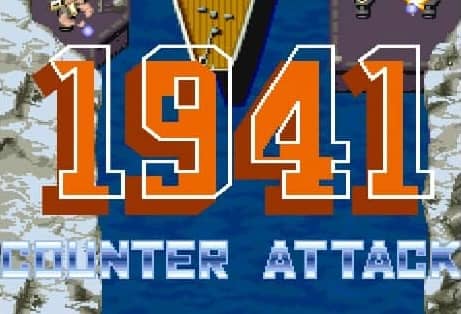
Gameplay and design
The core gameplay of "1941" is vertical scrolling shooting, where players control a fighter plane advancing upward on the screen, shooting down incoming enemy aircraft while dodging dense bullet patterns. The goal is straightforward: survive the hail of bullets and shoot down as many enemies as possible. Like many games of its kind, enemy formations appear periodically, and shooting them down often yields weapon upgrade items (POW) that enhance firepower, giving players more confidence in subsequent battles.
The game's most distinctive feature is its energy system instead of the traditional life count. The player's fighter has an energy gauge; when hit by enemy bullets or colliding with enemy planes, energy decreases rather than losing a life outright. The game only ends when energy is depleted. This design gives players more buffer when taking damage, but it also means each hit weakens combat capability, forcing players to weigh offense against defense.
The lightning attack is another major feature. By pressing the B button, players can consume a portion of life energy to unleash a large-scale lightning attack that instantly clears most enemies on screen. This skill can be a lifesaver in critical moments, but at the cost of energy; if energy is too low, using it might directly end the game. Therefore, when to use the lightning attack is a strategic point players must carefully consider.
The game also introduces a stage loop mechanic. Each stage can be played up to three times, with difficulty and enemy configurations changing each loop. If players finish a stage without using all three loops, the remaining loops convert into bonus points. This design encourages players aiming for high scores to consider not only clear efficiency but also whether to risk challenging higher-difficulty loops.
Two-player cooperative mode is another highlight. Player 1 uses the P-38 Lightning fighter, while Player 2 pilots the DH.98 Mosquito bomber; the two aircraft differ slightly in performance but both play important roles. In cooperative mode, players can cover each other and jointly deal with enemies, but they must also avoid colliding with each other. This blend of cooperation and competition greatly enhances the game's fun.
Background and release
"1941" was released by Capcom in 1990, using the then-advanced CP System (CPS-1) arcade board. This board, introduced by Capcom in the late 1980s, was renowned for its powerful graphics processing, providing "1941" with smooth visuals and rich color. Upon its arcade release, the game attracted many players and became one of the popular shooters of the time.
As the third entry in the 194X series, "1941" is a prequel to "1942" in the timeline. The game is set in 1941, during World War II, but the timeline is fictional, featuring numerous advanced aircraft and intense aerial battles beyond its era. This fictional WWII backdrop adds imaginative scope and entertainment value.
Unlike its predecessors "1942" and "1943," which were set in the Pacific, "1941" shifts the battlefield to the North Atlantic and Western Front. This change brings new stage designs and enemy types, allowing players to experience the combat atmosphere of different theaters. From dense jungles to European towns, the variety of settings offers a rich visual experience.
In 1991, Capcom released a SuperGrafx port of "1941." The SuperGrafx was a home console by NEC with improved performance over the PC Engine, but it did not perform well commercially. Nevertheless, this port allowed more players to enjoy the game at home and received some positive reception in Japan.
"1941" achieved solid results in the arcade market. In Japan, Game Machine magazine listed the game as the third most popular arcade game in its March 15, 1990 issue, reflecting its popularity at the time. Additionally, the game received awards from Gamest magazine, further cementing its status in the shooter genre.
Development
"1941" was developed internally by Capcom, with music composed by Manami Matsumae. Matsumae is a renowned Capcom composer who has scored many classic games; her music style is dynamic and melodic, creating a tense and exciting combat atmosphere for "1941." The game's sound effects and music were highly recognizable in arcades, becoming an integral part of the experience.
The game was developed on the CPS-1 board, which gave Capcom a technical advantage. CPS-1 supported large sprites and rich colors, making "1941"'s graphics stand out among contemporary shooters. The development team fully utilized these hardware features, designing detailed enemy aircraft and explosion effects that provided visual satisfaction.
In game design, the team made an interesting decision: Player 2 does not use the same P-38 Lightning as Player 1 but instead pilots the DH.98 Mosquito bomber. The Mosquito was a British wooden bomber known for its speed and agility. This design not only reflects the Allied cooperation theme but also gives two players different handling experiences in co-op mode.
The energy system and lightning attack mechanics were innovative attempts in shooter design. Traditional shooters typically used life counts, but "1941" introduced an energy gauge, giving players more room for error while adding strategic depth. The lightning attack provided a high-risk, high-reward offensive option, a design rarely seen in shooters at the time.
During development, the team also considered the continue mechanism. According to sources, "1941" was the first shooter to add 1 point to the score upon continuing. Though seemingly simple, it was a novel approach at the time, giving players a small reward for continuing and encouraging them to keep challenging. This attention to detail reflects the team's care for player experience.
Reception and legacy
After its arcade release, "1941" received mixed reviews from Western media. Some critics praised its polished graphics and smooth controls, considering it a fine shooter on the CPS-1 board; others pointed out a lack of innovation in gameplay, with no significant breakthroughs compared to similar titles. This divided reception reflected the intense competition in the shooter market at the time.
In contrast, the SuperGrafx port received favorable reviews in Japan. Japanese players and media gave the port high marks, believing it preserved the arcade version's essence while fully utilizing the SuperGrafx's hardware. However, a reader poll by PC Engine Fan scored the SuperGrafx version 19.44/30, ranking 368th, which is not high, indicating some disparity in player opinions.
Despite mixed reviews, "1941"'s influence as a key entry in the 194X series cannot be overlooked. It is not only a prequel to "1942" but also laid the groundwork for the later sequel "19XX: The War Against Destiny" (1996). That sequel continued some of "1941"'s design concepts and further expanded the series' world.
Over the years, "1941" has been included in several Capcom classic collections. For instance, it was featured in "Capcom Classics Collection Remixed" (PSP) and "Capcom Classics Collection Vol. 2" (PS2 and Xbox), allowing a new generation to experience this classic arcade game. In February 2021, the game was re-released in the second pack of the "Capcom Arcade Stadium" compilation for Nintendo Switch, evoking nostalgia among veteran players.
Looking back, "1941" may not be the brightest star in shooter history, but with its unique energy system, two-player co-op design, and prequel storyline, it left a deep impression on players. It witnessed Capcom's arcade-era glory and showcased the diverse possibilities of shooter gameplay. For fans of retro shooters, "1941" is a classic worth trying.





