Gameplay and design
The core gameplay of Trials of Mana revolves around six selectable protagonists, from which the player chooses three to form a party and embark on an adventure to prevent the resurrection of the Mana Goddess. Each protagonist has an independent backstory and motivations, and depending on the chosen characters, the game presents three main storylines, with different story directions and final bosses. This design not only enhances narrative depth but also greatly increases replay value, encouraging players to try different combinations and experience various story branches.
The game supports two-player simultaneous play, a change from the previous game's three-player online co-op, focusing more on cooperation between two players. In battle, players can control character movement and attacks in real time, and use a ring command menu to quickly switch items or use skills. The limited inventory capacity forces players to carefully plan their supplies during the adventure, adding strategic depth and making combat and exploration more tightly paced.
The time system is a major feature of Trials of Mana, with in-game day/night cycles and a weekly cycle. Different times of day and days of the week affect NPC appearances, shop hours, and enemy types. For example, certain events or quests only trigger at specific times, and nighttime enemies may be stronger or drop different items. This system makes the world feel more alive and encourages players to plan their actions based on the time, adding extra depth to exploration.
The class change system is the core of character growth. When characters reach levels 18 and 38, they can undergo two class changes, each with a light and dark path, resulting in four possible class routes. Class changes not only alter character appearance and stat growth but also unlock unique skills and special moves. Players can freely customize their party based on their configuration and combat style, creating personalized character combinations. This freedom offers rich possibilities in battle strategy.
The combat system emphasizes action, requiring players to master attack timing, dodging, and skill execution rather than relying solely on numerical superiority. The boss battles are particularly well-designed, with each boss having unique attack patterns and weaknesses that require observation and strategy. Additionally, the two-player co-op mode allows both players to control characters simultaneously, enabling combo attacks in battle. This real-time cooperation is a highlight of the game and sets Trials of Mana apart from similar titles.
Background and release
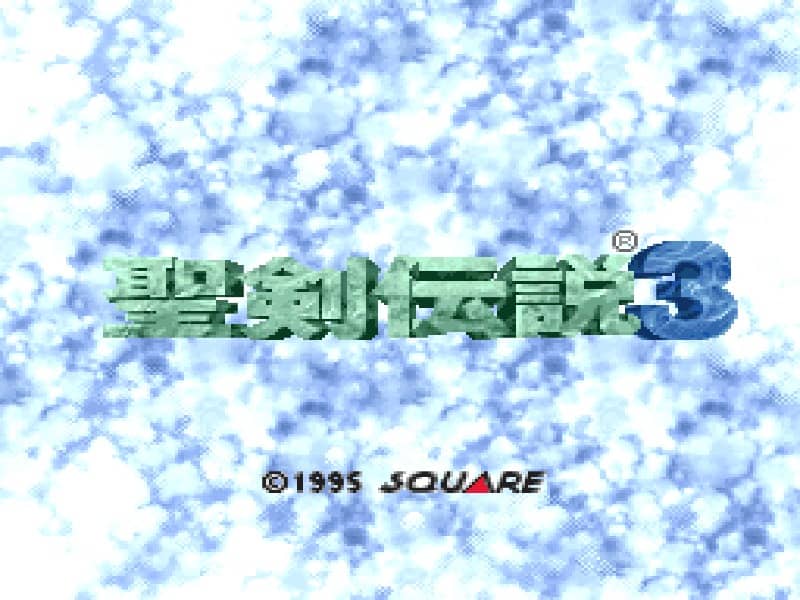
Trials of Mana was released in Japan on September 30, 1995, exclusively for the Super Famicom. As the sequel to Secret of Mana, it carried high expectations from series fans and was highly anticipated before its release. However, the game was not released overseas; Square's North American division planned an English version for late 1995, but it was ultimately canceled due to technical issues, high localization costs, and the rise of competing consoles, leaving the game a Japan-only experience for a long time.
Due to the lack of an official English version, overseas players' knowledge of Trials of Mana relied mainly on fan efforts. In 1999, a fan translation project led by Neill Corlett completed an unofficial English patch, allowing the game to be played in English on emulators. This patch spread widely in the community and became the only way for many Western players to experience Trials of Mana, also building its overseas reputation.
In June 2017, the game was included in the Japanese Nintendo Switch release of Collection of Mana, marking its first official appearance on a modern platform. In June 2019, the collection was released in North America and PAL regions as Collection of Mana, with the game officially titled Trials of Mana. This official localization finally allowed overseas players to experience the classic through legitimate means, filling a long-standing gap.
On April 24, 2020, a 3D remake of Trials of Mana was released worldwide for Windows, Switch, and PS4. The remake fully upgraded the original content with full 3D graphics and real-time combat, and added voice acting and rearranged music. While the remake adjusted some gameplay elements, the core six-protagonist multi-path narrative and class change system were preserved, allowing both new and old players to appreciate the original's charm.
From its Japan-only release in 1995, to the fan patch in 1999, to the official English version in 2019 and the remake in 2020, the release history of Trials of Mana reflects changes in the gaming industry. It evolved from a region-locked title to a classic recognized by players worldwide, and this process also highlights the important role of fan communities in spreading game culture.
Development
Development of Trials of Mana began in 1993, with series creator Koichi Ishii as designer, Hiromichi Tanaka as director, and Tetsuhisa Tsuruzono as producer. Ishii aimed to create a game emphasizing action and character growth, with the theme of 'independence.' He hoped to build friendships through character interactions and shared problems, a philosophy that permeated the game's story and character design. The team initially planned the game as a continuation of Secret of Mana but ultimately decided to build from scratch to better emphasize action.
The development process was not smooth, with the team facing setbacks from discarded prototypes. According to Tanaka, early versions experimented with different battle systems and perspectives but failed to meet expectations. Additionally, the team suffered significant staff attrition, with many programmers reassigned to projects like Chrono Trigger, leading to disputes between Tanaka and producer Hironobu Sakaguchi. Despite these challenges, the team overcame them and completed the game.
Character designs were handled by manga artist Shinichi Yuki, who created distinctive and expressive designs for the six protagonists. These designs not only fit the game's world but also enhanced character portrayal. For music, Hiroki Kikuta composed the score, not only creating melodious tracks but also personally handling sound effect selection and editing, and producing MIDI samples matched to the SFC hardware. This attention to detail made the game's music stand out in the 16-bit era.
The time system was an innovation during development; Ishii wanted the world to feel more realistic, so he introduced day/night and weekly cycles. This system was uncommon in RPGs at the time, requiring the team to design different events and enemies for various times, increasing workload but also adding unique charm. Additionally, the class change system underwent repeated adjustments to ensure balance and playability between light and dark paths.
Despite the challenges, the team's efforts paid off. Trials of Mana achieved top-tier graphics and music for the SFC, and its gameplay was seen as an improvement over its predecessor. Ishii later stated that the theme of 'independence' also reflected the team's spirit of persevering in creative work despite difficulties, a spirit felt in every detail of the game.
Reception and legacy
Trials of Mana received critical acclaim upon release, with graphics praised as among the best on the SFC and music highly commended. Critics considered the gameplay an improvement over its predecessor, with fluid action combat and a deep class change system. However, the story received mixed reviews; the multi-path narrative was seen as interesting and adding replay value, but characters and plot were criticized as bland and clichéd. Nevertheless, the game is still regarded by many players as a classic of the SFC era.
The game's multi-path narrative structure is one of its most influential designs. The setup of six protagonists and three storylines was quite ahead of its time, giving players motivation to try other character combinations after completing the game once. This replayability became a major selling point. Many later RPGs adopted similar multi-protagonist storytelling, but Trials of Mana's uniqueness lies in that each path not only has different story but also different final bosses and endings, which was quite rare at the time.
Due to the lack of an official English version, the fan translation patch played a crucial role in overseas dissemination. This patch not only allowed more players to experience the game but also fostered an active fan community that discussed strategies, shared fan works, and even created comprehensive English databases. This fan-driven distribution helped Trials of Mana gain a loyal following in the West and laid the foundation for later official localization.
The official English release in 2019 and the remake in 2020 brought Trials of Mana back into the public eye. The remake, while preserving the original's core content, reimagined the classic with modern technology, attracting a new generation of players. Media outlets like Nintendo Life called it 'one of the best RPGs of the 16-bit era,' a testament to both the original's quality and the game's timeless appeal.
The influence of Trials of Mana extends beyond the game itself; it propelled the development of the Mana series and provided a reference for later action RPGs. The game's theme of 'independence' and the friendships between characters still resonate with players years later. As a representative work of the SFC era, it proves that even in a time of technical limitations, excellent creativity and solid craftsmanship can create timeless charm.