
Gameplay and design
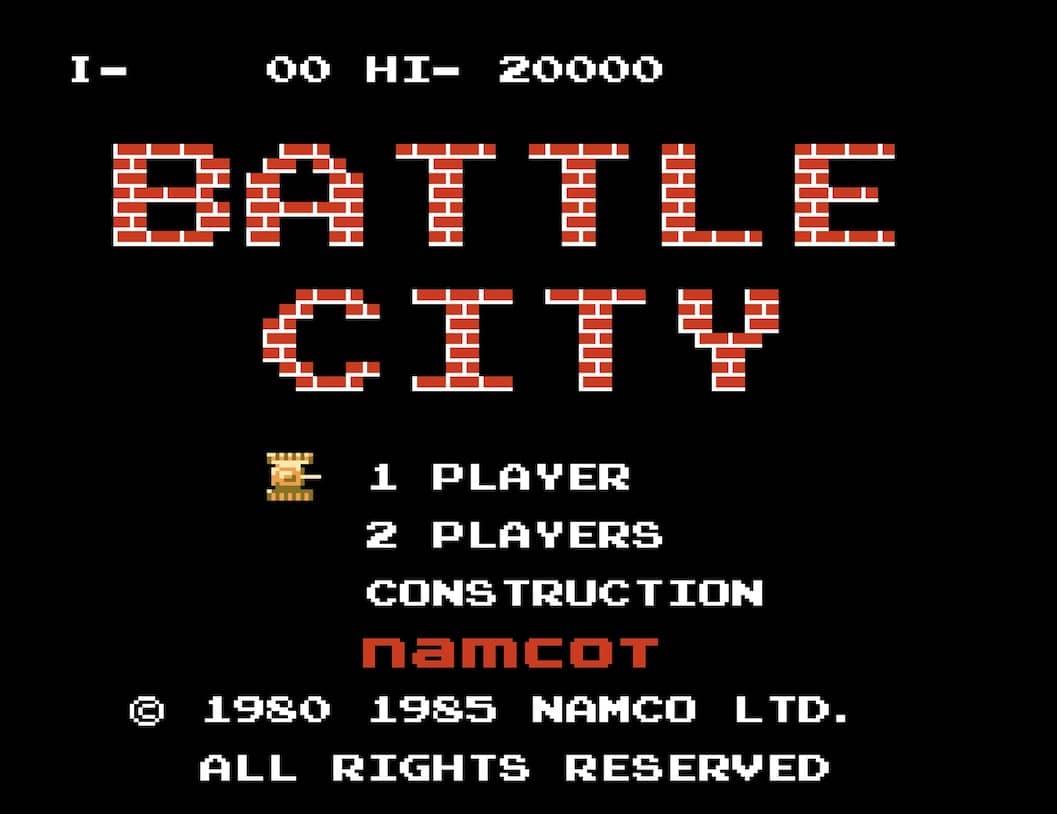
The core rules of "Battle City" are deceptively simple: you control a tank, and on a fixed-screen battlefield, you must destroy enemy tanks that continuously pour in from the top while protecting the eagle-flag base at the bottom. If the base is destroyed, the game ends immediately. This simple objective creates the game's tension—you must go on the offensive, but you can't stray too far from home; attack and defense must be balanced simultaneously.
The terrain design on the battlefield makes each level full of variety. Brick walls can be destroyed by shells, steel walls require a full firepower upgrade to penetrate, water is impassable but bullets can fly over it, forests obscure vision, and ice makes tanks slide. These elements combine to create different offensive and defensive routes, forcing players to decide whether to flank or assault head-on based on the terrain, rather than just charging in blindly.
Destroying certain enemy tanks drops power-ups, including increasing firepower, temporarily freezing enemies, destroying all current enemies, adding a shield to your tank, and reinforcing the walls around the base. The choice of whether to pick up these items is also interesting: for example, a firepower upgrade lets you penetrate steel walls, but it also makes your bullets split into two, which can sometimes accidentally hit teammates or the base, so you have to weigh the situation.
Two-player co-op is a major highlight. Two players can fight simultaneously, and their shells won't destroy friendly tanks, but they will briefly stun each other. This design encourages cooperation while retaining the risk of friendly fire—hitting your teammate in the heat of battle can leave them immobilized under enemy fire, potentially dooming you both. In co-op, deciding who defends and who attacks often matters more than aiming skill.
The game includes 35 built-in levels and a level editor, allowing players to place bricks, steel walls, water, and forests to design unique battlefields. This editor was quite ahead of its time, greatly expanding the game's replayability beyond the built-in levels. Sharing custom maps among players also became a simple pleasure of early gaming communities.
Background and release
The roots of "Battle City" can be traced back to Namco's 1980 arcade game "Tank Battalion." That game already established the basic framework of defending a base and repelling enemy tanks, but the arcade version was limited by hardware and controls, making the gameplay relatively straightforward. In 1985, Namco decided to bring this concept to the Famicom, significantly expanding it to suit home consoles, resulting in "Battle City."
The Famicom version of "Battle City" was released in Japan on September 9, 1985. At that time, the Famicom was entering its mainstream phase, and players' demands were shifting from simple arcade ports to more replayable and deeper experiences. "Battle City" retained the arcade's excitement while adding terrain variation, a power-up system, and two-player co-op, perfectly matching the expectations of home console players.
The game's name, "Battle City," literally translates to "battle city," while Chinese players more commonly know it as "Tank Battle," which directly describes the game's content. This name became widely popular in Chinese-speaking communities, even becoming synonymous with Famicom shooting games for many players. The tank artwork on the game's cover and cartridge also became a lasting first impression of "Famicom games" for many children of that era.
At the time of "Battle City's" release, there were plenty of shooting games on the Famicom, but most were airplane or space-themed; games featuring tanks as the protagonist were relatively rare. Namco's decision to port and deepen the arcade tank gameplay was both a reuse of their own work and a way to fill the gap in the home console market for "land warfare shooters." This thematic differentiation made it stand out among many games.
The game was well-received after release, and Namco later released ports or remakes on various platforms. Although "Battle City" didn't become a phenomenon like "Super Mario," it has always held a special place in the hearts of Famicom players. For many Chinese players, it was one of the first games to enter their homes via "yellow cartridge" consoles, carrying special childhood memories.
Development
Specific development details about "Battle City" are scarce in public records, but it's certain that it was made by an internal Namco team with a clear goal: to adapt the arcade "Tank Battalion" gameplay for the Famicom experience. Arcade games typically pursue short, intense thrills, while home console games require longer play sessions, so the development team invested considerable effort in level design and system depth.
One of the game's most ingenious designs is the eagle-flag base. This flag is both the objective you must protect and carries a symbolic weight—at the time, using a concrete object rather than an abstract icon to represent "home base" was uncommon. When the eagle is hit, the screen flashes red, accompanied by sound effects, creating a strong sense of urgency. This emotional feedback was quite effective for an early game.
The level editor was a forward-thinking decision in "Battle City's" development. In 1985, most games didn't allow players to modify levels, but "Battle City" provided a complete editing tool, letting players freely place terrain. This feature may have stemmed from the team's consideration of "extending game longevity" and reflects Namco's experimental spirit in game design.
The implementation of two-player co-op is also noteworthy. The Famicom controller had only two buttons, but "Battle City" used simple button mapping to allow two players to play smoothly simultaneously. Friendly shells don't destroy teammates but briefly stun them—this detail was likely intentional, avoiding chaotic friendly fire while retaining the risk, making cooperation more meaningful.
Although the enemy tank types are few, different movement speeds and firing rates, combined with terrain, create a rich challenge. The development team also designed a "dodge" mechanic—enemy tanks sometimes deliberately avoid your gunfire, adding unpredictability to battles. These details show the team's dedication to gameplay depth under limited hardware constraints.
Reception and legacy
"Battle City" has always enjoyed a good reputation among players, especially veterans of the Famicom era, who often hold deep affection for it. The game is easy to pick up but not lacking in strategy, and this "easy to learn, hard to master" quality makes it suitable for players of all ages. Many players still remember the scenes of cooperating with friends or family to defend the base; that sense of teamwork and tension is the game's most precious part.
Media and critics have also given "Battle City" predominantly positive reviews, generally recognizing that it demonstrated the depth expected of home console games at the time. While graphics and sound were limited by hardware, the gameplay was widely praised. Some retrospective articles mention that it proved "simple rules can yield rich gameplay," a case study cited by many game designers later.
The enduring influence of "Battle City" is evident in its repeated re-releases. From Nintendo's Wii Virtual Console to Namco's "Namcot Collection," the game has been officially brought to new platforms, allowing new generations to experience its charm. This sustained vitality indicates that the core design withstands the test of time, not just nostalgia.
In Chinese gaming communities, "Battle City" is even more of a cultural icon. It was one of the earliest Famicom games to enter China, and countless players encountered it through clone consoles like the "Subor." Even today, there are many discussions, guides, and custom levels about "Battle City" online, and some have even remade it with modern engines. This enthusiasm spanning decades is the best proof of the game's quality.
While "Battle City" didn't directly spawn a series of imitators, its design ideas—defending a base, terrain interaction, and two-player co-op—can be seen in many later games. As a classic, it is often studied as a "prototype." For players, it remains that beloved and frustrating game that you can't stop playing: "Battle City."





