
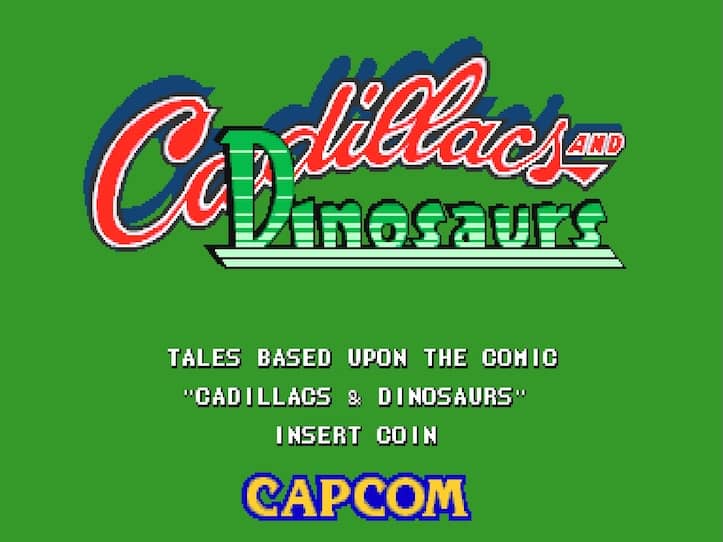
Gameplay and design
The core gameplay of Cadillacs and Dinosaurs is side-scrolling beat 'em up action, with players fighting through eight stages punctuated by brief story interludes. Rather than an open adaptation of the comic's plot, the game tightly strings together combat, boss battles, and narrative snippets to create the fast-paced experience typical of arcade titles. Players face waves of human enemies and dinosaurs, using punches, kicks, and weapons to carve a path through enclosed arenas. The pace is primarily melee-focused, but not monotonous: the appearance of dinosaurs, limited ammunition for guns, and the insertion of driving stages all interrupt the flow of hand-to-hand combat, forcing players to adjust their tactics.
The game offers four selectable characters: Jack Tenrec, Hannah Dundee, Mustapha Cairo, and Mess O'Bradovich. They are roughly categorized as balanced, technical, speed, and power types, differing in speed, strength, attack range, and handling, which affects how players approach crowds and escape danger. Despite having four characters, the arcade board supports up to three players simultaneously, so players must choose based on team composition. This design introduces trade-offs in every cooperative session, as different character combinations change the rhythm of progressing through the game.
The combat system includes grabbing enemies, basic combos, and a desperation move. The desperation move costs health when it hits, but quickly clears space around the player, creating a trade-off of health for safety. Controls involve an eight-directional joystick for movement, with separate buttons for attack and jump; pressing attack and jump together triggers a move called "MEGACRUSH," as documented in the official manual. This move is not a free special but requires players to weigh health against crowd-clearing effect, using it in critical moments.
Beyond hand-to-hand combat, the game features temporary weapons such as guns, dynamite, clubs, and rocks. Guns have limited ammo, so they serve as powerful situational tools rather than replacements for melee. Dinosaurs are not fixed allies or enemies; startled dinosaurs may attack human enemies or players, making them unpredictable elements on the battlefield rather than a simple monster horde. This design keeps combat dynamic, as players cannot treat all creatures as foes but must read the situation and exploit dinosaur unpredictability.
In one stage, the heroes drive Jack's repaired Cadillac in a chase and combat sequence, briefly changing the movement and visual presentation, directly incorporating the car from the title into gameplay. The game's stages range from an underwater city, swamp, desert, garage, burning village, mine, to a laboratory, with the eight-stage route alternating between urban ruins, wilderness, and biotech imagery, enriching the visual variety.
Background and release
Cadillacs and Dinosaurs was released by Capcom in 1993 on arcade hardware using the CP System Dash board, a later revision of the CPS-1 family. The Japanese title is Cadillacs Kyouryuu Shinseiki, while Chinese players know it as "Konglong Kuai Da," which is not a literal translation of the English title. Capcom's sales flyer confirms the company, title, and year.
The game is set in the 26th century, after environmental and geological disasters forced human civilization to live underground for centuries. Upon returning to the surface, human communities find the world reoccupied by prehistoric animals, along with remnants of old technology. This setting originates from Mark Schultz's comic Xenozoic Tales, whose first professional story appeared in Death Rattle #8 in 1986, with the main series running to 14 issues by 1996. Schultz has said he had conceived the world for years before publication, with the setting well-developed but not all plot details fixed.
Dinosaurs serve as both evidence of ecological destruction and threats in combat. The player characters fight against human gangs and mutated creatures to restore order to the world. Dinosaurs in the game are not fixed to one side; startled dinosaurs may attack human enemies or players, making them unpredictable elements on the battlefield.
At the time of the game's release, the comic world had also extended into television and licensed merchandise, so the name "Cadillacs and Dinosaurs" was used during this period. Later, due to the expiration of licensing agreements, Schultz reverted to using "Xenozoic" as the title. The manual notes that the Cadillac name, script, emblems, and car designs are trademarks of General Motors, used under license. Schultz recalled that when big corporate adaptations began, he largely stepped back, did not participate in game design, and never played video games.
Cadillacs and Dinosaurs is not a direct adaptation of the animated series but is based on the same comic source. The 1993 animated series and the arcade game were released around the same time, but they are independent adaptations. The arcade version condenses the comic's grand world into an eight-stage arcade experience, focusing on combat and action rather than retelling the comic's continuous plot. The game offers four selectable characters, but the arcade board supports up to three players simultaneously, so players must choose based on team composition.
Development
The development of Cadillacs and Dinosaurs was based on Mark Schultz's comic Xenozoic Tales. Schultz recalled that he had conceived the world for years before publication, with the setting well-developed but not all plot details fixed. However, when big corporate adaptations began, he largely stepped back and did not participate in game design. He never played video games, so he did not feel he could judge Capcom's mechanics. The comic's first professional story appeared in Death Rattle #8 in 1986, with the main series running to 14 issues by 1996. The game is set in the 26th century, after environmental and geological disasters forced human civilization to live underground for centuries, and upon returning to the surface, they encounter prehistoric animals and remnants of old technology.
Capcom's sales flyer promoted a dedicated three-player version and stated that the game would also be available as two- or three-player kits, consistent with the configurable cabinet settings in the manual. The manual also lists three cabinet modes: three players with three coin slots, three players with one coin slot, and two players with one coin slot. The third player uses a separate I/O interface, while the fourth player's interface is unused. The Japanese title is Cadillacs Kyouryuu Shinseiki, while Chinese players know it as "Konglong Kuai Da," which is not a literal translation of the English title.
The board supports Capcom's QSound audio, but only when installed in a compatible QSound cabinet; the manual instructs operators using other cabinets to select mono. The operator menu offers two difficulty controls: one with eight levels and one with four levels, the latter affecting the rate of difficulty increase; the manual also states that the game automatically increases difficulty based on play time. Operators can configure starting lives (1 to 4) and various score reward plans, including a no extra lives option. Continue availability and demo mode sound can be configured independently, indicating that the cabinet's commercial presentation and continue rules are partly determined by the operator. The board stores configuration in EEPROM and includes test screens for input/output, sound voice, color, scrolling layers, and memory, reflecting the maintenance needs of arcade products.
A Capcom Power System Changer version was teased in 1994 Club Capcom materials but never released, so it does not count as an official home port. The 1993 arcade game had no official contemporary home console port. Another game titled Cadillacs and Dinosaurs: The Second Cataclysm is a separate work and not a port of this game. Later, due to the expiration of licensing agreements, Schultz reverted to using "Xenozoic" as the title. The arcade version is not a direct adaptation of the animated series but is based on the same comic source.
Reception and legacy
Cadillacs and Dinosaurs was listed as one of the active arcade hits in Japan during June 1993 by industry reports, and in the U.S., RePlay magazine's operator poll ranked it ninth in video software for the same period. Contemporary magazine reviews highlighted its graphics, animation, cooperative play, and varied weapons, but these reports do not represent a unified critical consensus.
Mark Schultz recalled that he was told Capcom's arcade game was above average and understood that it still has followers today. This attests to the game's enduring recognition, but it is not his own first-hand evaluation of the specific design. Schultz was not familiar with the game's mechanics, so his comments are more those of an outside observer. He mentioned he never played video games, so his assessment is based on others' accounts rather than personal experience.
The game combines a licensed comic world, four distinctive heroes, three-player co-op, dinosaurs, and arcade-exclusive history to form a unique identity. However, the evidence does not support the claim that licensing issues alone explain its later absence. The Cadillac name license did expire later, but Capcom has not provided a complete causal explanation. Additionally, the game had no official home port, but the planned Capcom Power System Changer version was canceled, adding to its arcade-exclusive history.
The game's lasting memory primarily comes from its unique setting and cooperative experience. The Cadillac-driving stage also enhances its distinctiveness.





