
Gameplay and design
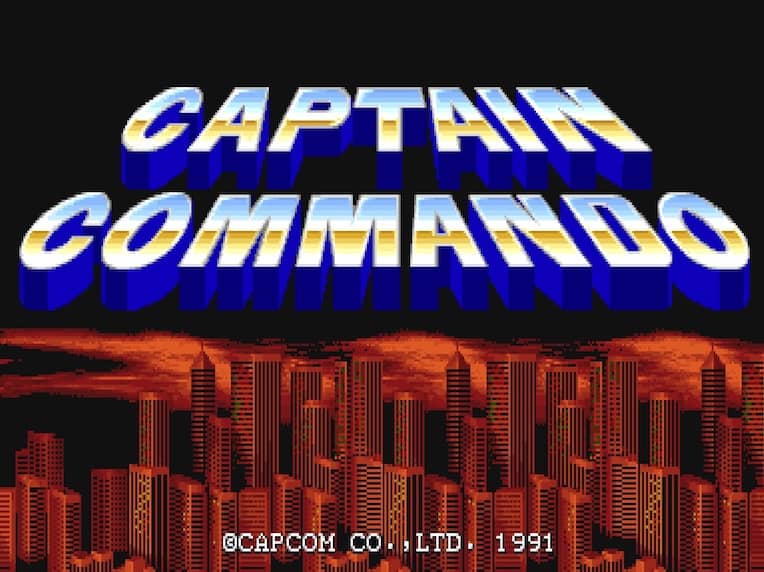
Captain Commando's core gameplay continues the beat 'em up formula Capcom established with Final Fight: players advance through side-scrolling stages, defeating enemies along the way, and face a boss at the end of each level. The game supports up to four players simultaneously, depending on the cabinet settings, which often led to four players huddled around the screen in cooperative play at arcades. Controls are simple, with an eight-way joystick and two buttons for attack and jump, but mastering combos and avoiding enemy swarms requires practice.
The game introduces a dash move, triggered by tapping the joystick twice in a direction, allowing characters to quickly close in on enemies or escape danger, adding more variety to combat. Dashing can be followed by attacks to create more powerful combos, especially useful against groups of enemies. Compared to Final Fight, the dash makes controls more flexible and becomes a hallmark of Captain Commando's feel, requiring players to time it well to navigate chaotic battles.
The weapon system is another highlight. Players can pick up three types of guns and shuriken exclusive to the ninja Ginzu. These weapons can be carried into the next area, unlike in Final Fight where they disappear when the scene changes. Guns have limited ammo but pack a punch, useful for clearing crowds in critical moments. Shuriken are unlimited but only Ginzu can equip them, making him a great ranged fighter. The combination of weapons and character traits gives each character a distinct playstyle.
There are also three rideable robots: a boxing type, a flame type, and a freeze type. These robots have their own health bars and completely change the player's attack style when mounted. The boxing robot excels at close-range combos, the flame robot sprays fire to hit large groups, and the freeze robot can freeze enemies, creating opportunities for the team. Robots not only boost combat power but also add strategic choices, such as saving one for a boss fight to gain an advantage.
The game consists of nine stages, with settings ranging from futuristic city streets and subways to enemy bases. Enemy design is distinctive, featuring regular soldiers, elite enemies, and bosses, each with unique attack patterns and weaknesses that require observation and strategy. Stages also include traps like flame throwers and falling objects that can cost health if not avoided. The difficulty curve is well-balanced, offering a satisfying experience for newcomers while providing challenges for veterans.
Background and release
Captain Commando is the seventeenth game Capcom released on the CP System arcade board, the same platform that hosted classics like Final Fight. The game is set in a futuristic version of Metro City in 2026, sharing the same world as Final Fight, though the stories are not directly connected. This shared universe was uncommon in arcade games at the time and showcased Capcom's forward-thinking approach to building a game universe.
The story takes place in Metro City, a crime-ridden future metropolis where a super-criminal organization led by the alien tyrant Scumocide is causing chaos. Captain Commando and his allies rise to fight this evil organization. The plot is straightforward, but the stage transitions and character dialogue create a strong sci-fi adventure atmosphere. Scumocide is named Genocide in the Japanese version, a name that more directly reflects his destructive nature.
Released in 1991, during the golden age of arcade gaming, Captain Commando quickly became popular in arcades thanks to its impressive graphics, smooth gameplay, and four-player cooperative fun. The Japanese arcade magazine Game Machine listed it as the most popular arcade game in its December 1, 1991 issue, and Micom BASIC Magazine ranked it 19th in February 1992, confirming its commercial success.
The game's success was no accident; it built on the proven gameplay of Final Fight and added innovations like dashing and rideable robots, giving players a fresh experience within a familiar framework. The four playable characters each have distinct traits, from Captain Commando's melee strength to Ginzu's ranged agility, catering to different player preferences. This variety and cooperative appeal set Captain Commando apart from other beat 'em ups.
The title and protagonist's name, Captain Commando, have no connection to Marvel Comics characters like Captain America; the name comes from a mascot created by Capcom's American division. This is often misunderstood in the game's history, but Captain Commando is an original Capcom character, only superficially similar in name and appearance. The game is commonly known as "Ming Jiang" among Chinese players, a translation that has become its common name.
Development
The character Captain Commando actually predates the game itself. Between 1986 and 1989, Capcom's American division created a fictional mascot named Captain Commando to promote NES games. This mascot appeared on the packaging and manuals of various games, such as 1942, Ghosts 'n Goblins, and Mega Man, under the "Captain Commando Challenge Series" banner, with the captain's image on the back of boxes recommending games.
By 1989, a revised version of the mascot appeared on Capcom's NES game packaging in North America, featuring a flight suit and an alien ape companion. This design was more sci-fi and superhero-like. However, when Capcom decided to make Captain Commando the protagonist of an arcade game, they felt the American original was "not cool" and redesigned the character. The arcade version was designed by Akira Yasuda (Akiman), who later worked on the Street Fighter series.
Yasuda's design for Captain Commando discarded the overly cartoonish and bulky elements of the original American version, giving him a sleeker, more handsome look. The captain wears a red-and-blue battle suit and a mask, appearing both heroic and mysterious. This design not only fit the arcade aesthetic but also made the character more iconic. Yasuda's insistence on "coolness" transformed Captain Commando into another classic Capcom character.
The development of Captain Commando was based on the engine and gameplay of Final Fight, providing a solid foundation. The team built on the classic formula and added new mechanics like dashing and rideable robots, pushing the gameplay forward. Supporting four players simultaneously was technically challenging at the time, but Capcom managed it well, ensuring smooth performance with multiple players on screen.
During development, the team also focused on character balance and diversity. Each of the four characters has strengths and weaknesses: Captain Commando has high attack but slow speed, Ginzu is fast but fragile, Baby Head is small but has a unique attack range, and Mack is well-rounded. This design encourages players to try different characters and increases replayability. The enemies and bosses also received careful attention, with each boss having distinct attack patterns that left a lasting impression on players.
Reception and legacy
Captain Commando received widespread acclaim after release, achieving both commercial success and critical praise. Japan's Gamest magazine ranked it 7th in the "Grand Prize" category and awarded it 3rd place for "Best Action Game" in its sixth annual awards. British magazine Sinclair User even listed Captain Commando among games "most likely to save the universe," alongside titles like Captain America and Spider-Man, an exaggerated but telling reflection of its impact.
In 2013, Heavy.com ranked Captain Commando among the top 25 beat 'em up games of all time, cementing its place in gaming history. Even years later, players fondly remember the cooperative fun and satisfying combat. As a representative of the arcade golden age, Captain Commando, along with Final Fight and Tenchi wo Kurau, defined the beat 'em up genre and influenced many subsequent games.
Captain Commando has also become a Capcom mascot, appearing as a playable character in Marvel vs. Capcom (1998) and its sequel Marvel vs. Capcom 2, fighting alongside Marvel heroes. He also appears in crossover games like Namco × Capcom and Project X Zone 2, showcasing his cross-franchise appeal. These appearances have boosted his popularity and delighted veteran players.
Captain Commando has been included in multiple compilations, allowing new and old players to experience the classic. In 2006, it was included in Capcom Classics Collection: Remixed and Capcom Classics Collection Volume 2; in 2018, it appeared in Capcom Beat 'Em Up Bundle for Switch, PS4, Xbox One, and Windows; and in 2021, it was part of Capcom Arcade Stadium. These collections have kept Captain Commando alive in the modern era.
The game's world and characters have also influenced other Capcom titles. In Street Fighter 6, it is revealed that Ginzu's father, Gou, is a direct successor to Guy and serves as Kimberly's teacher, confirming that Captain Commando shares a universe with Street Fighter. This cross-game connection tightens Capcom's game world and lets players of Street Fighter 6 spot Captain Commando easter eggs. Additionally, a two-volume manga adaptation was published by Gamest Comics in Japan in 1994, later translated and released overseas by UDON, further expanding the game's story.





