
Gameplay and design
The core gameplay of Chip 'n Dale Rescue Rangers revolves around two-player cooperation. The game supports a single-player mode, but two-player cooperation is where it truly shines. In two-player mode, player 1 controls Chip and player 2 controls Dale, allowing both players to move simultaneously and work together. This design lets players either fight side by side or playfully mess with each other—for example, picking up a teammate and throwing them. This interaction adds a lot of fun and made the game a popular choice for gatherings with friends back in the day.
The basic controls include walking, jumping, and crouching, but the most distinctive mechanic is picking up and throwing objects. Players can lift acorns, crates, barrels, balls, and other items from the environment and hurl them at enemies or obstacles. Thrown items not only damage enemies but can also trigger switches or break open hidden passages. This mechanic makes both combat and exploration flexible and varied, requiring players to strategize based on the items available in each scene rather than simply jumping on enemies.
In terms of the life system, each character can only withstand three direct hits before losing a life. The game has no password feature, meaning players cannot save progress mid-game and must finish in one sitting or start over. This design was common at the time but demanded a high level of skill and patience. In two-player mode, sharing a pool of lives adds tension to teamwork, as one player's mistake can cost both.
Two important supporting characters appear in the game. Monterey Jack occasionally shows up to use his strength to break through obstacles, opening new paths for the players. Zipper, on the other hand, can provide temporary invincibility, allowing players to safely traverse dangerous areas in critical moments. The timing and effects of these characters are carefully designed so they don't overshadow the main gameplay but offer significant help when needed, making players feel supported by their partners.
The level design offers a variety of themed stages, from city streets to underground warehouses, each with unique traps and enemy configurations. Players can freely choose the order of levels, a non-linear structure that was uncommon in platformers at the time. Hidden secret areas and extra lives are scattered throughout the levels, encouraging thorough exploration. The overall difficulty is moderate, but in two-player mode, poor coordination can actually make the game harder, adding challenge to the fun.
Background and release
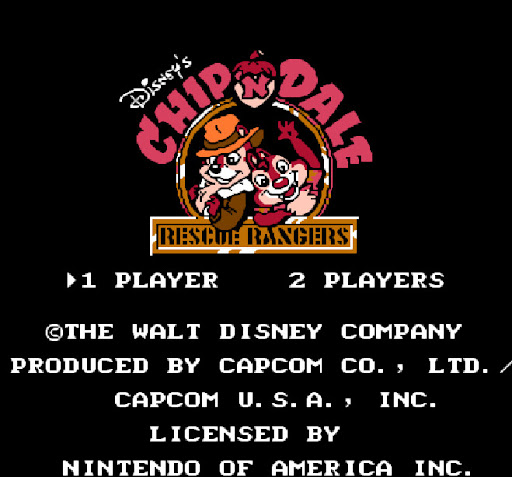
Chip 'n Dale Rescue Rangers was developed and published by Capcom, first released in North America and Japan in 1990 for the Famicom/NES, and in Europe in 1991. The game is based on the Disney animated series of the same name, which was popular at the time and followed two chipmunks, Chip and Dale, and their friends as they formed a rescue team to solve various cases. The game brought the characters and world of the show to the console, letting players control these adorable characters themselves.
The game achieved solid commercial success, selling approximately 1.2 million copies worldwide. This number was above average for NES games at the time and demonstrated the success of combining an animated IP with gaming. For Capcom, it was their second Disney collaboration after DuckTales in 1989, further strengthening their partnership and laying the groundwork for more Disney-licensed games.
The story is based on the animated series but simplified. In the game, the Rescue Rangers are helping a girl named Mandy find her missing kitten, but during the investigation, Gadget is kidnapped by the villain Fat Cat. Chip and Dale must embark on a rescue mission, ultimately saving Gadget and defeating Fat Cat. The game doesn't have a complex narrative, but through cutscenes between levels and character interactions, it captures the feel of the cartoon.
It's worth noting that regional versions of the game had differences. The Japanese and European versions fixed a minor graphical glitch in the opening animation of the North American version. While a small detail, it reflects Capcom's attention to localization. Additionally, leaked prototype cartridges show that in early versions, collecting flowers and stars to earn extra lives required half the number needed in the final version, indicating that the development team adjusted the balance to make the game more reasonable.
Years later, the game was included in The Disney Afternoon Collection, released in April 2017 for PlayStation 4, Windows, and Xbox One. This compilation brought together several classic games based on Disney animated series, allowing both new and old players to revisit these titles on modern platforms. This re-release brought Chip 'n Dale Rescue Rangers back into the spotlight and proved its lasting appeal as a classic.
Development
Chip 'n Dale Rescue Rangers was Capcom's second Disney game after DuckTales. By then, Capcom had extensive experience developing for the NES, and the Disney licensing partnership offered new creative directions. The game was produced by Tokuro Fujiwara, who had worked on hardcore action games like Ghosts 'n Goblins, but here he shifted to a lighter, more accessible platformer, showcasing his versatility.
According to Disney game producer Darlene Lacey, this game was one of the 'least troublesome' projects among Capcom's, with few changes during development. This was likely due to the mature setting of the animated IP and Capcom's familiarity with the NES. The team could focus on polishing the gameplay rather than constantly adjusting direction. This smooth development process resulted in a highly polished final product.
The game's composer was Asano Fujita, who created lively and upbeat background music that complemented the lighthearted style of the show. The music loops during levels without becoming tiresome, enhancing immersion. Sound effects, such as throwing items and hitting enemies, have crisp, satisfying sounds that make controls feel responsive. These auditory elements together create the game's unique atmosphere.
During development, the team made careful adjustments to game balance. Differences between the prototype and final versions show that in the early version, collecting flowers and stars to earn extra lives required half the number needed in the final version, meaning the final version raised the requirement, making players work harder to explore and collect. Though seemingly minor, this adjustment affected the game's pacing and challenge, reflecting the team's attention to player experience.
The graphical fixes between versions are also noteworthy. The North American opening had a minor graphical glitch, which was fixed in the Japanese and European versions. This attention to detail shows Capcom's quality control across different regions. While these fixes don't affect core gameplay, they are a sign of respect for perfectionist players. These behind-the-scenes details reveal the team's dedication to quality behind a classic game.
Reception and legacy
Chip 'n Dale Rescue Rangers received generally positive reviews upon its North American release. Electronic Gaming Monthly praised the graphics and two-player mode but criticized the low difficulty. Indeed, for experienced players, the game might be a bit easy, but it also made it an accessible entry point for players of all ages. The fun of cooperative play compensated for the lack of challenge, making players more willing to share the joy with friends.
Europe's Mean Machines magazine gave a different take, calling the game 'tough and fun' and noting that its speed and challenge set it apart from other NES platformers. This difference in reviews may reflect varying perceptions of difficulty across regions, but both acknowledged the game's fun. The game also received the 1990 Parents' Choice Award from the Parents' Choice Foundation in November 1990, highlighting its popularity among family players.
Over time, Chip 'n Dale Rescue Rangers has solidified its place in gaming history. Nintendo Power ranked it 79th on its list of the top 100 Nintendo games in 1997; IGN ranked it 71st on its top 100 NES games in 2009, calling it an 'addictive platforming masterpiece'; GamesRadar also listed it as the sixth-best Disney game in 2009, saying it 'still holds up.' These rankings and reviews demonstrate the game's standing among professional media.
The game's success led to a sequel. Capcom released Chip 'n Dale Rescue Rangers 2 in December 1993, also for the NES. The sequel continued the gameplay and style of the original but added new elements, such as throwable enemies. While the sequel also received good reviews, the original Chip 'n Dale Rescue Rangers remains beloved by players, as it laid the foundation for the series and became a cherished memory for many gamers.
In terms of long-term impact, Chip 'n Dale Rescue Rangers is not just a classic game but also a successful example of Capcom's collaboration with Disney. It proved that games based on animated IPs could be both high quality and fun, setting a benchmark for future Disney games. The 2017 re-release in The Disney Afternoon Collection allowed a new generation to experience the game's charm. To this day, it is still regarded by many as one of the best cooperative platformers of the NES era.





