
Gameplay and design
The core of DoDonPachi is vertical-scrolling bullet hell shooting, where players weave through dense enemy fire while blasting foes with their own weapons. Three fighter types are available, each with distinct shot patterns and handling. Type A is a red fighter with a narrow shot, ideal for concentrated firepower. Type B is a green helicopter whose side guns rotate with movement, offering flexible attack angles. Type C is a blue fighter with a three-way spread shot that covers a wide area. Players can choose based on preference and stage demands, and each type supports different tactical styles in skilled hands.
The fighters' attack modes are split into shot and laser. Holding the fire button merges the option units into a vertical laser in front of the ship, slowing movement and generating a ring that damages enemies on contact. Shot mode boosts the density of normal bullets, making it great for clearing fodder and bullet patterns. Laser mode enhances penetration and provides a shield effect, ideal for bosses and dense enemy clusters. Switching between modes is key to mastering the game, requiring players to adapt to the battlefield. The bomb system also stands out: using a bomb during shot unleashes a massive explosion that clears enemy bullets, while using it during laser releases a high-power beam that destroys bullets in its path.
The item system is rich and varied, including P (weapon power-up), B (extra bomb), MP (appears after continuing, maxes out power), bees, stars, large stars, and pentagons. Bees are the central collectible, with 13 per stage, starting at 100 points and doubling with each pickup up to 100,000, but resetting to 100 if you lose a life. Collecting bees affects not only score but also the conditions for entering the second loop, so players must carefully plan routes to gather bees while dodging bullets, adding strategic depth.
The new MAXIMUM mode is a highlight of the scoring system. When the bomb stock is full and you collect a bomb, MAXIMUM mode triggers, adding points every second with a multiplier starting at 2 and increasing by 1 for each bomb collected. This mode encourages players to actively collect bombs when full for higher scores, adding tension and risk. The scoring system (GPS), improved from the previous game, builds combos for points; continuous laser hits on enemies maintain the combo, requiring steady output and precise aim, which is key for high scores.
The game features a two-loop structure. The first loop has six stages, while the seventh is only accessible in the second loop. Entering the second loop is demanding: you must clear the first six stages without dying and meet one of these conditions: lose at most two lives, achieve a maximum combo of at least 270 (Type A), 300 (Type B), or 330 (Type C), score at least 50 million points, or collect all 13 bees in four of the six stages. The second loop ramps up bullet density and difficulty significantly. After defeating the stage 6 boss, a hidden stage unlocks, featuring a battle against the giant mechanical bee Hachi, followed by the true final boss Hibachi. Defeating Hibachi yields the best ending; otherwise, you get a normal ending.
Background and release
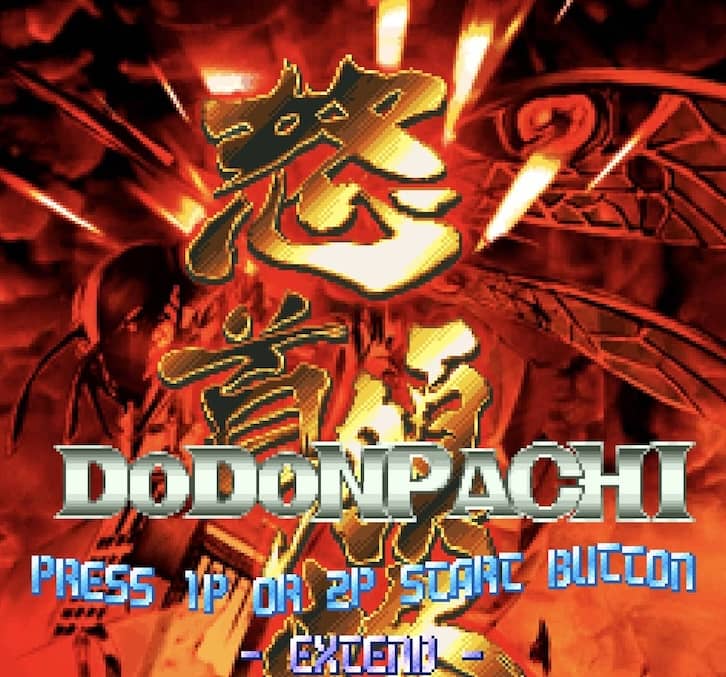
DoDonPachi was released in Japan on February 5, 1997, developed by Cave and published by Atlus. It ran on the Cave 68000 board, Cave's first-generation arcade hardware. As Cave's second game, it built on the foundation of the previous DonPachi and further established the bullet hell mechanics that would underpin later titles like DoDonPachi Dai-Ou-Jou. The title 'DoDonPachi' mimics gunfire while also referencing bees, meaning 'Angry Boss Bee,' a pun that hints at the game's theme and enemy design.
The story pits players against an invasion of mysterious mechanized alien races, but a darker secret lies beneath. Players pilot fighters to battle the invaders and protect Earth. As the game progresses, the truth emerges: these so-called 'mechanized aliens' are actually allies, and the commander Schwarlitz Longhener is plotting to destroy humanity. This plot twist is a hallmark of Cave's early games, showcasing a dark narrative style that contrasted with the simple 'shoot the aliens' setups common in shooters at the time.
After the arcade release, Atlus brought the game to the Sega Saturn in Japan on September 18, 1997. The Saturn version included an exclusive 'Saturn Mode' with new stages and bosses, offering extra challenges. It also supported both horizontal and vertical display orientations, letting players adjust the screen to their preference. The Saturn port was well received, earning a reader score of 8.9766 out of 10 from Sega Saturn Magazine, ranking 83rd, indicating its popularity.
On September 10, 1998, SPS developed and published a PlayStation port. The PS version added a manual slowdown and a 'wait-control' system, allowing finer control over movement and reducing difficulty. It also supported both orientations, but in vertical mode, players had to select their fighter in the options. The PS port garnered some attention but had fewer exclusive features than the Saturn version. On September 17, 2002, Cave released an i-mode mobile version titled DoDonPuchi via the Gaesen Yokocho service, but it was a standalone adaptation, not a direct port of the arcade original.
On May 26, 2010, the PS port was re-released on the PlayStation Network by Hamster Corporation, giving a new generation of players a chance to experience this classic. In 2011, an Xbox 360 version was bundled with the visual novel Instant Brain, featuring online leaderboards and Kinect support, but it was not sold separately. These later ports and adaptations have made DoDonPachi accessible beyond arcades, but the core experience remains rooted in the original arcade version.
Development
DoDonPachi was developed by Cave, marking its second game and the sixth on its first-generation arcade hardware. Cave was founded in 1994 by former Toaplan employees, focusing on shooters. Before DoDonPachi, Cave had already released DonPachi and other titles, accumulating experience in bullet pattern design. During development, the team aimed to push beyond the previous game's limits, introducing new mechanics and denser bullet patterns to appeal to hardcore shooter fans.
The title 'DoDonPachi' was crafted with clever wordplay. It mimics the 'don' sound of gunfire while also referencing bees, meaning 'Angry Boss Bee.' This pun not only highlights the game's theme of fighting bee-like enemies but also hints at the core bee collection mechanic. The title's creativity reflects Cave's attention to overall design, with the 'bee' motif woven throughout from title to gameplay.
The game's setting, where players fight a mysterious mechanized alien invasion with a darker secret, was established early in development. Cave wanted a story different from traditional shooters, incorporating twists and dark elements. In the true ending, the aliens are revealed as allies, and the commander plots humanity's destruction—a bold narrative choice at the time, showcasing Cave's early ambition.
During development, Cave fine-tuned the game's balance. The three fighter types each have distinct traits but remain balanced, allowing players to choose based on preference. Core mechanics like MAXIMUM mode, bee collection, and the GPS combo system were refined through extensive testing to provide depth and replayability. The two-loop structure was introduced to give skilled players a challenge, enhancing the game's long-term appeal.
The arcade version ran on the Cave 68000 board, which was powerful enough for high-density bullet patterns and smooth scrolling. Subsequent Saturn and PS ports optimized the core gameplay for home consoles. The Saturn version's new 'Saturn Mode' and the PS version's manual slowdown were adjustments based on platform characteristics, reflecting Cave's commitment to quality ports.
Reception and legacy
DoDonPachi received widespread acclaim upon release and is considered a classic of the bullet hell genre. Sega Saturn Magazine readers gave the Saturn version a score of 8.9766 out of 10, ranking 83rd, showing its high popularity among players. The game's high difficulty and deep scoring system attracted a dedicated core audience, making it a popular cabinet in arcades. Many players were drawn to its intricate bullet patterns and intense gameplay, repeatedly challenging themselves for higher scores and the true ending.
The game was included in the 2010 book 1001 Video Games You Must Play Before You Die, further cementing its place in gaming history. The book features games of significant influence and cultural value worldwide, and its inclusion indicates professional recognition. Its unique bullet design, two-loop structure, and dark narrative set it apart from many other shooters.
DoDonPachi left a lasting impact on subsequent works, especially Cave's own sequels like DoDonPachi Dai-Ou-Jou. The MAXIMUM mode, bee collection, and two-loop structure established in this game became core series mechanics, carried forward and expanded in later titles. Additionally, its dark storytelling influenced Cave's later games, such as Mushihimesama, shaping Cave's distinctive narrative style.
In the bullet hell genre, DoDonPachi is regarded as a benchmark. Its high-density bullet patterns and precise hitbox design set standards for later games. Many indie developers have drawn inspiration from it, creating various bullet hell titles. The game maintains a lasting presence in the player community, with players still researching scoring strategies and no-miss clears, and related videos and discussions are widely shared online.
Though the arcade original is years old, its influence persists. Subsequent ports and re-releases allow new players to experience this classic. The game's success also solidified Cave's position in the shooter genre, making it synonymous with bullet hell. For players who relish challenge and perfection, DoDonPachi remains a memorable name.





