
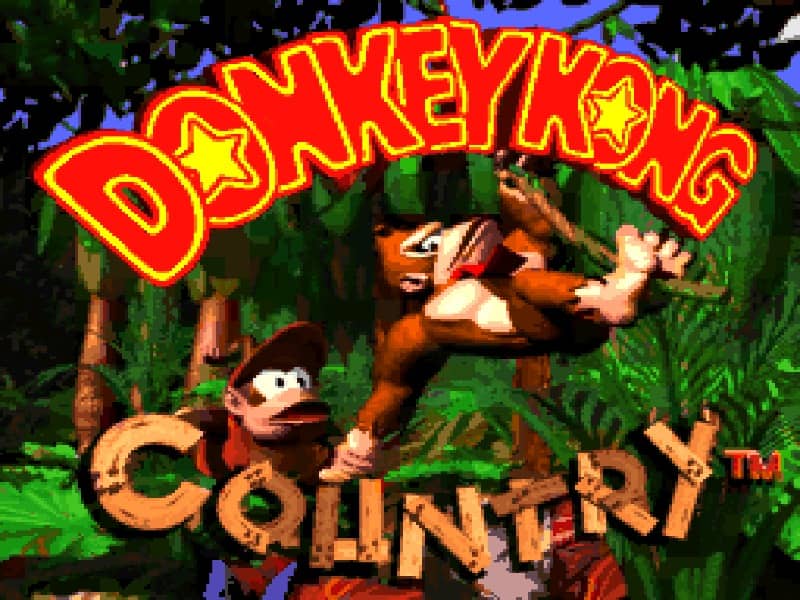
Gameplay and design
The core gameplay of Donkey Kong Country revolves around switching between two characters. Players can swap between Donkey Kong and Diddy Kong at any time. Donkey Kong is stronger and can easily smash through obstacles, while Diddy Kong is more agile and can jump farther. This design forces players to choose the right character for different situations—for example, switching to Donkey Kong when facing enemies that need a heavy blow, or using Diddy Kong's long jump to cross wide gaps. Character switching isn't just a tactical choice; it also adds fun to the controls, offering multiple solutions for each level.
The animal buddies are another highlight. Players can ride Rambi the rhino, who can knock enemies flying with his horns and even break through certain walls. In underwater levels, Enguarde the swordfish makes combat easier, as his sword-like snout can pierce through enemies. These buddies aren't available throughout the entire game; they appear in specific levels, and players need to find them and use them wisely. The inclusion of animal buddies enriches the gameplay and encourages exploration, as finding them often means a safer path through the level.
Collectibles are a major part of the game. Each level is scattered with bananas, K-O-N-G letters, balloons, and animal tokens. Collecting 100 bananas or gathering all four K-O-N-G letters grants an extra life, while balloons provide temporary invincibility or a life bonus, and animal tokens unlock bonus levels. These collectibles aren't mandatory, but they encourage players to thoroughly explore every nook and cranny. Hidden bonus levels often contain large amounts of bananas and letters, making the collecting process full of surprises.
The game also features various special mechanics, such as minecart levels and barrel cannons. In minecart levels, players ride a cart along tracks, jumping over obstacles with a strong sense of rhythm. Barrel cannons launch players to high places or hidden areas. These mechanics not only test your skills but also deliver thrilling experiences. Additionally, swinging on ropes and climbing vines add to the variety of actions, making the level design more diverse.
Multiplayer is a standout feature. The competition mode lets two players take turns tackling the same level, racing to see who reaches the end first, while the cooperative mode allows both players to play simultaneously, one controlling Donkey Kong and the other Diddy Kong. In co-op, players must work together to solve puzzles, such as one stepping on a switch while the other passes through. This design makes the game great for playing with friends and increases replay value.
Background and release
The creation of Donkey Kong Country is closely tied to the growth of Rare. Founded in 1985 by brothers Tim and Chris Stamper, Rare developed over 60 games for the NES, accumulating a wealth of technical experience. By the early 1990s, Rare sought technological breakthroughs and invested in expensive Silicon Graphics workstations to render 3D models. These machines cost up to £80,000 each, but they laid the groundwork for the pre-rendered graphics that would follow.
At the time, Nintendo was facing fierce competition from Sega, especially with the Sonic the Hedgehog series performing strongly on 16-bit consoles. To counter Sega's Aladdin, Nintendo decided to commission Rare to revive the Donkey Kong series. Donkey Kong had been an arcade star for Nintendo in the early days but had gradually faded. Nintendo hoped that with Rare's technology, this classic character could be reborn and inject new life into the SNES.
The game was first unveiled at the June 1994 Consumer Electronics Show in Chicago, as the finale of Nintendo's presentation. Nintendo invested $16 million in marketing and sent out a promotional video titled "Donkey Kong Country: Exposed" to showcase the game's pre-rendered visuals. This high-profile promotion was extremely rare at the time and underscored Nintendo's confidence in the title.
The game was released globally in November 1994, with North America getting it on November 21 and Japan on November 26. The timing coincided with the holiday shopping season, and combined with a strong marketing push, the game quickly became a hit. It set a record for the fastest-selling game at the time, moving 500,000 copies in its first week and reaching 1 million in the US within two weeks. This success not only proved the game's appeal but also solidified the SNES's position in the 16-bit console war.
The success of Donkey Kong Country was no accident. It was not just a technical showcase but also a product of the collaboration between Nintendo and Rare. Nintendo provided the brand and distribution channels, while Rare contributed technology and creativity. This partnership model later became a benchmark for Nintendo's second-party collaborations and laid the foundation for future Donkey Kong titles.
Development
The development of Donkey Kong Country took 18 months, starting with a team of just 12 people and eventually growing to about 20. This was a relatively small team for the time, but Rare's engineers made the most of their SGI workstations. They used these expensive machines to render high-precision 3D models, then compressed the image data using ACM compression technology to fit onto SNES cartridges. This pre-rendering technique gave the game an unprecedented level of detail and lighting effects, far surpassing other 16-bit games of the era.
During development, Shigeru Miyamoto, though not serving as director or producer, offered design suggestions. For example, he suggested adding a ground-pound move for Donkey Kong, which later became a signature ability. Miyamoto's involvement reflected Nintendo's commitment to the game and ensured that the gameplay aligned with Nintendo's design philosophy. However, rumors of Miyamoto's negative comments about the game have been clarified as dubious and should not be cited as fact.
In terms of character design, Donkey Kong and Diddy Kong underwent evolution. The original Donkey Kong was a villain in the arcade version, but in this game, he was reimagined as a brave but somewhat clumsy hero. Diddy Kong was a newly designed character, serving as Donkey Kong's nephew, smaller and more agile, providing a stark contrast. These designs not only made the characters more endearing but also provided the basis for the two-character gameplay.
Music is a major highlight, with most of the soundtrack composed by David Wise, including the famous underwater theme "Aquatic Ambience." This track is renowned for its ethereal atmosphere and complex melody, taking five weeks to complete. Wise utilized the SNES's audio chip to create rich, layered sound effects that perfectly matched the game's jungle and underwater settings. Another composer, Eveline Novakovic, contributed seven tracks, including the world map theme, adding diversity to the game.
The initial story draft was 15 pages long, but Nintendo thought the manual was too limited and had it condensed. The final plot is simple and direct: Donkey Kong and Diddy Kong's bananas are stolen by King K. Rool, and they must traverse six worlds to reclaim them. This straightforward narrative allows players to dive into the action without being distracted by complex storytelling. The development team focused more on level design and visual presentation, which was key to the game's success.
Reception and legacy
Upon release, Donkey Kong Country received widespread acclaim, with critics praising its groundbreaking graphics and stating that it redefined the visual standards for 16-bit games. The game won multiple Game of the Year awards, including from several major publications. Players and critics alike were amazed by the cinematic visuals achieved through pre-rendered 3D graphics, which were unprecedented at the time. The game's success also directly boosted SNES sales, giving it an edge in the 16-bit console war.
The game left a lasting impact on the Donkey Kong series and on Rare's trajectory. Its success prompted Nintendo to purchase a 25% stake in Rare, making it a second-party developer. Rare subsequently developed several Donkey Kong titles, such as Donkey Kong Country 2 and Donkey Kong 64, further cementing the series' status. Rare also became a top-tier developer thanks to this game, laying the groundwork for later hits like GoldenEye 007.
In the platforming genre, Donkey Kong Country's influence is profound. It proved that pre-rendered graphics could be applied to action games and inspired many later works. For instance, the developers of Crash Bandicoot have cited this game as a major inspiration. The game's design elements, such as dual-character switching, animal buddies, and collectibles, were widely adopted by subsequent platformers and became classic genre staples.
The game's long-term reception hasn't been without controversy. Over time, some critics have revisited the gameplay, noting that the controls feel somewhat stiff and that level design sometimes relies too heavily on visual spectacle. However, most players and media still regard it as a classic of the SNES era. It frequently appears on lists of the greatest games of all time, and its music is highly praised, with "Aquatic Ambience" widely considered a masterpiece of video game music.
Donkey Kong Country sold 9.3 million copies worldwide, making it the third best-selling game on the SNES and the best-selling title in the Donkey Kong series. It was later ported to the Game Boy Color and Game Boy Advance, and has been re-released digitally multiple times, allowing new generations of players to experience this classic. The game's success lies not only in its commercial and critical achievements but also in the technical ideas and design inspiration it provided for future game development, marking it as a significant milestone in gaming history.





