
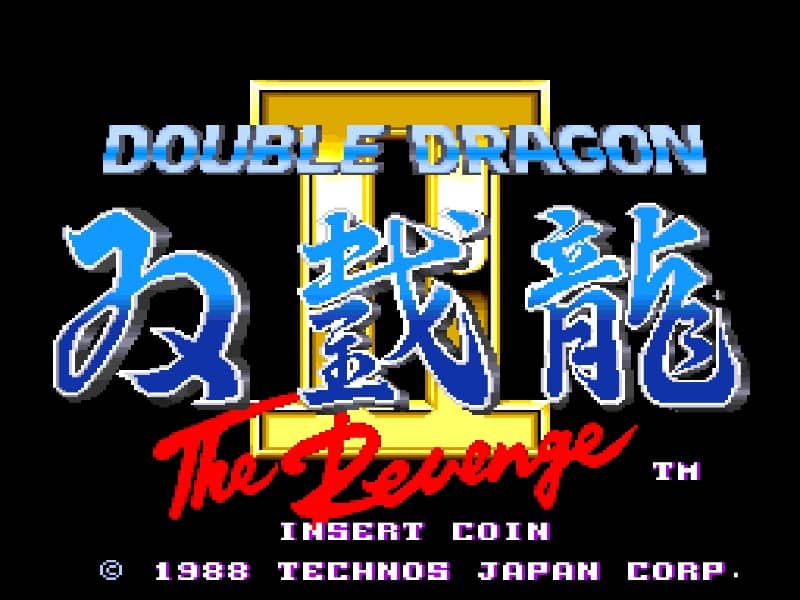
Gameplay and design
Double Dragon II: The Revenge made bold changes to the controls, replacing the original's punch and kick buttons with left and right attack buttons, similar to the design in River City Ransom. Players simply press the corresponding attack button based on the direction of the enemy, and the character automatically punches or kicks, making the controls more intuitive and allowing for easier combos. This design was controversial at the time but quickly proved suitable for the pace of beat 'em ups, becoming a hallmark of the game.
In addition to basic attacks, the game introduced a new move: the whirlwind kick. Players can press the attack button while jumping, and the character spins their legs to sweep enemies around them. It has high power and wide range but also a long recovery time, requiring precise timing. The whirlwind kick enriched combat strategy, giving players more options when facing groups of enemies, and became a staple in subsequent series entries.
The game is divided into four areas: a heliport, a lumber yard, a farm, and the gang's new hideout. Each area ends with a boss fight, with one or two mini-bosses encountered along the way. The level design emphasizes pacing, featuring both open outdoor scenes and narrow indoor spaces. Enemies swarm from all directions, requiring players to use positioning and attacks flexibly to progress.
The enemy variety is extensive, each with unique traits. Linda is the only female enemy, using a whip, knife, and grenades, with long reach and high damage. Burnov is the boss of mission 1, wearing a steel mask; when defeated, his body disappears leaving only his clothes, but he later re-materializes. Jeff is a palette swap of Billy and Jimmy, able to use all their moves, making him a tough opponent. Chin Taimei uses a kali stick and does not drop a weapon when knocked down. Willie wields a machine gun, with fierce firepower.
The final boss is the Shadow Clone, which can use all of the player's attacks and drains the player's energy when close. In two-player co-op, each player faces a clone, requiring teamwork to hold them off. Players have a health bar and a timer for each level; losing all health, running out of time, or falling into pits or spikes costs a life. This design increases the challenge and makes the sense of accomplishment after clearing the game stronger.
Background and release
Double Dragon II: The Revenge was developed and released by Technos Japan in 1988, as the first sequel to Double Dragon. The story picks up after the previous game, with Willie, the leader of the Shadow Warriors, shooting Billy's girlfriend Marian. Billy and Jimmy decide to avenge her. This simple plot provides clear motivation and makes players feel more immersed as they progress.
The game was initially developed as an upgrade kit for the original Double Dragon, but later evolved into a standalone game due to increased memory. Some assets from the original were reused, but the core system and level design were significantly changed. This transition from an upgrade kit to a standalone title was uncommon in game development at the time and reflects Technos' keen understanding of market needs.
After the arcade release, the game was ported to multiple platforms. The NES version was released on January 15, 1990, developed by Technos and published by Acclaim, but it differs significantly from the arcade version, with changes to levels and systems. The PC Engine version was remade by Naxat Soft in 1993, and fans refer to it as "Double Dragon II PCE." Additionally, Virgin Mastertronic released ports for ZX Spectrum, Commodore 64, IBM PC compatibles, Amiga, Amstrad CPC, and Atari ST in 1989, developed by Binary Design.
The Mega Drive version was released exclusively in Japan by Palsoft on December 20, 1991. It is a direct port of the arcade version, but with smaller character sprites and lighter colors. The level design for mission 2 was significantly altered, making it longer and more complex, and Jeff was omitted. Additionally, there is input lag when using the six-button controller. The Game Boy version, titled Double Dragon II, is unrelated to the arcade game; it was originally a Kunio-kun game in Japan and was released in North America and Europe in 1991.
In 2013, DotEmu released the Double Dragon Trilogy compilation, which includes this game, for iOS, Android, and Steam. Hamster Corporation re-released the game in 2016 for PS4 and in 2018 for Switch as part of the Arcade Archives series. These re-releases allow a new generation of players to experience this classic and demonstrate its enduring appeal.
Development
During the development of Double Dragon II: The Revenge, Technos Japan faced a choice: to continue with the original's system or to innovate. They ultimately decided to change the controls, replacing the punch and kick buttons with directional attack buttons, a change borrowed from their own River City Ransom. This design allows players to focus more on positioning and timing rather than complex button combinations, lowering the barrier to entry.
The game was initially developed as an upgrade kit, meaning it was intended for arcade operators to upgrade existing machines by swapping circuit boards. However, as memory increased, the development team realized they could make a complete game, so they added more new content. Reusing assets from the original saved development time, but designing new levels, enemies, and moves still required considerable effort.
The computer ports were handled by Binary Design, who had to adapt the arcade graphics and controls to platforms with varying performance. The ZX Spectrum and Commodore 64 had significant hardware limitations, so the porting team had to simplify graphics and sound while preserving the core gameplay as much as possible. These ports varied in quality but allowed more players to experience the game.
The Mega Drive version was published by Palsoft and is a direct port of the arcade version, but with smaller character sprites and lighter colors. The level design for mission 2 was altered to be longer and more complex, possibly to suit the home console pacing. However, input lag with the six-button controller affected the experience, which was a drawback of this version.
In 2013, the Internet Archive provided the uncompiled assembly source code (DRGNSRC.LZH) of the DOS version for download, offering valuable material for game history research and fan modifications. The release of the source code allows players to gain insight into the game's underlying implementation and reflects the spirit of openness and sharing in game culture.
Reception and legacy
Double Dragon II: The Revenge was commercially successful. In Japan, Game Machine magazine listed the game as the seventh most successful arcade cabinet in March 1989. In the UK, the game ranked third on the Atari ST sales chart in early 1990. These achievements demonstrate the game's popularity at the time and solidified Technos' position in the beat 'em up genre.
The game received positive reviews from players and media. In 2013, Arcade Sushi ranked the game ninth on its list of the "10 Best Retro Beat 'em Ups." While not a top ranking, given the many great games from the golden age of beat 'em ups, being included is a recognition of its quality. Players particularly appreciated its fast-paced combat and challenging boss battles.
The game had a lasting influence on subsequent beat 'em ups. The directional attack system, while not original, was popularized through this game, and many later beat 'em ups adopted similar designs. Moves like the whirlwind kick became signature series moves and were used in later entries. The game's four-area structure and boss battle design also provided a template for similar games.
However, not all spin-offs were successful. In 2013, Double Dragon II: Wander of the Dragons, developed by Korean studio GRAVITY and published by Barunson Creative, was released for Xbox 360 and received very poor reviews. The game was only loosely based on the original and had little connection to the arcade version, being considered a failure by players. This serves as a reminder that adaptations of classic IPs must be handled with care.
Overall, Double Dragon II: The Revenge is a milestone in the history of beat 'em up games. It achieved commercial success and left a deep mark on gameplay design. Despite its age, it remains accessible to modern players through compilations and Arcade Archives re-releases, continuing to influence a new generation of game developers.





