
Gameplay and design
Double Dragon III: The Sacred Stones continues the series' classic beat 'em up gameplay but makes several bold adjustments. The game supports two-player simultaneous play and offers two modes: A and B. In A mode, teammates cannot damage each other, making it ideal for cooperative play; in B mode, friendly fire is enabled, adding challenge and chaos. When playing cooperatively, the two brothers can perform combined moves like the double whirlwind kick and the triangle jump kick, which are powerful but require precise coordination, adding fun to the cooperative experience.
The most significant innovation is the character-switching system. The game eliminates the traditional life count and instead unlocks new characters after defeating bosses. Playable characters include the Lee brothers, Chinese martial arts master Chin Seimei, and ninja leader Ranzou Yanagisawa. By pressing the select button, players can freely switch between current characters, each with unique moves, health, and speed. This design allows players to choose characters flexibly based on the combat situation, adding strategic depth.
Complementing the character-switching is the backup weapon system. Each character is equipped with a unique weapon: the Lee brothers use nunchaku, Chin Seimei uses iron claws, and Ranzou uses shuriken. These weapons can be crucial in key moments but have limited uses, requiring careful management. Additionally, weapons dropped by enemies can be picked up and used, including throwing knives, tridents, and beer bottles. These weapons are powerful but one-time use, disappearing after use.
In terms of the action system, this game returns to punch and kick buttons and adds a dash move triggered by double-tapping the directional pad. The dash allows players to quickly close in on enemies or escape danger, and it opens up new possibilities for combos. The game retains the classic hair-grab move but removes shoulder throws, flying knees, and super uppercuts, replacing them with running jump kicks (which can become triangle jump kicks) and aerial somersault throws. These new moves make combat flow more smoothly and encourage players to try different attack strategies.
This game removes the shop system from the arcade version, so players cannot purchase items or upgrade abilities between levels; all resources come from pickups during combat and character switching. This change makes the game more focused on action and makes character selection a key factor in determining the strategy for clearing the game. Overall, the gameplay design of this installment is unique within the series, and although some changes were controversial at the time, they provided new ideas for subsequent works.
Background and release
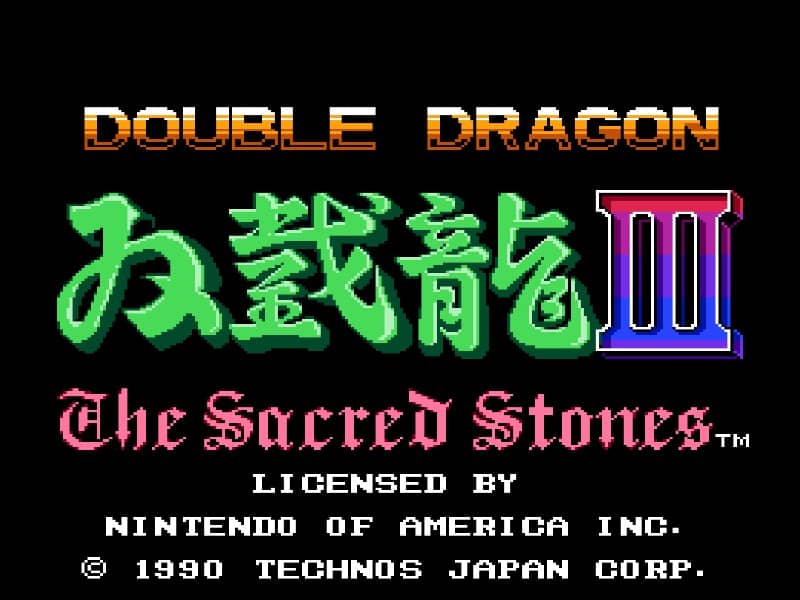
Double Dragon III: The Sacred Stones was first released in Japan on February 22, 1991, and later in February of the same year by Acclaim Entertainment in North America and Europe. The Japanese version is titled "Double Dragon III: The Rosetta Stone," while the American version is "Double Dragon III: The Sacred Stones." Despite sharing the name with the 1990 arcade game Double Dragon 3, this game is not a port but a parallel project developed by Technōs Japan for the NES, with significant differences in story and gameplay.
There are notable differences in the story between the American and Japanese versions. The Japanese story revolves around Billy and Jimmy Lee brothers seeking three sacred stones to become the strongest fighters in the world; Marian is not kidnapped, and the final boss is a resurrected Cleopatra. In contrast, the American version adopts a more traditional series setup: Marian is kidnapped, and the brothers journey to China, Japan, Italy, and Egypt to find the sacred stones to save her, with a different final boss. These changes make the American story more aligned with the expectations of Western players.
The American story also includes unique details. The witness Brett (named Aldo in the Japanese version) dies in the story, and the first-level boss Jim is revealed to be the brother of Willy, the villain from the original Double Dragon. These elements add themes of revenge and destiny to the American story, making it more relatable to series veterans. In contrast, the Japanese story focuses more on the brothers' self-improvement, with less mention of Marian, giving it a purer atmosphere.
The game achieved decent commercial success in its release month, becoming the seventh best-selling video game in the United States. However, Acclaim Entertainment's overestimation of market demand led to an inventory backlog of about 500,000 units. This situation reflected the early signs of saturation in the NES market and affected the publisher's confidence in subsequent titles. Nevertheless, the game maintained a certain reputation among players, and its unique gameplay attracted a loyal fanbase.
As the third installment of the Double Dragon series on the NES, this game represents the series' exploration of transitioning from arcade to home console. The concurrent development with the arcade version means this game is not a simple port but a product redesigned for home consoles. This parallel development model was uncommon at the time and makes this installment particularly special within the series. Both in story and gameplay, it presents a different face from the arcade version, offering players another Double Dragon experience.
Development
Double Dragon III: The Sacred Stones was developed by Technōs Japan, the company that also created the first two games in the series. The Japanese title "The Rosetta Stone" directly points to the central role of the sacred stones in the game, while the American title "The Sacred Stones" emphasizes their sacred nature. This difference in titles reflects the different narrative focuses of the two versions: the Japanese version leans toward adventure and puzzle-solving, while the American version is more action-oriented and redemption-focused.
During localization, the American version underwent significant story modifications, which were not simple translations but a re-creation tailored to the Western market. Besides the core change of Marian being kidnapped, the American version also adjusted some character and scene settings to better fit the cultural background of Western players. This deep localization was uncommon at the time and reflects the publisher's emphasis on the Western market.
A well-known anecdote is that in the American version's two-player mode opening, Billy's name is misspelled as "Bimmy." This error is not a translation mistake but an oversight during localization. Interestingly, this error later inspired the enemy "Bimmy 'n' Jammy" in Double Dragon: Neon, becoming a frequently discussed Easter egg among series fans. This shows that even small mistakes during development can become cultural symbols years later.
The Japanese version is relatively more forgiving in difficulty, with characters having more initial health and fewer enemies, possibly to cater to Japanese players' different preferences for action games. Additionally, the Japanese version's ending changes depending on which characters survive, increasing replay value, while the American version always shows the full ending, focusing more on narrative completeness. These differences indicate that the development team considered the needs of different markets during production.
The development process ran in parallel with the arcade version of Double Dragon 3, with the two projects sharing some assets and settings, but the gameplay designs are vastly different. This parallel development model required the team to make trade-offs in resource allocation and creative direction, resulting in two distinct games. Although this game did not meet commercial expectations, its innovative attempts during development provided valuable experience for Technōs Japan and offered references for future game development.
Reception and legacy
Double Dragon III: The Sacred Stones received mixed reviews upon release. Some players appreciated the character-switching system and backup weapon mechanics, seeing them as innovations that brought new possibilities to the beat 'em up genre; others expressed dissatisfaction with the removal of lives and the unbalanced difficulty curve. Nevertheless, the game holds a special place among series fans, and its unique gameplay design has influenced subsequent works.
The character-switching system is a significant experiment in the series, breaking the traditional single-character limitation of beat 'em up games and allowing players to choose characters flexibly based on the combat situation. This design was later inherited and developed in titles like Double Dragon: Neon, becoming a hallmark of the series. Although this game did not achieve great commercial success, its design philosophy has inspired later game developers.
The "Bimmy" spelling error, an accident during localization, unexpectedly became part of the series' culture. This error is not only frequently mentioned by fans but also inspired the enemy "Bimmy 'n' Jammy" in Double Dragon: Neon, serving as a cross-era Easter egg. This phenomenon also shows that small mistakes in game development can sometimes become unique cultural symbols, adding extra charm to the work.
This game has been re-released on multiple platforms, including Wii U and Switch, allowing a new generation of players to experience this classic. These re-releases typically retain the original gameplay and story but may optimize graphics and controls. Through this, the game continues to maintain its vitality, influencing and entertaining new player groups.
As the third installment of the Double Dragon series on the NES, this game holds a transitional position in the series' history. It inherits the core gameplay of the first two games while introducing new mechanics and narrative directions, injecting new energy into the series. Although it did not reach the heights of its predecessors, its innovative spirit and unique charm have left a deep impression on players and provided valuable experience for subsequent works.





