
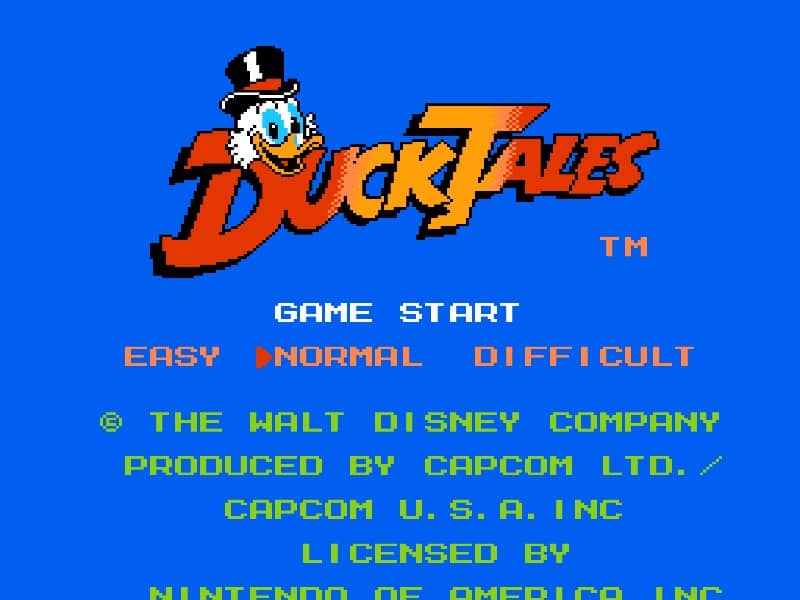
Gameplay and design
The core gameplay of Duck Tales revolves around Scrooge McDuck's cane. You can swing it to whack enemies or crates, but the real twist is that when you press the attack button mid-jump, Scrooge uses the cane like a pogo stick, bouncing off the ground. This lets you attack enemies from below and also reach higher platforms. The cane isn't just a weapon—it's a mobility tool, and it gives the game a fresh feel.
There are five levels in total: the African Mines, the Amazon, the Himalayas, Transylvania, and the Moon. After the opening, you're free to choose the order of the levels, so you don't have to follow a fixed path. Each level hides treasures and a boss, and you need to collect all five main treasures before you can head to Transylvania for the final showdown with the vampire duck. This open-ended structure gives players a lot of freedom and encourages trying different routes on each playthrough.
The game features three different endings, depending on how much money you have when you finish. If you just beat the game normally, you get the standard ending; if you reach ten million dollars, you see the perfect ending; and if you've spent all your cash, you get a bad ending. This multiple-ending setup encourages you to grab as many coins as possible in the levels and adds replay value.
There's also a hidden cheat code: press the select button during gameplay to spend three million dollars and restore your health. Back in the day, this was a thoughtful hidden extra that let less skilled players keep going at critical moments, but since it costs money, you have to weigh whether it's worth it.
Each level has its own unique theme and enemies—like the minecarts in the African Mines, the jungle traps in the Amazon, and the low-gravity jumps on the Moon. The boss fights are also distinctive, requiring you to use the cane bounce cleverly to hit weak points. The overall difficulty is no pushover, but the pace is snappy, and once you get the hang of the controls, you can pull off smooth combos that feel really satisfying.
Background and release
Duck Tales launched on the NES in North America in 1989 and was ported to the Game Boy the following year. The game is based on the hit Disney animated series of the same name, which followed Scrooge McDuck and his three nephews on globe-trotting treasure hunts, competing with rival Flintheart Glomgold to see who would become the world's richest duck. The show's popularity gave the game a solid foundation, and many players were drawn in by the familiar characters and world.
This was Capcom's first collaboration with Disney, but it wasn't the first Disney-licensed game Capcom published—they had previously released Mickey Mousecapade, developed by Hudson. However, Duck Tales was the first Disney game Capcom developed in-house, and it set the stage for a long and fruitful partnership.
Commercially, the game was a huge success. The NES version sold around 1.67 million copies, and the Game Boy version about 1.43 million, making it one of Capcom's best-selling titles on both platforms. That was a standout achievement at the time and proved the potential of combining Disney IP with solid gameplay.
Given the success of the original, Capcom released a sequel, DuckTales 2, in 1993, which continued the same gameplay and style. The original game was also later included in The Disney Afternoon Collection, which hit PC, PS4, and Xbox One in 2017, and a Switch version was published by Atari in 2026, letting both old and new players revisit the classic.
In 2013, WayForward Technologies developed a high-definition remake, DuckTales: Remastered, for PC, Xbox 360, PS3, and Wii U, with a mobile port following in 2015. The remake kept the original levels and gameplay but added HD graphics, rearranged music, expanded story, and full voice acting, featuring surviving cast members from the animated series—a real treat for fans.
Development
The development team for Duck Tales came from within Capcom, and the core members were veterans of the Mega Man series. Producer Tokuro Fujiwara, character designer Keiji Inafune, and sound programmer Yoshihiro Sakaguchi all worked on the game, which explains why the level structure and feel have clear Mega Man influences. That experience made the platforming gameplay rock-solid.
During development, the team made some adjustments. For example, the crosses on the coffins in the Transylvania level were replaced with 'RIP' text, likely to avoid religious elements; the health-restoring item was changed from a hamburger to ice cream to better fit Disney's tone; and an option that would let Scrooge give up money was removed, since the character's whole deal is his love of wealth.
Scrooge's shirt color was changed from blue to red during development because blue didn't stand out well against blue and dark backgrounds. Switching to red made the character pop on screen. It's a small detail, but it shows the team's attention to visual clarity, and it became part of Scrooge's iconic look.
A leaked prototype cartridge shows that the early version differed quite a bit from the final release. For instance, the level names were different, and there was unused music and text, including the Japanese name 'RoboDuck' for Gizmoduck. These elements never made it into the final game, but they offer a glimpse into the development process.
When porting to the Game Boy, the team kept the same gameplay, music, and levels, but adjusted the level layouts to accommodate the different screen resolution. This optimization for the hardware ensured the handheld experience didn't suffer too much, showing the team's dedication to the port.
Reception and legacy
Duck Tales received unanimous praise from critics and players upon release. Electronic Gaming Monthly lauded its gameplay and color, calling it 'an example of excellent game design,' while Mean Machines described it as 'very hard and challenging,' requiring skill to beat. These reviews highlight the game's design and difficulty strengths.
Years later, the game still ranks high on various media lists. Nintendo Power placed it 13th on its list of the best NES games in 2008 and 44th on its list of the greatest games of all time in 2012. IGN ranked it 10th on its top 100 NES games in 2009, calling it one of the best games built on the Mega Man framework. These honors cement its classic status.
The game's most enduring legacy is the 'Moon Theme' music. Composed by Hiroshige Tonomura, the tune is so catchy that Polygon has called it one of the most famous tracks in gaming history. In the 2017 Disney animated reboot of DuckTales, the theme was even used as a lullaby, showing its cultural impact beyond the game itself.
The release of DuckTales: Remastered gave a new generation the chance to experience this classic. While the remake expanded on the content, the core gameplay and level design stayed true to the original. At the same time, the original 8-bit game was re-released through the compilation, satisfying old fans' nostalgia and letting new players enjoy the authentic pixel-art charm.
All in all, Duck Tales isn't just a great platformer—it's a successful example of collaboration between Capcom and Disney. It proved that adapting an animated IP into a game could be both fun and faithful, and it set a benchmark for future Disney games. Even today, it remains an irreplaceable childhood memory for many players.





