Gameplay and design
The battle system in Final Fantasy V builds on the series' foundations, retaining the Active Time Battle (ATB) system introduced in the previous game, but now with a visible time gauge that clearly shows each character's and enemy's progress toward their next turn. This makes combat feel more dynamic and strategic, as players can plan their actions with a clear view of the turn order. This design became a standard for the series and influenced many later titles.
The job system is the core of the game and its most distinctive feature. It offers 22 jobs (26 in the Game Boy Advance version), ranging from traditional roles like Warrior and White Mage to new ones like Blue Mage, Time Mage, and Mime. Each job has unique abilities and traits. Characters can switch jobs at any time, and they earn job points in battle to level up their job and unlock more abilities. This freedom of customization lets players build a party that suits their playstyle and the challenges they face.
The most ingenious aspect of the job system is ability inheritance. Skills learned in one job can be equipped to other jobs, allowing for combinations like a Warrior who can cast White Magic, or a Black Mage who wields dual swords like a Ninja. The possibilities are nearly limitless, enabling players to devise unconventional tactics, such as a party of Mimes using Blue Magic, or physical attackers with Time Magic's Haste. This high level of customization gives the game significant replay value even after the main story is complete.
Beyond combat, exploration is also well-developed. Players can ride chocobos to traverse land quickly, sail ships across oceans, and later pilot an airship to soar through the skies. The airship scenes utilize Mode 7 effects, with the planet slowly rotating beneath the vessel, a visual effect that was impressive at the time. The game also includes numerous side quests and hidden content, such as seeking legendary weapons and challenging secret bosses, offering plenty for explorers.
The story progression is distinctive as well, revolving around four elemental crystals that the heroes must protect. As the plot unfolds, the world splits into two, and players must travel between them to solve puzzles and thwart the villain's schemes. This dual-world setting enriches the game's map and adds twists to the narrative. Overall, Final Fantasy V's gameplay preserves series traditions while boldly innovating in the job system and battle mechanics, setting a benchmark for future titles.
Background and release
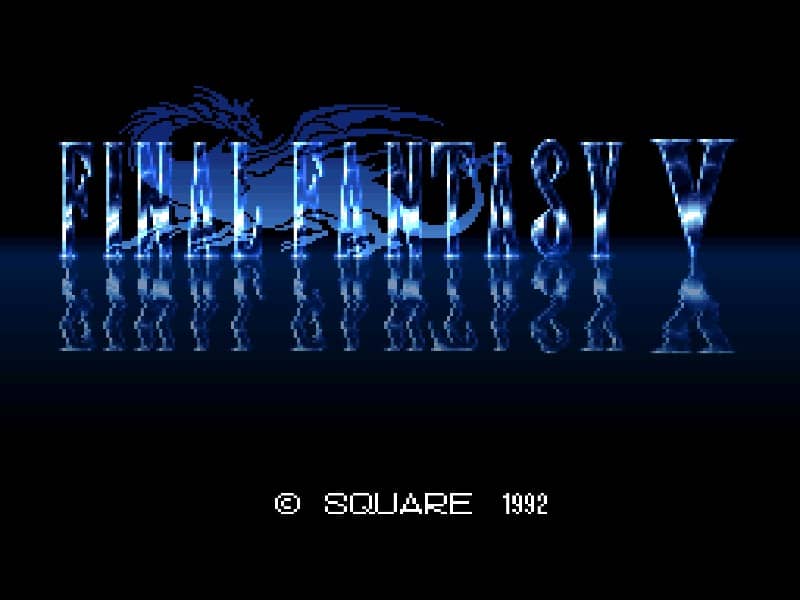
Final Fantasy V was released in Japan on December 6, 1992, for the Super Nintendo. On its first day, it sold approximately 900,000 copies, generating sales of 8.8 billion yen, demonstrating the series' strong appeal in Japan. By the end of 1992, cumulative sales reached 2.45 million units, ranking second in Japan's annual sales charts, just behind Dragon Quest V. This success solidified Square's position in the RPG genre and made Final Fantasy a national-level franchise on par with Dragon Quest.
The game was not initially released in North America, and there is a complex story behind this. Square had planned to localize the game for the North American market but ultimately canceled the project, reportedly due to the game's high difficulty and a perceived mismatch with Western players' tastes. This decision disappointed many Western fans and led to the creation of the first complete fan translation project in gaming history. Fans organized to translate the game's text into English, allowing non-Japanese players to experience the title.
It wasn't until 1998 that the game was ported to the PlayStation by Tose, as part of the Final Fantasy Collection. This version added animated cutscenes at the beginning and end, enhancing the story's presentation. In 1999, the PlayStation version was released in North America as part of Final Fantasy Anthology, marking the first official release of Final Fantasy V outside Japan, seven years after the original.
In 2006, the game was ported again to the Game Boy Advance, adding four new jobs, a new dungeon called the Sealed Temple, and a hidden boss named Enuo, enriching the content. In 2013, a high-definition version developed by Matrix Software was released for iOS and Android, followed by a Windows release in 2015. This version included the GBA additions and was optimized for touch controls.
In 2021, Square Enix released a Pixel Remaster version for Steam, iOS, and Android, with Switch and PS4 versions in 2023, and Xbox Series X/S in 2024. The Pixel Remaster faithfully recreates the original graphics and music with modern enhancements and subtle adjustments, making the classic more accessible to new players. Through these numerous ports and remasters, Final Fantasy V has become one of the longest-lived titles in the series.
Development
Final Fantasy V was directed by series creator Hironobu Sakaguchi, who later stated before the release of Final Fantasy IX that this was his favorite game in the series. Sakaguchi also contributed to the script, collaborating with Yoshinori Kitase on the story. Sakaguchi outlined the overall plot, while Kitase added humorous elements to balance the more serious tones, creating a lighthearted atmosphere despite the heavy themes.
The job system, the game's core, was designed by Hiroyuki Ito, who also served as battle planner alongside Akihiko Matsui. Ito emphasized freedom and player choice, hoping players would create their own combat styles through job combinations. This design philosophy later influenced subsequent Final Fantasy titles, especially spin-offs like Final Fantasy Tactics.
Character design was handled by Yoshitaka Amano for concept art, with character and sprite designs by Kazuko Shibuya, and monster designs by Tetsuya Nomura. Amano's unique illustration style gave the game a dreamlike and mysterious atmosphere. Nobuo Uematsu composed 56 tracks for the game, with the two-disc original soundtrack containing 67 pieces. Tracks like "Clash on the Big Bridge" and "Dear Friends" became series classics, with the latter serving as the title for the 2004 concert tour "Dear Friends -Music from Final Fantasy-".
The development team consisted of 45 people, a relatively large project at the time. The game used a 16-megabit cartridge, storing a wealth of sprites, animations, and background data. During development, the team paid special attention to the airship scenes, using Mode 7 effects to create the rotating planet visual, a signature feature of the Super Nintendo that added to the game's appeal.
The game's story is set a thousand years before the present, when the sorcerer Enuo threatened the world with the power of the Void. People sealed him away using twelve legendary weapons, but the Void could not be destroyed, and the world was split into two. The main antagonist, Exdeath, is formed from the coalesced evil souls sealed within the great tree in Moore Forest. This setting provides a grand narrative backdrop, making the adventures of the five protagonists feel significant.
Reception and legacy
Final Fantasy V received positive reviews from critics and players upon release. Famitsu's four reviewers gave it a score of 34/40, and GameFan awarded it Best Import Game and Best Music of 1992. The game's commercial success and critical acclaim in Japan further cemented Square's leading position in the RPG genre. However, due to its initial absence in North America, its influence in the West was limited until the fan translation changed that.
The game's first complete fan translation project is a milestone in gaming history. With no official localization in sight, fans took it upon themselves to translate the entire game into English, allowing countless non-Japanese players to experience the title. This event showcased the passion and creativity of the gaming community and prompted Square to pay more attention to overseas markets, advancing the series' localization efforts in the West.
The job system is one of Final Fantasy V's greatest contributions to the series. Its freedom to combine job abilities was later adopted and expanded in multiple titles, such as Final Fantasy Tactics and Final Fantasy X-2. Jobs introduced in this game, like Blue Mage, Time Mage, and Mime, became recurring jobs in the series, appearing in many later installments, demonstrating the game's deep influence on the series' design.
The game's world and story also left a lasting impact. The dual-world setting and crystal-based narrative provided a classic template for the series, while the five protagonists' development and emotional depth resonated with players. The ending changes based on the number of surviving party members, a novel feature at the time that increased emotional investment. In 1994, Square collaborated with Madhouse to produce an OVA anime titled Final Fantasy: Legend of the Crystals, which serves as a direct sequel set 200 years after the game, further expanding the world.
Through multiple ports and remasters, Final Fantasy V has been introduced to generations of players. The Pixel Remaster, while preserving the original's essence, optimized the graphics and controls, earning praise from both new and returning players. Today, the game is still regarded as one of the best in the series for its job system, and its design concepts and narrative techniques continue to influence the development of role-playing games.