
Gameplay and design
Final Fight 3 offers four playable characters: series veterans Guy and Mayor Haggar, plus two newcomers—Lucia, who wields a baton, and Dean, who fights with a lead pipe. Each character has distinct normal attacks, throws, and special moves, with noticeably different feels. Guy's moves are quick and agile, Haggar retains his grappling-heavy, powerful style, while Lucia and Dean lean toward speed and range, giving players varied playstyles on repeated playthroughs.
The game adds several enhancements to the action system. Players can dash forward, chain attacks from dashes, grab enemies from behind, and even move while facing a direction, making combat faster-paced than its predecessor. More importantly, it introduces command-based special moves similar to Street Fighter, such as directional inputs plus punch or kick for special attacks. Super moves require filling a gauge below the screen; once full, they unleash devastating attacks. However, the gauge depletes if unused for a while, so timing is crucial.
Level design features six stages, each with unique bosses, but the standout is the branching path system. In some stages, players choose different routes—for example, in stage 2, they can take the rooftop or the underground, each with different enemies and bosses. This is rare in beat 'em ups, offering more choices and replay value.
The weapon system is another highlight. Each character excels with specific weapon types—Lucia with batons, Dean with lead pipes—and picking up their preferred weapon unlocks a unique combo with increased range and damage. This encourages players to actively grab weapons rather than fight barehanded, adding strategic depth to item acquisition.
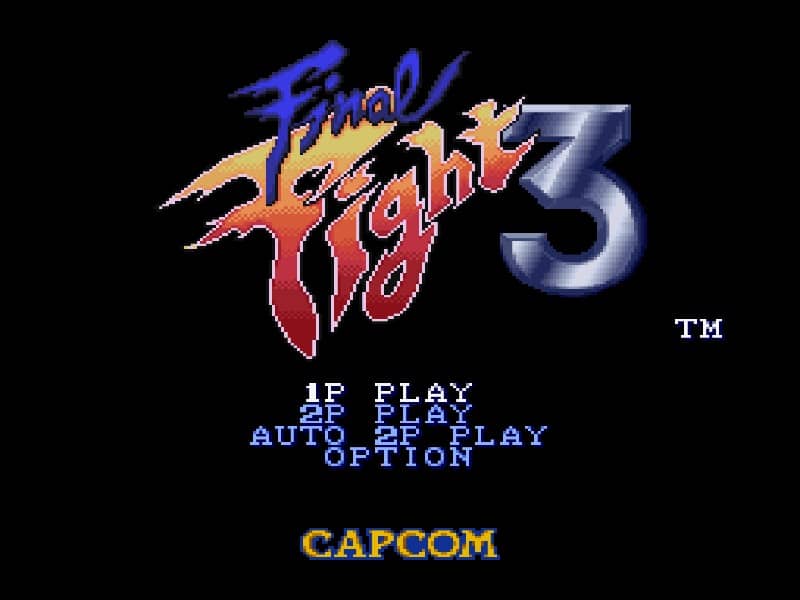
The game supports single-player, two-player co-op, and a single-player mode with a CPU partner. In co-op, players can coordinate, such as one grabbing an enemy while the other attacks, or using super moves together to clear the screen. The CPU partner mode gives solo players a helper, though the AI is average, mostly drawing fire. Overall, the game boasts solid controls and rich systems, making it a standout beat 'em up on the SFC.
Background and release
Final Fight 3 was released by Capcom for the Super Famicom in Japan in December 1995, with the Japanese title Final Fight Tough, while Western versions were simply called Final Fight 3. It is the second sequel in the Final Fight series on the SFC, following the SFC-exclusive Final Fight 2. Notably, it is the only series entry without an arcade version, developed entirely by Capcom's home console division, making it a title crafted specifically for console players.
The story takes place after the Mad Gear gang's defeat, when Metro City has regained peace, but a new criminal organization, the Skull Cross gang, emerges, kidnapping Mayor Haggar's daughter and plotting to control the city. Guy, Haggar, and newcomers Lucia and Dean team up to crush this new threat. While the plot follows the classic damsel-in-distress trope, the new characters add intrigue.
The release timing is interesting. In 1995, the SFC was in its late lifecycle, with next-gen consoles like the PS and SS already out, yet Capcom chose to release an original sequel on the SFC, indicating the platform's large player base. The game launched in North America in January 1996 and Europe in March, albeit later, but Western fans' love for beat 'em ups ensured it gained attention.
From a series perspective, Final Fight 3 is the last traditional sequel on the SFC. Subsequent titles like Final Fight: Revenge shifted to 3D fighting, moving away from classic beat 'em up gameplay. Thus, this game marks the series' final 2D beat 'em up, and its new systems inspired later games in the genre.
Interestingly, the Japanese title Final Fight Tough deviates from the previous naming convention, using 'Tough' perhaps to emphasize the game's hard-edged style. The Western version, however, used the straightforward Final Fight 3, making it clear as the third entry. This naming difference reflects varying market positioning between Japan and the West at the time.
Development
Final Fight 3 was developed by Capcom's home console division, which typically handled arcade-to-console ports, but this time they created an entirely original game. Without arcade constraints, the team had more freedom to design content like branching paths and multiple endings, which are difficult in arcade games that require short, fast-paced sessions, whereas console players are more willing to explore.
The branching path and multiple ending system was a series first and a key promotional point. The game presents different ending screens and text based on the chosen character, route, and difficulty. This was rare in beat 'em ups at the time, making players feel their choices mattered rather than just fighting through. The idea may have been influenced by the multi-ending designs common in RPGs.
The super move gauge was another innovation, clearly borrowing from the Super Combo gauge in Super Street Fighter II Turbo. Players build energy by attacking enemies, then unleash powerful super moves when full. The team integrated fighting game elements into the beat 'em up, boosting the excitement. However, the gauge auto-depletes if unused, likely to encourage aggressive play rather than hoarding.
In character design, adding newcomers Lucia and Dean was a bold move. Lucia, a female police officer using a baton, proved successful, even returning in Street Fighter V years later. Dean, a street fighter with a lead pipe, has a wild look and moves. The team worked hard to balance old and new characters, ensuring each had a unique playstyle.
The music is also noteworthy. The first stage theme, 'For Metro City,' is a urban-sounding track that was later used as Guy's theme in Hyper Street Fighter Alpha, highlighting its quality. While the overall soundtrack isn't as celebrated as its predecessor's, this one track became a classic, serving as a hidden gem from the development team.
Reception and legacy
Upon release, Final Fight 3 received mixed reviews. In Japan, Famitsu readers gave it a score of 21.2 out of 30, neither high nor low. Western outlets like GamePro's The Axe Grinder praised Lucia's inclusion and the graphics but criticized boss designs as just larger regular enemies lacking character. Next Generation felt the new features weren't enough to make it a significant improvement, calling it 'more of the same.'
Four editors at Electronic Gaming Monthly echoed similar sentiments, citing high repetitiveness and noting that despite system innovations, the overall experience differed little from its predecessor. These criticisms centered on the core gameplay not breaking new ground; branching paths and super moves, while fun, didn't change the inherent grind of beat 'em ups. However, some players felt these new systems were enough to make the game stand out.
Over time, the game's reputation has improved. In 2018, Complex listed it among the best SFC games, calling it the best in the trilogy. In 2023, Time Extension also included it in a list of the best beat 'em ups, again labeling it the series' best. This reversal is partly due to evolving player appreciation for the genre and recognition of the game's forward-thinking design.
The game's influence on later works is mainly seen in its characters and music. Lucia returned as a playable character in Street Fighter V, delighting old fans and introducing new players to this Final Fight character. The first stage theme 'For Metro City' was used for Guy's theme in Hyper Street Fighter Alpha, a cross-game homage that underscores the music's quality.
In summary, Final Fight 3 may not have received its due at launch, but its place in beat 'em up history is undeniable. It attempted to blend fighting game elements into the genre and introduced branching paths and multiple endings, echoes of which can be seen in later indie games. For fans of beat 'em ups, this is an unmissable SFC title whose value has finally been recognized years later.





