
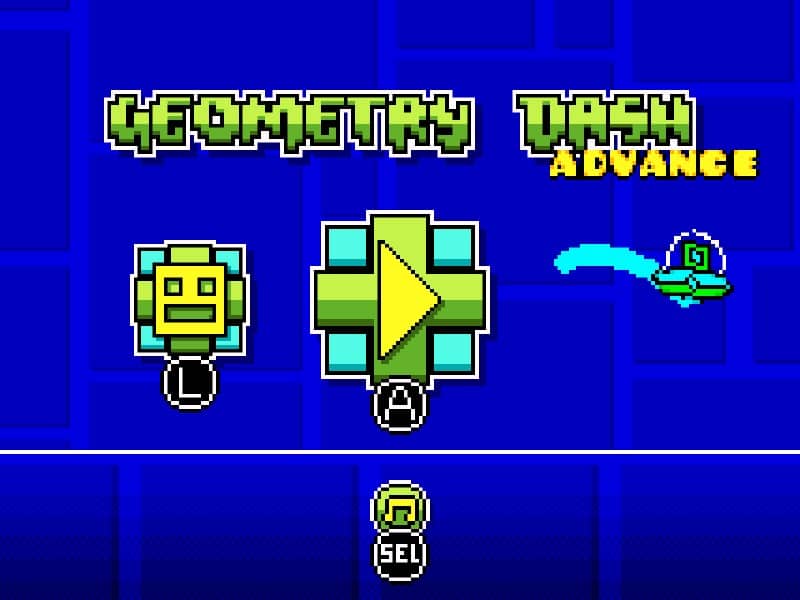
Gameplay and design
The core gameplay of Geometry Dash Advance stays true to the original Geometry Dash's one-button rhythm: you control a square, tapping the screen or pressing a button to the beat of the music, making it jump, flip, and dodge spikes and obstacles. The team made matching the original's physics a top priority, fine-tuning jump timing, speed changes, and collision feedback, as this is crucial to the port's success. On the GBA's physical buttons, the feel is different from a touchscreen, but the rhythm remains tight, and players quickly find the familiar beat.
The stable v0.9-beta release includes the main official levels up through Blast Processing, letting players tackle these classics in order and experience the difficulty curve from easy to hard. Beyond the official content, the game also features a large number of custom levels designed by community members, making the most of the GBA's hardware. Some emphasize precise jumps, while others play with visual rhythm. These custom levels turn the game from a simple compressed collection of the original into a small creative space built around the GBA's constraints.
Practice mode is another key feature, accessible from the pause screen, allowing players to learn longer levels in segments without restarting from the beginning each time. This is especially friendly to GBA players, as levels on the handheld often require repeated trial and error, and practice mode helps reduce frustration. Icon customization is also retained, letting players choose the color and appearance of their square just like in the original. It may seem simple, but it adds a layer of personal visual choice that enhances immersion.
The endless mode added in v0.9-beta is a highlight, generating random levels that can be played indefinitely, offering unlimited challenges beyond the official levels. This mode further departs from the level-by-level remake approach, pushing the project from a nostalgic tech demo to a standalone, replayable mode. While random levels aren't as carefully designed as handcrafted ones, they offer plenty of rhythmic variety, perfect for picking up and playing for a few minutes in spare time.
The GBA's 240×160 pixel screen and physical buttons make Geometry Dash Advance feel quite different from the mobile version. The visual information density has to be rearranged, with obstacles and visible distance adjusted for the small screen, requiring players to focus more intently on what's ahead. Physical buttons provide clearer feedback than a touchscreen, but the button travel introduces a subtle delay, which the team optimized the physics to accommodate, helping players adapt to the difference.
Background and release
The GitHub repository for Geometry Dash Advance was created on December 12, 2024, and the project page directly describes it as a GBA demake of Geometry Dash. The original was created by RobTop Games, and the project credits this in its acknowledgments. Since the repository went public, development has been ongoing, with the team releasing stable versions regularly while also providing nightly builds for players to try out. This development pace has helped the project gain considerable attention in a short time.
Stable version v0.7-beta was released on April 27, 2025, marking an early milestone. It already included the main official levels up through Electrodynamix, two custom levels, icon customization, practice mode, and a music test feature. The v0.7 release let players experience the core early content of the original on the GBA for the first time, and it laid the groundwork for later versions.
v0.8-beta followed on December 8, 2025, keeping the main levels up to Electrodynamix but increasing custom levels to 11, along with improvements to songs and details. This version saw a significant boost in content, and the rise in custom levels reflected the community's creative activity. v0.9-beta arrived on March 20, 2026, expanding the main levels to Blast Processing, adding more custom levels and new visual effects, and introducing the endless mode for the first time.
The project offers two download tracks: stable releases and nightly builds. Nightly builds are for unstable, in-development versions, containing the latest but possibly unfinished features. The team explicitly warns players not to confuse nightly builds with public stable releases, as nightly versions may have bugs or unpolished content. This distinction shows the project's careful version management and lets players choose the version that suits their needs.
In the GBA homebrew and demake culture, Geometry Dash Advance occupies an interesting niche. The GBA has long been discontinued, but the homebrew community remains active, and demakes often bring modern games to old hardware, blending technical challenge with nostalgia. This project is a typical example, taking a rhythm game that relies on modern touchscreens and fast graphics and reworking it to run on a 2001 handheld. The contrast itself is appealing.
Development
Geometry Dash Advance is led by AleFunky, who is credited with main development, code, levels, testing, and bug fixes. The project is not a solo effort; members like ElAngel378 and orionConstel contributed to music, levels, graphics, testing, and bug fixes, along with several other music and level contributors. This collaborative approach allows the project to advance on multiple fronts simultaneously and ensures a diversity of content.
Technically, the project uses the devkitPro toolchain, with code primarily in C, and relies on GBA development libraries such as libgba, libtonc, and Maxmod. These are mainstream choices for GBA homebrew development: libgba provides low-level hardware access, libtonc includes graphics and math libraries, and Maxmod handles audio playback. By choosing these mature components, the team prioritized efficiency and stability over reinventing the wheel.
The GBA's hardware limitations are a constant challenge. The 240×160 screen resolution means the interface, obstacles, and visible distance all need to be rearranged; you can't simply scale down the original graphics. For audio, the original music must be converted to a format the GBA can handle, and the public repository uses source files like XM, S3M, and WAV in the build process. The color palette is also limited, so the team had to recreate the original's visual style within those constraints.
Music and graphics are important parts of the project, and the team separately credits the original music composers and the GBA arrangers, showing respect for the original creators. The music test screen lets players play the arranged tracks individually, serving both as a feature and a showcase of the audio conversion results. For graphics, custom levels and icon customization all need to be designed within the GBA's palette limits, testing the creativity of the art team.
The project's code repository is marked with the MIT license, but the team clearly credits the original Geometry Dash creators and the relevant music composers. This indicates that the open-source license covers only the code, not the original art, music, or intellectual property. The team has maintained clear boundaries in development, using open-source resources while respecting the original's copyright, an attitude worth commending.
Reception and legacy
What makes Geometry Dash Advance most appealing is how it reinterprets a modern rhythm game for an old handheld. The original relies on touchscreens, continuous music, and fast graphics, but the GBA's hardware is completely different, so the team had to rework visual density, button input, sound layering, and level loading. This reconstruction isn't just shrinking the screen; it's a rethinking of the game's essence, showing how rhythm games can work on different hardware.
The inclusion of custom levels has fostered a small creative community, where players can design their own levels and share them for others to challenge. This goes beyond a compressed collection of original levels, giving the game its own creative space independent of the original. The endless mode further expands replayability, turning the project from a nostalgic tech demo into a standalone, replayable mode, so even without new levels, players can keep facing challenges.
In the GBA homebrew and demake culture, this project is seen as an interesting case study. It demonstrates how modern games can be ported to old hardware and offers a reference for other developers. The open-source code and detailed documentation allow interested individuals to learn GBA development techniques, especially in audio conversion and physics tuning. This sharing of technical knowledge may have a longer-lasting impact than the game itself.
When evaluating this project, it's important to keep perspective: it's not an official sequel, nor a commercial success, but a player-made work in continuous development. As of the time of writing, the project is still being updated, and the stable version still carries a beta tag, indicating it's not fully finalized. But it's this unfinished state that lets players witness a demake project grow from zero to one, a sense of participation that commercial games rarely offer.
The relationship between the open-source code and the original's rights is also noteworthy. The MIT license covers only the code, not the original's art, music, or intellectual property, and the team clearly lists the original creators in their credits. This respect for copyright sets an example for other demake projects. If the project continues to develop, it may become a classic case in the GBA homebrew community, referenced by future developers.





