
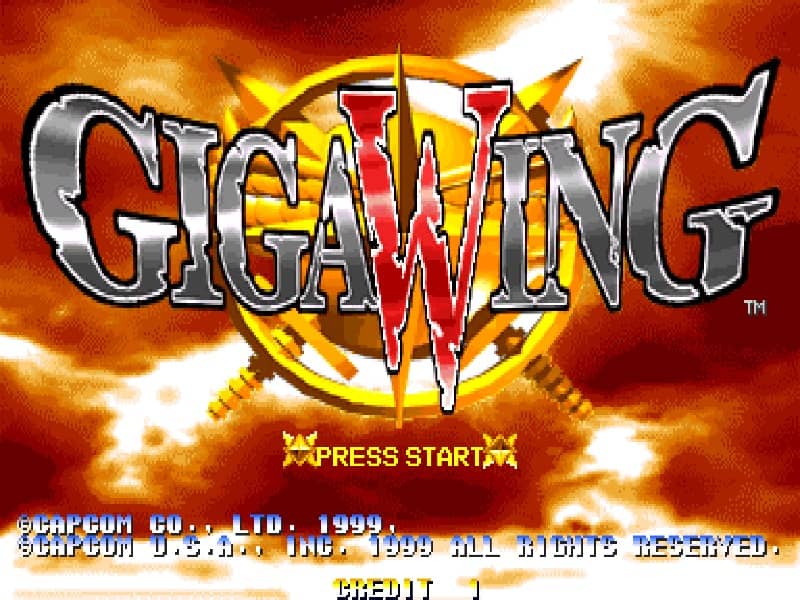
Gameplay and design
The core gameplay of Giga Wing revolves around the Reflect Force, a mechanic that adds a layer of strategic choice to the bullet-hell action. When enemy bullets approach, players can activate the Reflect Force to bounce them back, and these reflected bullets turn into medals that boost the player's score. This design not only encourages players to actively engage with the bullet patterns but also rewards high-risk maneuvers with high rewards, making it the game's most distinctive feature.
In addition to the Reflect Force, players have two other attack methods: a standard shot and a force bomb. The standard shot provides consistent damage output, while the force bomb clears all bullets from the screen, serving as a lifesaver in critical moments. However, bombs are limited and must be used wisely. Each of the three attacks serves a different purpose, and players must switch between them flexibly to survive the game's challenging stages.
The game consists of seven stages, each ending with a boss battle that tests the player's reflexes and strategy. Players start with three lives, but to reach the seventh stage, they must avoid using continues, offering a challenge for hardcore players. The difficulty system dynamically adjusts based on the player's score; the score at the end of each stage determines the player's rank, and the higher the rank, the stronger the enemies in subsequent stages, keeping the game consistently challenging.
The game supports a two-player co-op mode, allowing two players to fight side by side and tackle denser bullet patterns together. Co-op mode also introduces a new storyline, letting players experience a different narrative. In single-player, there are both bad and good endings depending on the player's performance, which adds replay value.
Four selectable characters each have their own traits: Sinnosuke, Ruby, Isha, and Stuck. They pilot futuristic aircraft in a steampunk-styled battlefield. Each character has an independent storyline, offering players different perspectives on the game world. This multi-character design is uncommon in arcade shooters and adds narrative depth to the game.
Background and release
Giga Wing was developed by Takumi and published by Capcom in 1999, debuting in arcades. The game uses a horizontal monitor, which is rare for vertical shooters, similar to Treasure's Radiant Silvergun. This design gives players a wider view of the battlefield but also changes the traditional vertical-scrolling visual experience, becoming a unique hallmark of the game.
The arcade version was listed as the tenth most successful arcade game of the month in the May 1, 1999 issue of Game Machine magazine, indicating its popularity in arcades at the time. Although the exact release date is not specified, Wikidata records it as November 11, 1999, which may be the release date for a particular version.
The Dreamcast port was originally scheduled for release in the United States in April 2000 but was delayed to July 18, 2000. This postponement made eager players wait a bit longer, but the final version was released smoothly. The Dreamcast version was later included in Capcom Arcade Stadium, allowing modern players to experience this classic.
The game's story is set in a fictional steampunk war, where players control one of four futuristic aircraft, attacking enemies with guns and missiles. The plot revolves around a medal with immense power, and the final boss is an evil character piloting the ship 'Stranger,' who instigated the war and historical conflicts. This medal-driven narrative echoes the game's core mechanic.
Giga Wing's release came at the tail end of the golden age of arcade shooters. With its unique Reflect Force mechanic and polished graphics, it stood out among many similar games. While it didn't become a household name like Raiden, it left a lasting impression on core gamers.
Development
Giga Wing was developed by Takumi Corporation, a company known for creating hardcore shooters, having previously developed titles like Thunder Wing. Capcom, as the publisher, provided strong marketing support. The development team built the game on the CPS-2 arcade board, fully utilizing its graphical capabilities to render a detailed steampunk world.
The game's steampunk worldview was a deliberate design choice by the development team, who blended retro-futuristic elements to create a unique visual style. The story revolves around a medal, a setting closely tied to the core mechanic; players collect medals in gameplay, and in the story, the medal is a key object of contention. This design integrates gameplay and narrative seamlessly.
Each of the four characters has an independent storyline, a design that required significant effort in development. Each character has different background stories and dialogue, allowing players to discover new content on repeated playthroughs. Co-op mode also adds an extra storyline, further enriching the game's narrative, reflecting the team's emphasis on narrative depth.
The game's difficulty adjustment system was an innovation during development, dynamically changing the game's difficulty based on the player's score. This design aimed to provide appropriate challenges for players of different skill levels, but it also means that skilled players face tougher enemies, increasing the challenge. This system was uncommon in shooters at the time.
The development team paid attention to details, such as the use of a horizontal monitor, which, though rare, may have been to adapt to the CPS-2 board's characteristics or to provide a wider field of view. The Reflect Force mechanic was carefully balanced to ensure it was powerful without making the game too easy. These design decisions collectively shaped Giga Wing's unique experience.
Reception and legacy
The Dreamcast version of Giga Wing received mixed reviews upon release, with GameRankings summarizing it as 'mixed.' Japan's Famitsu gave it a score of 28/40, while NextGen's Jim Preston commented that the game 'should come with eyedrops and headache pills,' hinting at the density of its bullet patterns. These reviews reflect the game's demand on players' reflexes and eyesight, but also indicate its unique standing among core gamers.
The arcade version was listed as the tenth most successful arcade game of the month in Game Machine in May 1999, a ranking that shows its commercial performance in arcades. Although it didn't top the charts, making it into the top ten among many games is a testament to its appeal.
The game was included in Capcom Arcade Stadium, allowing modern players to revisit this classic on contemporary platforms. This inclusion not only recognizes the game's historical significance but also gives a new generation of players the chance to experience the unique charm of the Reflect Force mechanic.
The Reflect Force mechanic became Giga Wing's signature design, encouraging players to actively engage with bullet patterns and turn danger into scoring opportunities. This mechanic influenced the design of some later shooters, even if not directly imitated, showcasing the game's value in gameplay innovation.
Although Giga Wing did not become a phenomenon, it enjoys a strong reputation among shooting game enthusiasts. Its steampunk style, multi-character narrative, and dynamic difficulty system have provided references for later games. As one of Takumi's representative works, it proves that in the arcade shooter genre, innovation and depth can still win players' hearts.





