
Gameplay and design
The core gameplay of Golden Axe is side-scrolling beat 'em up action. Players traverse the fictional land of Yuria, hacking through enemies to rescue the king and princess from the evil Death Adder. At the start, players choose one of three warriors: the dwarf Gilius Thunderhead, the barbarian Ax Battler, or the Amazon Tyris Flare. Each character has distinct strengths in attack power, speed, and magic, catering to different play styles.
The combat system is straightforward: players use weapons for melee attacks and can unleash magic. Magic is a highlight, with players collecting magic potions scattered throughout levels to fill a magic meter. The longer the meter, the more powerful the spell. Each character's magic differs, from summoning fire to causing earthquakes, providing visual spectacle and strategic depth.
Beyond standard combat, the game introduces rideable creatures. Players can mount cockatrices or dragons, which move faster and have unique attacks. Dragons, depending on color, can breathe fire or spit fireballs, speeding up combat and offering a different feel from on-foot fighting. This feature was innovative at the time and became a hallmark of Golden Axe.
The controls are solid, with clear hit detection and a variety of enemies, from basic soldiers to shield-bearing knights and spell-casting wizards, requiring players to adapt their tactics. Level design spans multiple environments, from forests to castles to the final showdown, each with distinct atmosphere and enemy layouts, keeping the experience fresh.
Notably, some ports include a Duel mode, allowing one-on-one player versus player battles, adding extra fun. However, the original arcade version lacks this mode; it was introduced in home console versions. Overall, Golden Axe's gameplay is top-tier for beat 'em ups, easy to pick up yet with enough depth.
Background and release
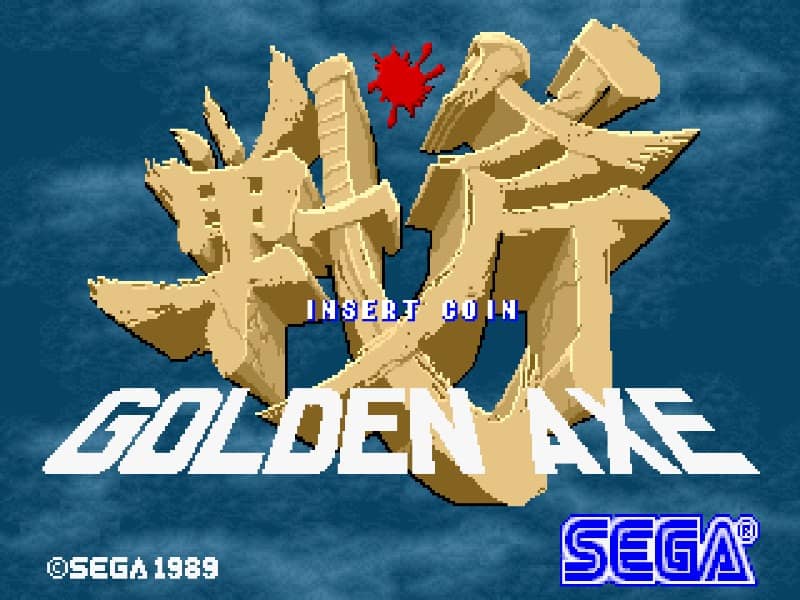
Golden Axe was released by Sega in 1989, running on the Sega System 16B arcade board, one of Sega's mainstream boards at the time, capable of smooth scrolling and vibrant colors. Upon release, it achieved notable success in Japan and overseas, becoming a popular cabinet in arcades.
The story is set in the fictional land of Yuria, a typical sword-and-sorcery world. Death Adder has kidnapped the king and princess, and the player's warrior must embark on a quest to defeat the evil forces. This simple plot provides clear motivation and immersion.
The success of Golden Axe led to ports on multiple platforms. The Mega Drive version, released in late 1989, added new levels and a Duel mode, and altered the ending, becoming the first version many players experienced. The Master System version was simplified, featuring only the barbarian Tarik and single-player, differing from the arcade original.
The PC Engine CD-ROM² version is unique for including animated cutscenes, with a story significantly different from other versions, offering an alternative experience. The game was also ported to home computers like the Amiga and Atari ST, broadening its audience.
The Golden Axe series expanded with sequels Golden Axe II and Golden Axe III, as well as remakes and compilations. In 2011, a PlayStation Network version was released; in 2017, the Mega Drive version came to iOS and Android as part of the Sega Forever service. In 2021, the Mega Drive version was released via the Nintendo Classics service, allowing a new generation to experience this classic.
Development
The lead designer of Golden Axe was Makoto Uchida, who had previously worked on Sega's Altered Beast. Uchida was heavily influenced by the film Conan the Barbarian, aiming to create a fantasy world with violent aesthetics. He drew inspiration from Double Dragon and Street Fighter but sought to differentiate the game, making it more than just a simple brawler.
The development team was small, with a production period of about one year. Within this tight schedule, the team efficiently handled game design, programming, and art. Uchida recalled that their goal was to create a game distinct from Double Dragon, so they incorporated magic and rideable creatures to make combat more varied and interesting.
In designing the magic system, Uchida emphasized collecting magic potions and building up the magic meter, offering players a risk-reward choice: use magic early or save for a higher level. This added strategic depth and motivated players to collect potions.
The idea for rideable creatures may have been inspired by mounts in Conan the Barbarian, but Uchida combined them with fantasy creatures, creating cockatrices and dragons. These creatures not only looked cool but played a significant role in gameplay, becoming powerful allies. The team worked hard to balance their abilities, ensuring they were strong without breaking the game's difficulty.
The arcade ending was creative and broke the fourth wall: it showed three children playing an arcade machine causing a fire, and the game characters entering the real world. This ending was rare at the time and left a strong impression. However, the Mega Drive version changed the ending, possibly because home console players expected a traditional happy ending.
Reception and legacy
Golden Axe was a commercial success. In Japan, Game Machine magazine's July 1, 1989 issue listed Golden Axe as the second most successful arcade cabinet of the month. In 1989, it was the 18th highest-grossing arcade game in Japan, and in January 1990, it became the highest-grossing arcade game in the United States. These achievements attest to its popularity.
The game also received awards and praise. Computer and Video Games awarded it the "C+VG Hit!" award, and The One gave it a "Star Buy" award. In 1991, PC Format listed Golden Axe among the 50 best computer games. These honors reflect professional recognition.
Among players, Golden Axe was equally beloved. In 1993, the ZX Spectrum version ranked 60th in Your Sinclair's reader poll. In 1995, Flux magazine ranked the Mega Drive version 70th on its "Top 100 Video Games" list. In 1996, GamesMaster ranked the Mega Drive version 100th on its "Top 100 Games of All Time" list. These rankings show its standing with players.
Subsequent ports and remakes also received decent reviews. GameRankings gave the Mega Drive version a 69% aggregate score, Metacritic gave the Xbox 360 version 68 out of 100, and TouchArcade gave the iOS version 3.5 out of 5 stars. While not top-tier scores, they are respectable given the game's age.
Golden Axe's influence extends beyond commercial and critical success, inspiring later beat 'em ups. Its magic system and mounted combat were borrowed by many successors, becoming genre staples. The game has been included in multiple compilations, such as Sega Smash Pack and Sega Genesis Collection, making it easily accessible to new players.





