
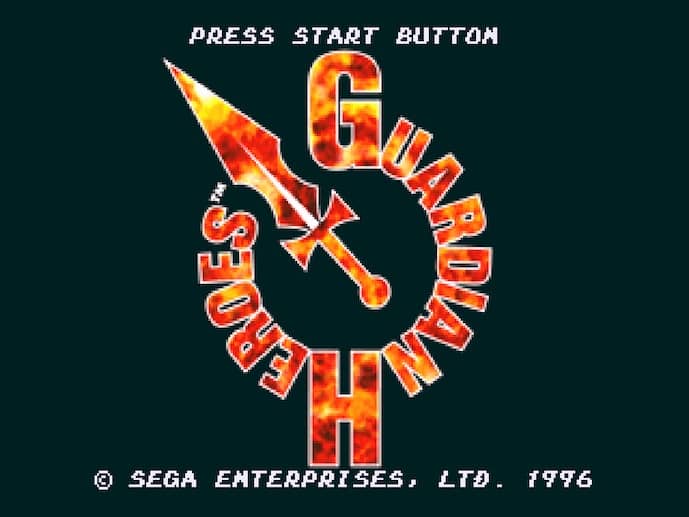
Gameplay and design
What makes Guardian Heroes most memorable is how it blends beat 'em up action with role-playing, and it does so quite naturally. The game is called a "battle RPG" by the development team, and that's fitting: you fight your way through like in Streets of Rage, but after each battle you earn experience points to raise your character's six stats—strength, vitality, intelligence, spirit defense, agility, and luck. These stats aren't just for show; they directly affect your performance in combat. For example, strength determines physical attack damage, intelligence affects magic power, and agility influences dodging and attack speed. You can allocate points based on your playstyle—if you prefer to go in head-on, you'd stack strength and vitality; if you favor magic, you'd focus on intelligence. This kind of freedom was rare in beat 'em ups at the time.
The combat system is another highlight, dividing the battlefield into three planes: foreground, middle ground, and background. You can switch planes at any time to dodge enemy attacks or sneak behind them for a surprise attack. This design adds a lot of strategy to battles, making them more than just standing and hitting. For instance, when facing a group of enemies, you can observe from the background, then switch to the middle ground to counter after they attack; against ranged enemies, you can close in by switching planes. The three planes aren't just decorative; they make every battle feel like a three-dimensional chessboard, requiring you to keep an eye on both your position and the enemy's. This mechanic was quite rare in 2D games at the time and became a hallmark of Guardian Heroes.
The story progression is also innovative. The game features multiple branching paths, and your choices at key points determine the story's direction, even affecting the final ending. These choices also change your karma value, which unlocks different dialogue and story events, giving each playthrough a fresh feel. For example, choosing to help a certain character might alter subsequent stages and bosses; the karma level also influences how some characters treat you and the ending you get. This kind of multi-path narrative was almost groundbreaking in beat 'em ups, making players feel their decisions matter rather than being led down a single path.
In addition to the single-player story mode, the game offers a versus mode for up to six players. You can choose from the main characters or use monsters, bosses, and even civilians unlocked after clearing the game. The versus mode isn't just a simple brawl; it uses the same three-plane and stat systems, making it quite deep. When playing with friends, you can try various tactics with different characters, like using a ranged character to shoot from the background or a melee character to pressure up close. This mode was popular at the time because it fully brought over the single-player combat system and added the fun of multiplayer competition, greatly enhancing replayability.
Overall, Guardian Heroes' gameplay design emphasizes "choice" and "growth." Whether it's the story branches, karma value, or stat allocation, it encourages players to play their own way. The three-plane combat adds more thought to the action, rather than just button-mashing. These mechanics combined give the game both the satisfying feel of a beat 'em up and the progression fun of an RPG, and they blend quite naturally. For players who enjoy depth and replayability, it offers plenty of reasons to try different routes and builds over and over.
Background and release
Guardian Heroes was originally released on the Sega Saturn in 1996, developed by Treasure and published by Sega. That year, the Saturn had been out for two years, but there weren't many 2D games that truly showcased the console's power. Treasure was known for making high-quality 2D action games, having previously created Gunstar Heroes and Alien Soldier, and had a great reputation among players. Guardian Heroes was an original title they made for the Saturn, with a clear goal: to push 2D action gameplay to its limits while adding RPG elements to enrich the content. After release, thanks to its solid feel and unique systems, it quickly gained a loyal fanbase among Saturn players.
The game's story is set after the war between the Earth and Sky spirits, where the human wizard Kanon overthrew the rule of the Khan, but a new threat emerges. The four main characters—Han, Randy, Nicole, and Ginjirou—discover a legendary sword during their adventure and decide to use it to fight evil. The story also includes a character named Serena and an undead warrior that can be commanded. This setting blends fantasy and adventure, providing a great stage for the branching narrative. Your choices in the game affect the story's direction, such as whether to help the spirits or humans, or whether to pursue power or protect peace. These choices create multiple possibilities and add replay value.
The game received positive reviews upon release, with several media outlets giving it praise. Four reviewers from Electronic Gaming Monthly all praised the game's combo system, multi-path design, and versus mode, saying these elements made the game content very substantial. Rad Automatic from Sega Saturn Magazine specifically mentioned the multi-path, high difficulty, and three-plane combat, calling it a "classic." GamePro, despite criticizing the lengthy dialogue and graphics, still strongly recommended it, calling it a true successor to Streets of Rage and Golden Axe. These reviews show that the game's fusion of action and RPG was recognized by both players and the press.
While Guardian Heroes wasn't a massive commercial hit, its reputation gradually made it an important title in the Saturn's library. In 1996, Electronic Gaming Monthly awarded it "Best Side-Scrolling Game of the Year" and the following year ranked it 66th on their "100 Best Games of All Time" list. These honors kept it in players' memories even after the Saturn's lifespan ended. Later, with the retro gaming boom, more new players discovered the game through emulators or the second-hand market, further cementing its classic status.
In 2011, Treasure partnered with Sega to bring Guardian Heroes to Xbox Live Arcade on Xbox 360 as an HD remaster. This version was released on October 12, 2011, supporting 16:9 widescreen and HD graphics, and added online multiplayer. The HD version wasn't a simple port; it offered both original and remixed graphics modes. The remixed mode applied an hqx-like upscaling filter and pencil shading effects to make the visuals clearer. Additionally, the remixed mode adjusted the control scheme, adding new moves like attack, dodge, air dash, and air recovery, inspired by Treasure's other game, Bleach: Blade of Fate. The HD version also rewrote the story mode's script, updated the dialogue, and renamed the Earth and Sky spirits to Earthblood and Skyborn. On November 6, 2016, the game became backward compatible on Xbox One, allowing more players to enjoy the classic on modern consoles.
Development
Development of Guardian Heroes began in June 1994, about two years before release. Treasure's team drew inspiration from two games: Fill-in-Cafe's Mad Stalker and Capcom's Alien vs. Predator. The former is a beat 'em up featuring robot combat, while the latter is a classic arcade beat 'em up from Capcom. Treasure took inspiration from these games but didn't simply imitate them; they wanted to create their own identity. They decided to incorporate RPG growth systems into the beat 'em up action and add branching storylines, so the game wouldn't be a linear path. This idea was quite bold at the time, as beat 'em ups typically had linear stages, and RPG elements were rarely integrated.
Treasure chose to use 2D sprite graphics rather than the 3D polygons that were starting to become popular. This decision wasn't due to technical limitations but out of confidence in 2D technology. Treasure had extensive experience in 2D, having showcased excellent pixel art and smooth animation since Gunstar Heroes. They believed 2D and 3D could coexist, and 2D had unique advantages in depicting action details and on-screen character counts. In fact, the three-plane combat and large numbers of on-screen enemies in Guardian Heroes were efficiently achieved with 2D graphics. The team fully utilized the Saturn's hardware capabilities to maintain a smooth frame rate while delivering rich visual effects.
The game's music was composed by Nazo² Suzuki and Norio Hanzawa, with synthesizer performance by Hideki Matsutake, a former member of Yellow Magic Orchestra. Matsutake is a pioneer of Japanese electronic music, and his involvement gave the soundtrack a strong electronic and rock style that fit the fast-paced combat perfectly. The music in the game is outstanding, from the intense battle themes to the atmospheric story music, leaving a lasting impression on players. This music later became part of the game's legacy and is often discussed by fans.
An interesting detail in the HD version's development: when Treasure was working on the Xbox 360 version, they had to recover the source code from DAT tapes. DAT tapes were a common data storage medium in the 1990s but had become obsolete, making recovery quite difficult. The team had to find compatible hardware and software to read these tapes, and they eventually succeeded in retrieving the original code. This experience shows how much Treasure valued the game, as they were willing to put in the effort to restore and remaster it rather than simply abandon it. The HD version was developed by Treasure themselves, and they not only improved the graphics but also added new gameplay mechanics, giving veteran players something fresh.
The remixed mode in the HD version was a highlight of the development. This mode applied an hqx-like upscaling filter to make pixel art look smoother at HD resolutions, and added pencil shading effects for a hand-drawn feel. The control adjustments were inspired by Bleach: Blade of Fate, adding moves like air dash and air recovery to make combat more fluid. These changes weren't just a simple port but an expansion and optimization of the original system. However, the HD version also made some controversial changes, such as rewriting the story script and renaming the Earth and Sky spirits to Earthblood and Skyborn, possibly to align with new story settings, but some old fans weren't pleased with these changes.
Reception and legacy
Guardian Heroes received several honors in the year of its release. Electronic Gaming Monthly awarded it "Best Side-Scrolling Game of the Year" in 1996 and ranked it 66th on their "100 Best Games of All Time" list the following year. While these awards and rankings aren't official, they reflect the high regard from media and players. IGN's Levi Buchanan listed the game as the third-best Sega Saturn game, and GamesRadar ranked it fifth among Saturn games, calling it a "wonderful co-op beat 'em up experience." These evaluations have kept Guardian Heroes a staple in Saturn game rankings.
In the beat 'em up genre, Guardian Heroes holds a solid position. Heavy.com ranked it the fourth-greatest beat 'em up of all time in 2013, ScrewAttack placed it fifth, and in 2023, Time Extension included it in the top 25 "best beat 'em ups of all time." These rankings come from different outlets but all point to the same conclusion: the game has had a profound influence on the genre. Its three-plane combat and branching narrative design have inspired later games, though few have managed to fully replicate its essence.
The success of Guardian Heroes also led to a sequel. In 2004, Treasure released Advance Guardian Heroes on the Game Boy Advance. This sequel continued the core gameplay of the original but was scaled down in graphics and scope due to the handheld's limitations. Despite this, it was still enjoyed by some players, proving the appeal of the Guardian Heroes brand. However, the sequel's impact was far less than the original, and the original holds a higher place in players' hearts.
The HD version brought Guardian Heroes renewed attention in the modern era. The Xbox 360 version allowed old fans to revisit the classic and also attracted new players to experience the game. Although some changes in the HD version (like the story renaming) sparked controversy, it was generally considered a successful remaster. After becoming backward compatible on Xbox One in 2016, the game's audience expanded further, allowing more modern players to experience this Saturn-era masterpiece.
Looking back at Guardian Heroes' history, it's a game that appeared at the right time. It captured the golden age of 2D action games while boldly incorporating RPG elements, creating a unique experience. Its branching narrative and karma system were ahead of their time and influenced many later games. Although it didn't become a household name, it remains a monument in the beat 'em up genre for core gamers. For fans of action games and RPGs, Guardian Heroes is a classic not to be missed.





