Gameplay and design
What makes Heroes of Jin Yong most memorable is its almost unrestricted freedom. At the start, the protagonist stands on a vast world map, free to go anywhere without a fixed quest order. You can seek out Duan Yu, provoke Ouyang Feng, or even charge straight to Bright Peak to challenge the six major sects. This design was rare in Chinese RPGs at the time; players were no longer led down a single path but truly had the power of choice.
The core objective is to collect all fourteen of Jin Yong's novels, each corresponding to a unique adventure. These novels are scattered across the jianghu, some requiring specific quests to obtain, others hidden in obscure corners. To gather them, players must interact with a variety of characters—some need help, others require combat, and some can only be dealt with through theft or deception. This collection-driven approach makes exploration rewarding and cleverly weaves the content of the fourteen novels together.
The morality system is a standout feature. The protagonist's actions alter a morality value: helping the weak increases goodness, while killing innocents turns you evil. This value affects NPC attitudes and changes the story's direction. Some characters only befriend the virtuous, while certain evil masters prefer a ruthless protagonist. Even the ending varies based on morality, making players feel their choices truly matter.
The combat system is turn-based but incorporates positioning and area-of-effect attacks. Players control their party's movement on the battlefield, using martial arts' attack ranges to strike enemies. There is a wide variety of martial arts, including sword, blade, fist, whip, internal energy, and lightness skills. Each has different effects and animations—for example, the Eighteen Dragon Subduing Palms is powerful but consumes high internal energy, while the Nine Swords of Dugu focuses on precision. Players can mix and match to create a unique combat style.
Many characters from Jin Yong's novels can join your party, such as Duan Yu, Linghu Chong, and Zhang Wuji. Each has distinct personalities and specialties—some excel in melee, others in ranged attacks, and some can heal. You can have up to five companions, and team composition is an art in itself. Additionally, there are hidden elements, like martial arts requiring specific conditions to learn and characters needing particular storylines to recruit, which add replay value.
Background and release
Heroes of Jin Yong arrived in 1996, during a period of rapid growth for Chinese single-player games. At the time, Soft-World had already released Romance of the Three Kingdoms II and New Shushan Swordsman, but both had lukewarm market reception, putting pressure on the company. No one expected that this game, developed by Heluo Studio, would become a major success, turning Soft-World's fortunes around and setting a benchmark for future wuxia RPGs.
The game is set in a fictional wuxia world where a modern person accidentally time-travels into the jianghu of Jin Yong's novels. The goal is to collect fourteen novels to return to reality, while also facing the challenge of becoming the martial arts alliance leader. This time-travel premise was very novel at the time, giving players a sense of immersion into the wuxia world. Characters and events are mostly drawn from Jin Yong's original works but rearranged—for instance, Blue Phoenix becomes a key figure in helping the protagonist find The Deer and the Cauldron, a role completely different from her original.
When released in South Korea, the game was translated as The Legend of the Condor Heroes Gaiden. Although somewhat misleading, this title reflects Jin Yong's influence in Asia. Korean players were likely more familiar with The Legend of the Condor Heroes, so the publisher chose a more relatable name. However, the game's content remained unchanged, still a grand story integrating fourteen novels.
Felipe Pepe, editor-in-chief of The CRPG Book, once praised the game as "a representative Chinese RPG full of literary flavor." This assessment is apt, as the game not only features rich plots and characters but also conveys the chivalrous spirit of Jin Yong's novels through quests and dialogue. Players' choices often involve moral and practical trade-offs, a literary depth rarely seen in domestic games of that era.
The game's success was no accident; it tapped into players' longing for the wuxia world and their desire for free exploration. In an age before widespread internet, word of mouth helped the game spread rapidly. Many players experienced for the first time "so this is how wuxia games can be played," a shock and novelty that later similar games found hard to replicate.
Development
Producer Xu Changlong, the core figure at Heluo Studio, was himself a veteran player of Western RPGs. Before developing this game, he had played many Western titles like Ultima, deeply influenced by their open-ended design. He realized that domestic RPGs remained stuck in linear storytelling, where players followed a script without true freedom. So he decided to break this mold by introducing elements like a world map, free exploration, and a morality system into wuxia games.
In addition to Western RPGs, the game may have drawn inspiration from Artdink's wuxia RPG, Knight's Tale. That game also featured high freedom and character development, providing Xu with ideas. However, Heroes of Jin Yong did not simply copy it; instead, it combined Jin Yong's worldview with its own distinct systems. For instance, the morality system directly affects story and character interactions, making choices more consequential.
The Heluo Studio team also left their mark on the game. The protagonist's default name, "Little Shrimp," was Xu Changlong's nickname, and the "Four Great Masters"—Southern Sage, Northern Fool, Kong Bala, and Lin Chuzi—were modeled after four studio members. These characters serve as guides, offering clues and assistance, adding a personal touch that made the developers feel connected and gave players a knowing smile.
During development, the team did not intend to fully recreate Jin Yong's plots but only kept the core framework, letting players decide quest order and methods. For example, Golden Wheel Dharma King appears as a boss in the Book and Sword storyline, and defeating him is necessary to obtain the Quran; Wei Xiaobao becomes a merchant, no longer directly tied to obtaining The Deer and the Cauldron. While some original fans were surprised by these changes, they also gave the game more freedom and playability.
The development process also faced technical challenges. For instance, the poison system had a bug where an enemy's HP would not drop below 1 after being poisoned, making it impossible to defeat them with poison alone. Although this bug affected balance, players found it amusing and even turned it into a unique tactic. Xu later admitted it was an oversight, but he was pleased that players enjoyed it—a happy accident.
Reception and legacy
The success of Heroes of Jin Yong directly led to what players call the "Heluo Trilogy." Heluo Studio followed it with Legend of Wulin and Heroes of the Three Kingdoms, both of which retained an emphasis on freedom and branching storylines. Though different in theme, the three games share the same design spirit and became enduring representatives of Chinese RPGs for a generation of players.
In 2001, Chinese Gamer International launched Jin Yong Online, bringing the single-player experience to the internet. This MMORPG achieved considerable success, allowing more players to enjoy the charm of Jin Yong's wuxia world. Although the online version made many gameplay adjustments, the core freedom and morality system remained, serving as an extension and expansion of the single-player game.
In 2015, Heluo Studio released Tale of Wuxia, but copyright issues prevented it from using the Heroes of Jin Yong name. The game preserved the original spirit while adding new plots and systems, and was well received by veteran players. In 2018, Heluo released Ho Tu Lo Shu: The Books of Dragon on Cube Game and Steam. Its reception was mixed, but it still showed how strongly the original had shaped the studio's later work.
In December 2024, CreateAI announced an AAA remake of Heroes of Jin Yong using Unreal Engine 5. The announcement drew attention from veteran players nearly three decades after the original release. Whether the remake can recover the feel of the original while reaching a new generation remains an open question, but the project itself reflects the game's lasting place in Chinese PC game history.
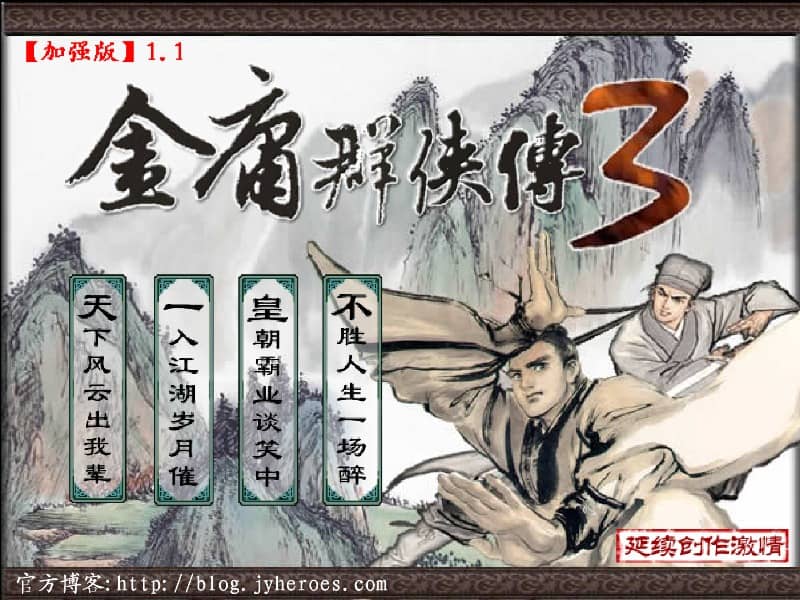
Beyond official works, numerous fan games have been inspired by Heroes of Jin Yong. One example is Jin Yong Legends 2, a 2006 Flash game by the creator known as Half Bottle of Fairy Vinegar, which found an audience through its homage to the original and its own ideas. These fan works show how the game's open-ended approach continued to give players and independent creators room to imagine new wuxia RPGs.