
Gameplay and design
The core gameplay of "Knights of the Round" is classic beat 'em up action, where players fight through side-scrolling stages, encountering various enemies and bosses along the way. Compared to Capcom's own "Final Fight," the biggest difference here is the introduction of a block and leveling system, making combat more than just button mashing, but adding a layer of strategy and rhythm. Players need to observe enemy attack timing, pull back on the joystick and press the attack button at the right moment to successfully block, granting brief invincibility and leaving enemies open. This mechanic is easy to learn but requires practice to master, offering a satisfying sense of achievement.
The leveling system is another standout feature. Characters accumulate experience during battles, and upon reaching certain thresholds, they automatically level up, with their weapons and armor visually changing and their attack and defense stats increasing. This RPG-like growth was uncommon in beat 'em ups at the time, giving players a clear progression goal and adding replay value. However, leveling is automatic, with no player choice in allocating points, serving more as a tool for designers to control difficulty and provide positive feedback.
Beyond standard attacks, each character has unique special moves. Arthur wields the holy sword, with a powerful slash as his special, covering a wide area with high damage; Lancelot is the fastest but slightly weaker, with a jumping kick that offers high mobility for closing in on enemies; Percival is the strongest but slower, using a battle axe that can perform a dash and a "giant swing" attack with devastating power. Players can choose their preferred character, and the distinct feel of each adds to the game's replayability.
Mounted combat is a highlight. Horses appear in stages, and when mounted, attack patterns change, and a quick double-tap forward makes the horse trample enemies for area damage. Riding makes characters more agile but also a target, requiring careful handling. Additionally, there's a "desperation attack" triggered by pressing attack and jump simultaneously, which clears most enemies on screen but costs one health bar. This move can be a lifesaver in tight spots, but timing is crucial since health is precious in arcade games.
The game features seven stages, each with distinct settings and enemy types, from forests and castles to dungeons, culminating in a showdown with the evil King Garibaldi. Regular enemies include sword-wielding soldiers, archers, and shield bearers, while boss battles test the player's use of blocking and special moves. The difficulty curve is well designed, easing players into the mechanics early on and demanding mastery of blocking and desperation attacks later. This balance makes the game challenging yet not frustrating, marking it as a mature work in Capcom's beat 'em up era.
Background and release
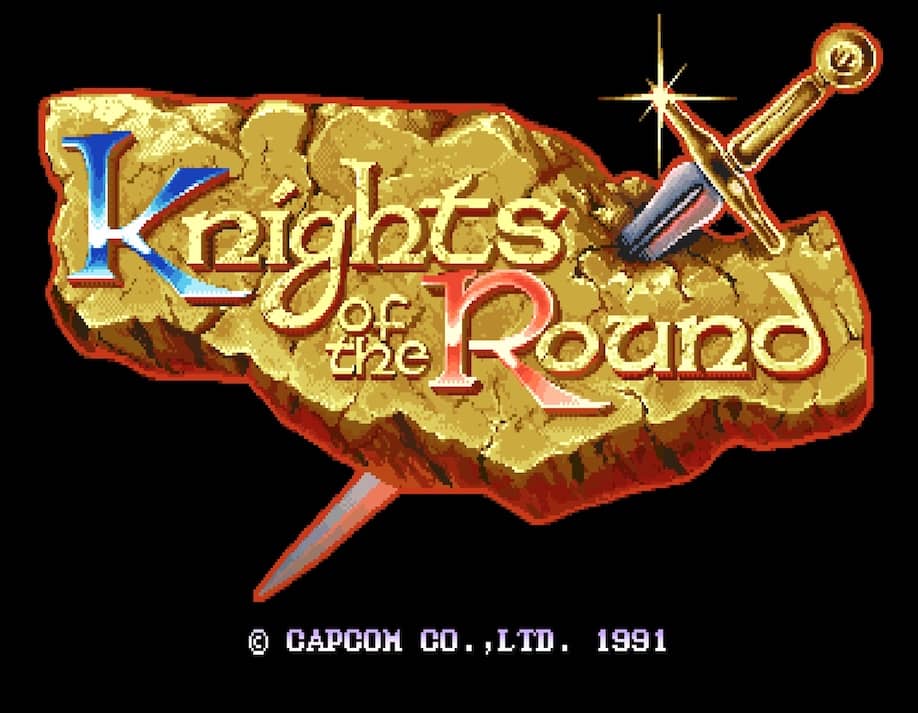
"Knights of the Round" was developed and released by Capcom in 1991, debuting on the CPS-1 arcade board. That era was the golden age of beat 'em ups, and Capcom had gained extensive experience with titles like "Final Fight." This game sought to blend classic medieval legend with proven arcade gameplay. Based on Arthurian lore, it tells the story of Arthur pulling the sword from the stone and, guided by Merlin, joining forces with fellow knights Lancelot and Percival to defeat the evil King Garibaldi. This European legend setting was distinctive among beat 'em ups of the time, which often leaned toward modern urban or fantasy themes.
After its arcade release, the game quickly gained attention in Japan and North America. According to industry magazines of the day, it was listed as one of the top two most popular arcade games in March 1992 by "Game Machine," ranked seventh by "Micom BASIC Magazine" in April, and sixth by North American "RePlay" magazine. While these charts reflect short-term popularity, they indicate the game's appeal in arcades. For a new IP, achieving such recognition suggested that its gameplay and theme resonated with players.
In 1994, Capcom ported "Knights of the Round" to the Super Nintendo (SFC). The SFC version retained the core gameplay but adapted graphics and controls, though hardware limitations reduced the number of on-screen enemies and overall smoothness. The port also introduced new modes or adjustments, but the experience fell short of the arcade original. Nevertheless, the SFC version allowed more home console players to enjoy the game, becoming a nostalgic memory for many. However, sales in Japan were only 5,225 units, a modest figure, possibly due to waning interest in beat 'em ups on home consoles by then.
Beyond the SFC port, "Knights of the Round" has been included in several Capcom compilations. In 2006, it appeared in "Capcom Classics Collection: Reloaded" for PSP and "Capcom Classics Collection Vol. 2" for PS2/Xbox; in 2018, the arcade version was part of "Capcom Beat 'Em Up Bundle" on modern platforms; and in 2022, it was included in "Capcom Arcade 2nd Stadium." These collections have made the classic accessible to new generations, underscoring its place in Capcom's history.
It's worth noting that the English title "Knights of the Round" translates directly to "圆桌骑士," but in Chinese-speaking communities, it is sometimes mistakenly called "圆桌武士," which actually refers to a different game. This confusion likely stems from similar translations, but the two games differ entirely in gameplay and theme. As an encyclopedia, we aim to clarify this to avoid misinformation. In Chinese, this game is commonly known as "圆桌骑士," which is the name used here.
Development
"Knights of the Round" was developed by Capcom using the mature CPS-1 arcade board. CPS-1, introduced in the late 1980s, was known for its vibrant colors and smooth character animations, having produced hits like "Final Fight" and "Street Fighter II." On this board, Capcom's developers had amassed considerable experience in action game design, and "Knights of the Round" was an innovation in both theme and mechanics. The game continued Capcom's high visual standards, with large character sprites, ample animation frames, and detailed backgrounds that created a rich medieval atmosphere.
In terms of gameplay design, "Knights of the Round" clearly drew inspiration from "Final Fight" and "Dungeons & Dragons." The former was Capcom's benchmark for beat 'em ups, while the latter introduced character growth and weapon systems. This game cleverly combined the two, preserving the satisfying action of beat 'em ups while adding depth through leveling and blocking. This design approach was not uncommon within Capcom at the time, but "Knights of the Round" excelled in balance and innovation, particularly with its block mechanic, which became its signature feature.
For character design, the game selected three iconic figures from Arthurian legend: Arthur, Lancelot, and Percival. Arthur, the protagonist, wields the holy sword Excalibur, with balanced abilities suitable for beginners; Lancelot is known for speed and agility, using a saber, with a jumping kick as his special, reflecting his legendary prowess as the greatest knight; Percival is portrayed as a powerhouse, using a battle axe with high attack but slow speed, and his "giant swing" attack fits his valiant image. This design respects the legends while serving gameplay, giving each character a distinct role.
During development, the team added interesting details. Mounted combat, for instance, was uncommon in beat 'em ups, but here horses are not just transportation but also participate in attacks, adding variety. The desperation attack was also a creative addition, offering a comeback opportunity at the cost of health, a risk-reward trade-off that reflects an understanding of player psychology in arcade design. These details show Capcom's dedication to the game.
Specific details about the development team and process are scarce, but the final product demonstrates Capcom's maturity in action game design. The game's performance on CPS-1 is exemplary, with smooth character animations and satisfying hit feedback, reaching top-tier standards of the time. While it didn't achieve the phenomenon status of "Street Fighter II," it holds a special place in the hearts of beat 'em up enthusiasts.
Reception and legacy
"Knights of the Round" received positive reviews upon release. Japan's "Gamest" magazine, in its sixth annual awards, ranked the game sixth for "Game of the Year" and sixth for "Player Popularity," reflecting its appeal among players. Western media also praised it; John Cook of "Sinclair User" noted that fans of "Golden Axe" would enjoy this game, highlighting its representation in the fantasy beat 'em up genre. Anthony Baize of AllGame called it a "solid" beat 'em up with "cool" characters, affirming its overall quality and character design.
On arcade charts, the game performed well. Beyond the short-term rankings mentioned earlier, a 1994 "Play Meter" equipment survey placed it fifty-first among arcade games. While not a top spot, considering the competitive market and the game's age of three years, its continued presence indicated lasting appeal. These achievements show that "Knights of the Round" succeeded both commercially and critically, becoming a classic in Capcom's beat 'em up lineup.
The SFC version received mixed reviews. GamePro's Andromeda praised the sprite quality but criticized the gameplay as slow and repetitive. This was largely due to hardware limitations that prevented the SFC from replicating the arcade's smoothness and enemy density, slowing the pace. However, some media and players viewed the SFC version positively; in 2018, Complex listed it among the best Super Nintendo games, suggesting it had merits. Despite modest sales, the SFC version allowed more players to experience the game.
In broader gaming culture, "Knights of the Round" has left its mark. In 2013, Heavy ranked it among the top 25 beat 'em ups of all time, reflecting its standing in the genre. In 2018 and 2022, the arcade version was included in Capcom compilations, allowing new players to enjoy the classic. These collections typically feature multiple games, but the inclusion of "Knights of the Round" indicates Capcom's recognition of its value, ensuring its continued availability in the digital age.
Overall, "Knights of the Round" is a beat 'em up that innovated in gameplay and stood out in theme. Its block mechanic and leveling system inspired later action games, and its Arthurian setting enriched the narrative dimension of beat 'em ups. While it didn't spawn a series like "Final Fight," it remains a gem from Capcom's golden era in the eyes of players. For fans of beat 'em ups, it's definitely worth a try.





