
Gameplay and design
The core gameplay of Lode Runner is simple and direct: players control a character moving through platform levels made of bricks and ladders, with the goal of collecting all the scattered gold. The amount of gold varies per level; once all is collected, a passage opens at the top of the level, and the character can walk through it to advance. It sounds easy, but enemies chase from all directions, making the collection process tense.
The game's most unique mechanic is digging. Players can dig a hole in the brick beneath their feet, and enemies that fall in are temporarily trapped, but the hole fills back up after a while, and the enemy respawns at the top of the level. This design lets players both escape pursuit and create new paths, but digging causes a brief pause, and mistiming it can put the player in danger.
The character cannot jump, but can fall from heights without taking damage, which is key to fast movement. Players start with five lives and earn an extra life for each level completed. The level design is clever; some gold is hidden in seemingly unreachable places, requiring digging and falling techniques to obtain, testing the player's observation and planning skills.
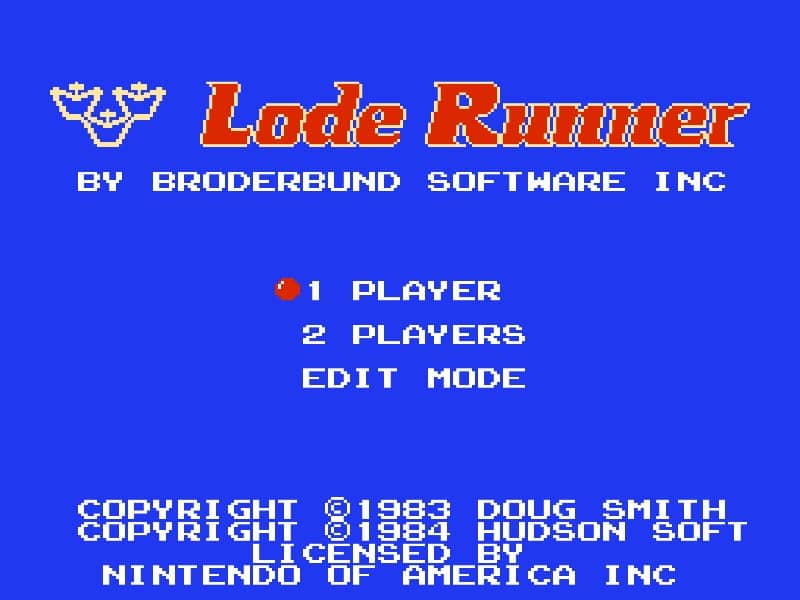
The Famicom version retains the core gameplay of the original but adds fruit and vegetable elements. Items like apples and carrots appear randomly in levels, and eating them grants bonus points. These items appear without a fixed pattern, adding a touch of randomness and making the visuals livelier.
The Famicom version also includes a built-in level editor, allowing players to design their own levels. However, the saving method varies by version: the Japanese version uses Family BASIC tapes for saving, while the North American NES version, lacking a tape drive, cannot save custom levels. This limitation means North American players can only experience the built-in 50 levels, but the editor's existence alone was exciting enough.
Background and release
The origins of Lode Runner trace back to 1980, when high school student James Bratsanas, inspired by the game Space Panic, wrote an early prototype called Suicide. This prototype already contained the basic concepts of digging and collecting gold, but it was still a rough draft.
In 1981, Bratsanas collaborated with Tracy Steinbeck to port the game to a university computer, and Douglas Smith later joined the development team. The game was briefly renamed Kong, clearly influenced by Donkey Kong, and later changed to Miner. These names reflect the game's evolution during its early stages.
In 1982, Smith created a playable version for the Apple II over a weekend using 6502 assembly language. Though crude, it already had the core gameplay. Smith brought it to Brøderbund, which initially rejected it, but when he submitted it again at Christmas 1982, he received offers from four publishers.
Brøderbund ultimately chose the name Lode Runner and paid an advance of $10,000 for pixel animation and 150 levels. Smith used his own level editor to design levels and invited friends and neighbors to contribute, making the original game exceptionally rich in content.
The original computer game was released on June 23, 1983, for the Apple II, Atari 8-bit, VIC-20, Commodore 64, and IBM PC. The Famicom version was released by Hudson Soft in 1984, and the North American NES version followed in 1986, making it one of the early third-party games.
Development
Douglas Smith recognized the importance of a level editor when developing the Apple II version. He not only used the editor to design game levels but also invited friends and neighbors to participate, greatly enriching the diversity of level designs. This open design approach was uncommon at the time and added a unique charm to the game.
When Hudson Soft took on the Famicom version, they faced the challenge of adapting a computer game for a home console. They kept the core gameplay but changed the graphics to a more cartoonish style and added scrolling screens and music. These changes made the game more appealing to Famicom players and distinguished it from the computer original.
The Famicom version reduced the number of levels from the original 150 to 50, to accommodate the storage and performance limits of the console. Although there were fewer levels, Hudson Soft maintained high standards in level design, with each level carefully crafted and a reasonable difficulty curve.
The implementation of the editor in the Famicom version was a technical highlight. The Japanese version used Family BASIC tapes as storage media, allowing players to save their custom levels. The North American NES version, due to hardware limitations, could not save levels, which became a significant difference between the two versions.
Hudson Soft also added fruit and vegetable bonus elements during the adaptation, which were not in the original. These randomly appearing items not only increased the game's fun but also reflected Hudson Soft's understanding of Famicom players' preferences. These changes made the Famicom version a work with its own distinct character, rather than a simple port.
Reception and legacy
Lode Runner achieved great commercial success. The original computer game became the best-selling computer game in the United States in 1983, with sales exceeding 300,000 copies by August 1984. The Famicom version also performed well in Japan, selling about 1.5 million copies by 1999, and all versions combined sold over 3 million copies worldwide.
The game received positive reviews from the media upon release. Softline in 1983 praised the game as "smooth, thoughtful, and addictive," and specifically commended the level editor. Computer Gaming World called it "one of the few arcade games for thinkers" and held a reader contest for custom levels, showing the editor's appeal.
PC Magazine gave the game a high score of 16.25 out of 18, calling it "a masterpiece of American ingenuity." In 1984, the game won the "Computer Game of the Year" award at the 5th Arkie Awards, further cementing its classic status.
Lode Runner left a lasting impact on subsequent games. It proved that a level editor could be a core selling point, inspiring many later titles. Additionally, its digging mechanic and platform-puzzle gameplay have been borrowed by several games, making it an important reference for the action-puzzle genre.
The success of the Famicom version brought great prestige to Hudson Soft and also drove the development of the Lode Runner series. Although this game is the beginning of the series, its design philosophy and gameplay essence continued in later installments, influencing an entire generation of players and developers.





