Gameplay and design
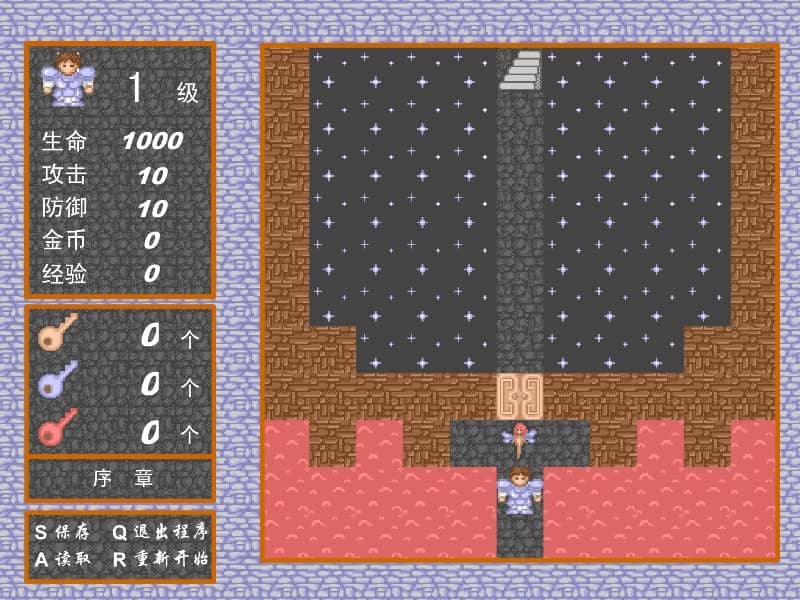
The core gameplay of 《魔塔 1.1》 is a fixed-value RPG, meaning that battles, enemies, and resources are all predetermined and do not vary randomly. Players control a warrior navigating the tower, and every encounter with a monster yields a deterministic outcome, with damage calculable through formulas. This design makes the game more like a puzzle-solving process, requiring careful planning of each step rather than relying on luck.
The controls are simple: arrow keys move the warrior, the spacebar or numpad 5 confirms actions, and numpad 8 and 2 handle up and down selections. This control scheme is common in Flash games, easy to pick up, but the game itself is far from easy. Players must manage limited resources, strategically deciding the order of battles and item usage to clear the tower.
Resources in the tower include health potions, gems, keys, gold, and experience points, all with fixed locations and quantities. Keys come in yellow, blue, and red, unlocking correspondingly colored doors, while gems boost attack or defense, and potions restore health. Players must budget carefully, as resources are finite; wasting them could make later enemies unbeatable.
The combat system is a typical example of fixed-value RPG, with no random elements; players know the outcome and losses before engaging. This design imbues the game with strategic depth, as players must decide which monsters to fight first, which to avoid, based on enemy attributes and their own status. Every decision can impact subsequent progress, often requiring repeated attempts.
The goal is to ascend floor by floor, ultimately reaching the top to rescue the princess. Each floor presents different enemies and puzzles, requiring exploration to collect keys and items that open doors to the next level. This progressive structure allows players to grow through challenges while experiencing the tower's oppressive atmosphere and the satisfaction of overcoming it.
Background and release
The Magic Tower series originated from MS-DOS games on the PC-98 platform in Japan, and this installment is a significant part of the Chinese Magic Tower lineage. In 2003, Fat Mouse Studio released the first Chinese version of Magic Tower, featuring 21 floors excluding the prologue, laying the groundwork for subsequent versions. As version 1.1, this game was released in 2004, increasing the floor count to 24, making it a key version for Chinese players at the time.
This version is distinct from the Flash version translated by a Wenzhou netizen in January 2004, which is a separate work. Fat Mouse Studio's version gained wider circulation among Chinese Magic Tower players, with its floor adjustments and content refinements making it a classic. The year 2000 noted in the local directory is incorrect; the actual release year is 2004, a point worth noting.
This game is part of Fat Mouse Studio's Magic Tower series, which also includes version 1.2. Both 1.1 and 1.2 were released in 2004, but 1.1 served as an intermediate version, expanding floors from 21 to 24, providing a transition to later versions. This change enriched the game's content and reflected the studio's responsiveness to player feedback.
The core definition of Magic Tower games is fixed-value RPG, and this installment perfectly embodies that trait. Unlike later player-created Magic Tower variants, this game retains the classic plot of a warrior rescuing a princess, though the genre has since evolved into many forms. This version holds a pivotal position in Chinese Magic Tower history, inheriting the essence of the original while laying a foundation for future innovations.
On Wikipedia, this game is categorized as a Chinese version of Magic Tower, released by Fat Mouse Studio. Although specific developer information is not detailed, the studio was active from 2003 to 2004, promoting the popularity of Magic Tower in China. This version differs significantly from the Japanese original and the English 50-floor version, serving as an important entry point for Chinese players.
Development
This game was developed by Fat Mouse Studio, but specific developer details are not specified in available sources, with the local directory listing it as UNKNOWN. Nevertheless, after releasing the first Chinese Magic Tower in 2003, the studio gained experience and quickly followed up with versions 1.1 and 1.2 in 2004, demonstrating notable development efficiency.
This is a Flash platform game, though Wikipedia does not mention the development tools used. Flash was a mainstream technology for web games at the time, easy to distribute, which helped Magic Tower spread rapidly among players. Fat Mouse Studio's choice of Flash likely stemmed from its convenience and broad compatibility.
Released in 2004 alongside version 1.2, version 1.1 served as an intermediate release, with the primary change being an increase in floors from 21 to 24. This adjustment may have been driven by player expectations for longer content or by the studio's balancing efforts. The added floors altered the game's pacing and difficulty distribution.
During development, the studio likely drew on the Japanese original and feedback from early Chinese versions. The fixed-value RPG design required significant effort in numerical balancing to ensure the game was both engaging and challenging. The resource distribution and enemy placement in this version reflect such meticulous design.
Although there are no detailed behind-the-scenes stories, the production context highlights characteristics of early Chinese game development: small teams, rapid iteration, and reliance on the Flash platform. Fat Mouse Studio's quick release of multiple versions showcased their passion for the Magic Tower genre and laid the groundwork for future Chinese Magic Tower games.
Reception and legacy
As a significant version of the Chinese Magic Tower, this game influenced the development of subsequent Magic Tower titles. By increasing the floor count from 21 to 24, it enriched the content and provided players with a longer challenge. Many players first encountered Magic Tower through this version and developed an interest in fixed-value RPGs as a result.
On Wikipedia, this game is classified as a fixed-value RPG, reflecting the core characteristics of Magic Tower games. This genre emphasizes strategy and planning over reaction speed, appealing to puzzle enthusiasts. The combat and resource management mechanics in this version became a reference template for later Magic Tower games.
This version is distinct from the Flash version translated by a Wenzhou netizen in January 2004, which is a separate work. Such distinctions help players understand the diversity within Chinese Magic Tower. This version enjoys high recognition in the Chinese Magic Tower community, and despite lacking specific sales or review data, its impact is undeniable.
In the AllGamesGo local directory, this game is ranked 35, with the platform listed as FLASH, and is described as a classic Flash puzzle-adventure game. This ranking reflects its standing among similar games. Players must climb floor by floor, battling, collecting keys and items, and managing resources to reach the top and rescue the princess—a gameplay loop still fondly remembered by many.
While Wikipedia does not mention specific sales or review figures, the game's existence itself attests to the vitality of the Magic Tower genre. As part of Fat Mouse Studio's Magic Tower series, this version, along with 1.2, constitutes an early classic of Chinese Magic Tower, inspiring later player-created Magic Tower games.