
Gameplay and design
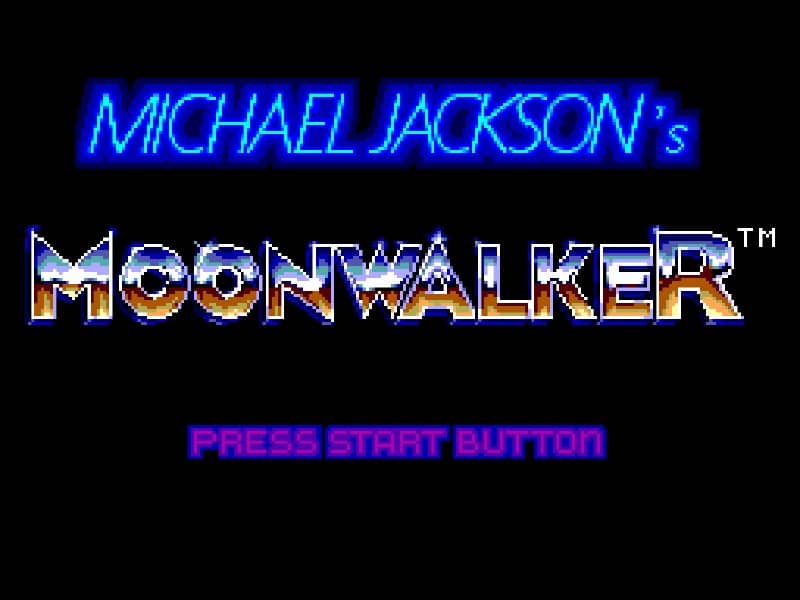
The Master System version of Michael Jackson's Moonwalker is a side-scrolling platform action game where players control Jackson through levels with the goal of rescuing children kidnapped by Mr. Big. Unlike the arcade version's isometric beat 'em up, the console version is closer to a traditional side-scroller, emphasizing a combination of jumping, climbing, and combat. This design lets players experience Jackson's stage moves more directly, rather than fighting crowds of enemies in open areas as in the arcade version.
Jackson's attacks are distinctive: his standard attack is a high kick from his dance routine, smooth and rhythmic. Holding the attack button and moving backward makes Jackson perform the moonwalk, a signature move that not only looks great but also allows for agile positioning in combat. His special attack involves spinning and throwing his hat; when charged, it makes enemies dance and take damage, but it costs health. These mechanics weave Jackson's dance elements into combat, making players feel like they're defeating enemies with dance steps.
Rescuing children is the core objective, and each child saved restores health, encouraging exploration. In the Master System version, after rescuing all children, the game moves directly to a final phase with an enemy rush, without the guidance of Bubbles (Jackson's pet chimpanzee) as in the Mega Drive version. This difference makes the Master System version more streamlined but also less guided, requiring players to figure out their next move.
The Master System version also has a unique mechanic: after rescuing a specific child and catching a comet, Jackson can transform into a robot. In this form, his abilities are greatly enhanced, with improved attack and movement speed, adding a sci-fi element. Although this feature isn't closely tied to the film, it serves as a reward that adds freshness to repeated playthroughs.
The game's music consists of synthesized versions of Jackson's songs, including tracks from the Bad and Thriller albums. These melodies enhance the atmosphere and make players feel more immersed. However, the Master System's sound and music are limited by hardware, sounding thinner compared to the Mega Drive version, but they still evoke memories of Jackson's classic works.
Background and release
Michael Jackson's Moonwalker originated when Michael Jackson contacted Sega in 1988, wanting to develop a game themed around himself. At the time, Jackson was at the peak of his career, with his music and dance captivating the world, and Sega was influential in the gaming industry. This collaboration led to the development of both arcade and console versions, with Jackson himself participating in the game design to ensure it reflected his artistic style.
The game's story is loosely adapted from the Smooth Criminal segment of the film Moonwalker, where Jackson must rescue children kidnapped by Mr. Big. Classic scenes and characters from the film are incorporated, but the story is simplified to fit the gameplay. Players control Jackson not only to fight but also to find clues in levels, making the game feel like an interactive movie.
In 1990, the Master System version was released alongside the Mega Drive version. The console versions were based on the evolved gameplay of the home computer version, completely different from the arcade version's three-quarter view shooting and fighting. Sega adjusted the game design for each platform: the Master System version focused on side-scrolling action, while the arcade version emphasized multiplayer cooperation and beat 'em up gameplay. This differentiation strategy was common at the time.
The arcade prototype was exhibited at the AAMA show in Mexico in early July 1990, but the exact release date of the Master System version is not specified in available sources. However, from the timeline, the console versions were developed almost simultaneously with the arcade version, yet their gameplay differs greatly. Sega clearly aimed to cover different player groups: arcade players enjoy fast-paced fighting, while console players prefer single-player storylines.
The song selection also varied by platform, with the arcade, console, and computer versions featuring different tracks. The Master System version included synthesized versions of classics like Bad and Thriller, which not only enhanced the game's atmosphere but also became a major selling point. For Jackson fans, hearing these melodies in a game was a draw in itself.
Development
During the development of Michael Jackson's Moonwalker, Sega received assistance from Jackson himself. Jackson not only participated in the game design but also offered suggestions on character movements and level styles. Such deep collaboration was rare in the gaming industry at the time and gave the game a personal touch. Sega's developers worked to translate Jackson's dance moves into game controls, ultimately achieving iconic moves like the high kick and the moonwalk.
The Master System and Mega Drive versions differed during development. The Mega Drive prototype is dated April 24, 1990, and includes the full Thriller track and a different final boss battle. The Master System version, however, lacks the Bubbles indicator and has different level designs. These differences may stem from hardware performance gaps and Sega's considerations of player needs on different platforms.
The prototype version was preserved online by Landon White on August 6, 2018, providing valuable material for researchers. By comparing the prototype and final versions, one can see the development team's efforts in balancing gameplay and adjusting content. For example, the Thriller track in the prototype may have been replaced or adjusted in the final version to fit the capacity limits of different platforms.
During development, Sega also faced the challenge of balancing game difficulty and entertainment. The Master System version, targeting a younger audience, had a relatively friendly difficulty but still offered a challenge. Jackson fans might focus more on the music and character, while general players care about controls and level design. Sega found a balance between the two.
It's worth noting that Jackson maintained a long-term collaboration with Sega, making cameo appearances in Space Channel 5 and Space Channel 5: Part 2, and appearing as a secret character in Ready 2 Rumble Boxing: Round 2. These collaborations show that Jackson's interest in the gaming medium was not a fleeting whim but a sustained commitment, making Moonwalker the starting point of his gaming career.
Reception and legacy
Michael Jackson's Moonwalker received considerable attention upon release, but reviews varied by platform. The Mega Drive version garnered more positive reviews, with MegaTech calling it an "addictive platform game" and praising its "excellent graphics," while Mega magazine ranked it as the 91st best Mega Drive game of all time but rated it "average." In contrast, the Master System version received fewer reviews, possibly due to the platform's smaller market share, but the game still had some influence.
In 2004, the Genesis version of Moonwalker was included in GameSpot's "Greatest Games of All Time" list, showing its place in players' hearts. Although the Master System version did not receive this honor, as a derivative work of the same IP, it contributed to the overall reputation of the game. For many players, being able to play a Jackson game on the Master System was a joy in itself.
The arcade version achieved commercial success in North America, becoming the highest-grossing new game on the RePlay arcade chart in September 1990 and receiving positive reviews from RePlay magazine. The arcade version's success boosted attention for the console versions, but the Master System version did not fully replicate that success. Nevertheless, it added a distinctive title to Sega's 8-bit lineup.
The game's impact extended beyond commercial success; it demonstrated the potential of combining celebrity IP with gaming. Jackson's involvement elevated the game beyond a mere adaptation, making it a cultural symbol. Players could not only enjoy action but also feel the charm of Jackson's music and dance. This cross-industry collaboration was later emulated by many games, but Moonwalker is undoubtedly one of the early success stories.
Looking back at Michael Jackson's Moonwalker, the Master System version may not be as well-known as the Mega Drive version, but it holds a unique place in the side-scrolling action genre. It proves that even with hardware limitations, creativity and collaboration can produce appealing works. For Jackson fans and retro gaming enthusiasts, this game is a classic worth trying.





