Gameplay and design
Mother3's gameplay continues the series' tradition of top-down exploration and turn-based combat, but adds a new music-based combo system that makes battles more engaging. Players control the protagonist Lucas as he moves across a vast map, entering battle upon contact with enemies. Battles use a first-person perspective, with enemies rendered as distorted animations in the background, a visual style that preserves the series' quirky charm while heightening the tension of combat.
The rolling HP system, a signature feature of the series, returns in this installment. When a character takes damage, their HP does not decrease instantly but rolls down rapidly like a taxi meter. As long as the player heals or ends the battle before HP reaches zero, the character can avoid falling. This mechanic gives players a chance to turn the tide in critical moments and makes the battle pace more thrilling, requiring quick decisions as the numbers tick down.
The music-based combo system is the game's most distinctive innovation. During normal attacks, a beat bar appears at the bottom of the screen, and players must press the A button in time with the background music. Successfully hitting the beats allows the attack to continue, with a maximum of 16 hits. This design tightly integrates music with combat, making battles feel like playing a tune. However, the timing is strict, requiring players to be familiar with each battle track, which adds challenge and fun.
Character growth follows the traditional experience point leveling system: defeating enemies grants experience, and leveling up improves stats. The equipment system allows players to strengthen characters by purchasing or finding weapons, armor, and accessories, some of which have special effects, such as resistance to certain status ailments. The game features a wide variety of items, including those that restore HP, PP (Psychic Points), and cure status conditions; using items wisely is key to battle.
Exploration and recovery mechanics also retain the series' charm. Save frogs are scattered across the map; talking to them saves progress and provides hints. Hot springs are another recovery facility, fully restoring HP and PP for a small fee. These designs let players adjust their status at any time during the adventure and preserve the series' lighthearted humor, such as the save frogs' witty remarks and the comfort of the hot springs.
Background and release
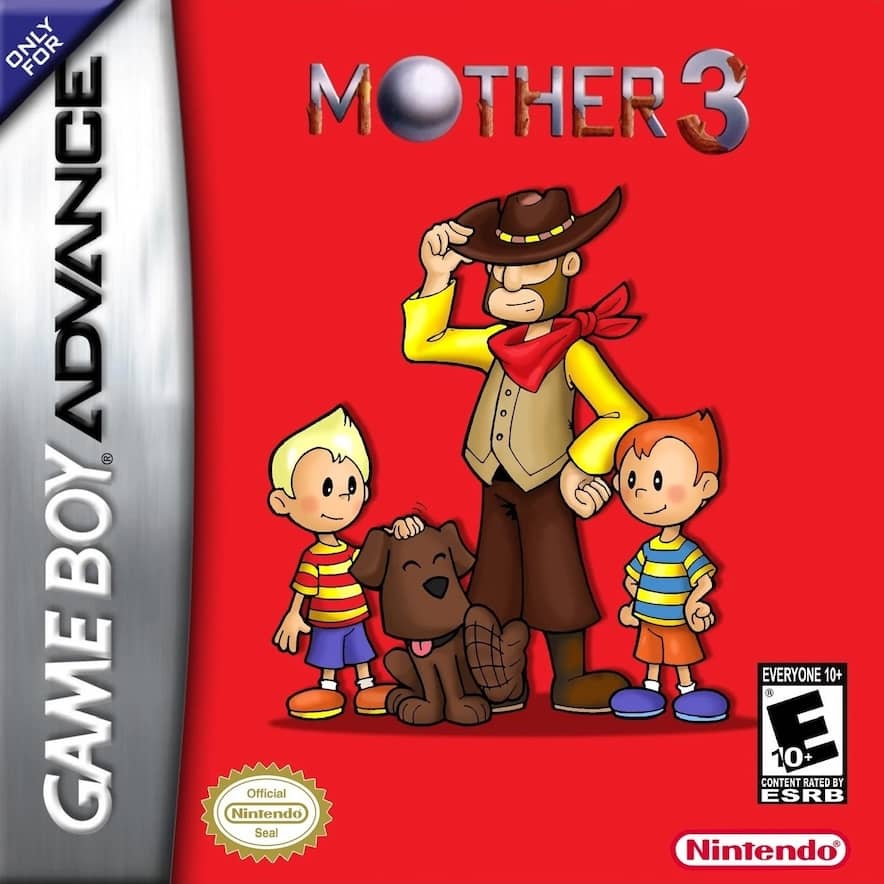
Mother3 is set on the fictional Nowhere Islands, an isolated archipelago where residents live peaceful lives. The protagonist, Lucas, is a boy with psychic abilities who lives with his twin brother Claus, his mother Hinawa, and his father Flint in the tranquil village of Tazmily. However, the Pig Mask Army shatters this peace, bringing mysterious powers and mechanized forces in an attempt to transform the islands into a highly industrialized society.
The game's story is divided into eight chapters, each told from a different character's perspective, gradually revealing the truth of the whole narrative. The first chapter follows Flint, Lucas's father, as he searches for his missing son after the death of his wife Hinawa, a tale filled with grief and anger. Subsequent chapters shift to Lucas's growth as he masters his psychic abilities and meets companions Duster, Kumatora, and Boney, together fighting against the Pig Mask Army.
The leader of the Pig Mask Army is Porky, the antagonist from the previous game in the series, Mother 2, who returns in this installment. Porky uses technology and brainwashing to control the populace, aiming to create a 'happy' society under his rule. Lucas and his friends' resistance is not only against tyranny but also a quest for their own destinies. In the story, Lucas's brother Claus is transformed into an enemy, and the brotherly confrontation becomes the climax of the plot, steeped in tragedy.
The game's themes are more mature and dramatic than its predecessors, touching on environmental destruction, capitalism, consumerism, loss, and grief. The industrialization brought by the Pig Mask Army gradually pollutes and commercializes the once-pristine islands, vividly depicted through scenes and NPC dialogue. The pain of losing loved ones, the cost of growing up, and the longing for peace intertwine, giving the story strong emotional resonance.
In terms of narrative style, the game retains the series' blend of humor and warmth, but the overall tone is heavier. Shigesato Itoi excels at using everyday details and dialogue to shape characters, allowing players to feel deep sorrow within a lighthearted atmosphere. Many scenes, such as Lucas's memories of his mother and the changes in the village, are moving. This fusion of joy and sadness is what makes Mother3's story most touching.
Development
The development of Mother3 is a legendary tale in gaming history, beginning in 1994 with an initial plan for the Super Famicom (SNES). After completing Mother 2, Shigesato Itoi began conceptualizing a sequel under the project name 'EarthBound 64.' However, with the release of the Nintendo 64, the development team decided to shift to the new platform and planned to use the 64DD expansion device, but technical challenges and platform transitions caused repeated delays.
In 2000, Nintendo officially canceled the 'EarthBound 64' project, despite a significant amount of content already being developed. Reasons for cancellation included the lengthy development cycle, high costs of platform transition, and internal team adjustments. Itoi later recalled feeling regret at the cancellation but did not abandon the story's concept. It wasn't until 2003 that Nintendo decided to restart the project on the Game Boy Advance, with Brownie Brown and HAL Laboratory co-developing, and Itoi continuing as writer and director.
The restart went relatively smoothly, but Itoi's dedication to the script and details still posed challenges for the team. He insisted that the game's 'Love Theme' be playable with one finger on a piano to convey simple, pure emotion. The music was composed by Shogo Sakai, who created a variety of tracks according to Itoi's instructions, preserving the series' signature melodies while incorporating new elements. Sakai's score aligns perfectly with the game's emotional tone, becoming a highlight of the work.
Initially, the game was planned to have 12 chapters, but this was eventually reduced to 8. Itoi mentioned in interviews that the adjustment was to tighten the story's pacing and avoid unnecessary length. The game's title also underwent several changes, starting as 'Forest of the Chimeras,' then 'The End of the Pig King,' before finally dropping the subtitle and settling on 'MOTHER3.' These changes reflect Itoi's ongoing reflection on the core of the story.
Producer Shigeru Miyamoto and Satoru Iwata were also involved in the project, providing support to the development team, especially in technical implementation and project management. Iwata, during his time at Nintendo, kept an eye on the project and helped push it to completion. The game was released in Japan on April 20, 2006, 12 years after its initial conception, spanning four platforms: SNES, N64, 64DD, and GBA. This lengthy development history has made Mother3 a 'dream come true' for many players.
Reception and legacy
Upon its release in Japan, Mother3 sold approximately 200,000 copies in its first week, and over 368,000 copies throughout 2006, ranking 36th in Japan for the year. This was a solid performance for a late-GBA title, demonstrating the loyalty of the series' fans. The game received a high score of 35/40 from Famitsu, entering the Platinum Hall of Fame. Reviewers generally praised its story, graphics, and music, but opinions on the battle system were divided, with some players finding the music combo system too strict.
The game was never officially released outside Japan, a topic of long-standing discussion in the player community. Nintendo never gave an explicit explanation, but it is widely believed to be due to localization costs, cultural differences, and the series' poor sales overseas. This absence fueled fan translation efforts. On October 17, 2008, Starmen.net released an unofficial English translation patch, led by Clyde 'Tomato' Mandelin, which took two years and translated approximately 1,000 pages of game script. The patch was downloaded over 100,000 times in its first week, allowing players worldwide to experience the game.
The fan translation patch had a profound impact, not only bringing Mother3 to a wider overseas audience but also sparking discussions about localizing other series entries. Many players discovered the series through this patch and became fans of Mother. The translation quality was so high that some media called it 'official-level fan localization.' This patch became a landmark event in game localization history, showcasing the power of the player community.
In the Super Smash Bros. series, Lucas appears as a playable character, starting with Super Smash Bros. Brawl and continuing in subsequent titles. His inclusion introduced many players to Mother3, even though the game itself was not released overseas. Lucas's moves in the game, such as PK Fire and PK Freeze, originate from the original, which also made fans feel a sense of familiarity.
Itoi has repeatedly stated that he has no plans for a fourth installment in the series, so Mother3 is considered the series' conclusion. Nevertheless, the game's influence has not waned; it frequently appears on lists of 'most wanted remakes or localizations.' In 2015, the game was re-released on the Wii U Virtual Console in Japan, and in 2024, it was made available again through the Nintendo Classics service, allowing a new generation of players to experience it. For many, Mother3 is not just a game but a memory of waiting, love, and the power of community.