
Gameplay and design
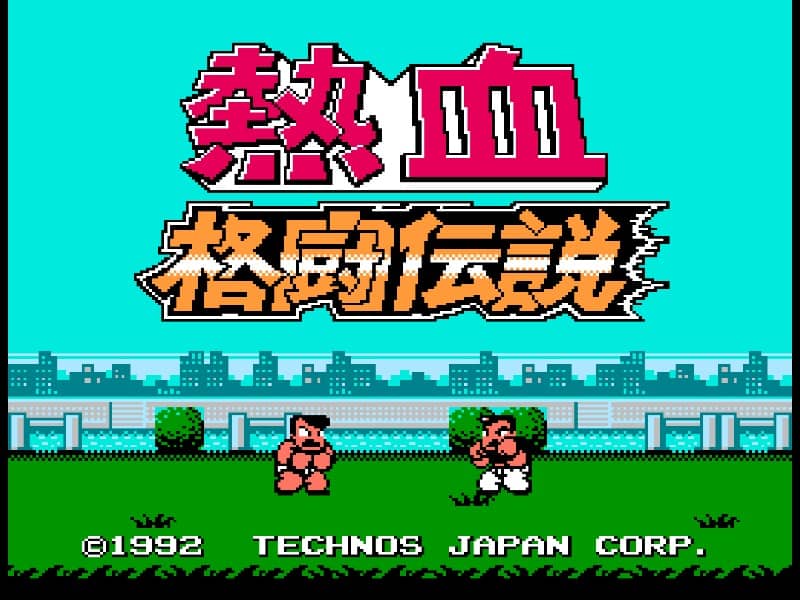
At its core, Nekketsu Kakutou Densetsu is a 2D fighting game where players control characters from the Kunio-kun series and battle opponents in a ring. The controls are similar to other fighting games of the era, with basic moves like punches, kicks, jumps, and blocks, but it adds the series' signature over-the-top style. For example, characters can pick up weapons scattered around the arena or use the environment to their advantage. This blend of competitive fighting and chaotic fun gives the game a unique personality.
The most striking feature is its support for up to four players simultaneously, which was unprecedented on the Famicom. However, to enjoy four-player matches, players needed to purchase a third-party multitap adapter, as Nintendo never released an official one for the system. This limitation raised the barrier to entry, but for those who could gather the necessary equipment, it offered a chaotic multiplayer experience that remains a frequent topic of discussion among fans.
The game offers several modes, including a single-player story mode and a free-for-all mode for multiplayer. In story mode, players fight through a series of opponents to reach a final boss, while free mode allows quick matches against friends. This design caters to both solo players and party groups, making the game enjoyable in various settings.
Character selection is a highlight, featuring many classic Kunio-kun characters such as Kunio and Riki, each with unique stats and special moves. While the differences between characters are not as pronounced as in later fighting games, the varied attributes and special attacks add a layer of strategy to character choice. This integration of series characters into a fighting game appeals to longtime fans and brings fresh energy to the genre.
The game's graphics on the Famicom are also noteworthy. Despite hardware limitations, the characters animate smoothly, and the stages are rich in detail, with settings ranging from school rooftops to city streets, all filled with iconic Kunio-kun elements. These visual efforts help immerse players in the game's world even during intense battles.
Background and release
Nekketsu Kakutou Densetsu was released in Japan on December 23, 1992, developed and published by Technōs Japan. The game came out near the end of the Famicom's life cycle, after Nintendo's 16-bit console, the Super Famicom, had already launched, but the Famicom still had a massive user base. Technōs Japan chose this time to release a fighting game, both to tap into the remaining market potential and to showcase their technical prowess.
As a spin-off of the Kunio-kun series, this game differs from other entries. The series had previously focused on beat 'em up games like Nekketsu Kouha Kunio-kun (Renegade) and Nekketsu Monogatari (River City Ransom), but Nekketsu Kakutou Densetsu shifted to a fighting game format. This genre change offered a fresh experience for series veterans and attracted fighting game enthusiasts. It was a bold experiment for the series.
This was also Technōs Japan's first attempt at a fighting game after porting Double Dragon to the Famicom. The company was known for action games, especially the Double Dragon series, which had achieved great success in Western markets. The experience gained from porting Double Dragon laid the groundwork for developing Nekketsu Kakutou Densetsu.
At the time, the fighting game boom was sweeping Japan, fueled by the popularity of Street Fighter II, and many developers saw the genre's potential. Technōs Japan was no exception, but creating a fighting game on the Famicom came with significant hardware constraints. Despite these challenges, the game stood out among other fighting games thanks to its unique multiplayer feature, becoming a classic for Famicom players.
The game's release during the year-end shopping season reflected Technōs Japan's confidence in the title. Although it was never officially released in Western regions, its popularity in Japan helped the company gain experience that later contributed to titles like Double Dragon on the Neo Geo. This game marks an important milestone in Technōs Japan's fighting game history.
Development
Nekketsu Kakutou Densetsu was developed by Technōs Japan, a company that later became known for its fighting games on the Neo Geo, such as Double Dragon and Voltage Fighter Gowcaizer. As an early attempt in the genre, many of its design concepts and technical methods were refined and expanded in later works. In many ways, this game served as a testing ground for Technōs Japan's fighting game technology.
Implementing four-player simultaneous play on the Famicom was the biggest technical challenge. Since Nintendo never provided an official multitap, the development team had to rely on third-party adapters. This meant the game had to be compatible with various adapters while maintaining smooth graphics and performance with four players on screen. This technical breakthrough demonstrated the team's deep understanding of the hardware's potential.
The development team made full use of the Famicom's hardware features. For example, they carefully designed character sprites and background layers to deliver rich visuals within the limited memory. To handle the chaos of four-player battles, they fine-tuned collision detection and hit detection to ensure fairness and fun. These technical details, though invisible to players, were crucial to the game's quality.
As a spin-off, the game borrowed many characters from the existing Kunio-kun series, but the team adapted them for fighting. Each character was given moves and stats suited for combat, allowing them to have distinct fighting styles. This approach satisfied fans' expectations and added variety to the game.
The development process was not smooth sailing. Due to hardware limitations, the team faced difficulties in achieving four-player simultaneous play, such as allocating limited CPU resources and preventing screen flicker. However, through clever programming and optimization, they managed to pull off what seemed nearly impossible at the time. This technical dedication became a key factor in Technōs Japan's later success in the fighting game genre.
Reception and legacy
Upon release, Nekketsu Kakutou Densetsu attracted attention for its unique four-player simultaneous battle feature. Although limited by hardware and accessories, those who experienced four-player matches praised the lively and chaotic fun. On the Famicom, it became a popular party game, and many players still fondly remember playing it with friends.
The game holds a place in fighting game history, proving that multiplayer fun could be achieved on low-performance hardware. This innovative spirit influenced many later games, especially Technōs Japan's own works on the Neo Geo, such as Double Dragon, which inherited some of its design ideas. It can be considered a pioneer of four-player fighting games on the Famicom, setting an example for future titles.
Since the game was initially released only in Japan, Western players were unable to experience it for a long time. That changed on February 20, 2020, when it was included in the Double Dragon & Kunio-kun Retro Brawler Bundle, released by Arc System Works for Nintendo Switch and PlayStation 4, with English localization for the first time. This allowed players worldwide to enjoy this classic and brought new recognition and reviews from Western audiences.
In the 2020 bundle, the game appeared alongside other Kunio-kun series titles as a representative entry. For old fans, it was a nostalgic trip; for new players, it was a chance to discover a classic. After the bundle's release, the game received positive feedback, with many praising its multiplayer fun and unique character appeal, noting that it remains playable even today.
The game's impact extends beyond itself, as it helped sustain the Kunio-kun series' vitality. Although Technōs Japan later went through bankruptcy and restructuring, the characters and gameplay of the Kunio-kun series are still beloved by many. As a gem of the series, its groundbreaking multiplayer design is still frequently discussed, leaving an indelible mark on the Famicom era.





