
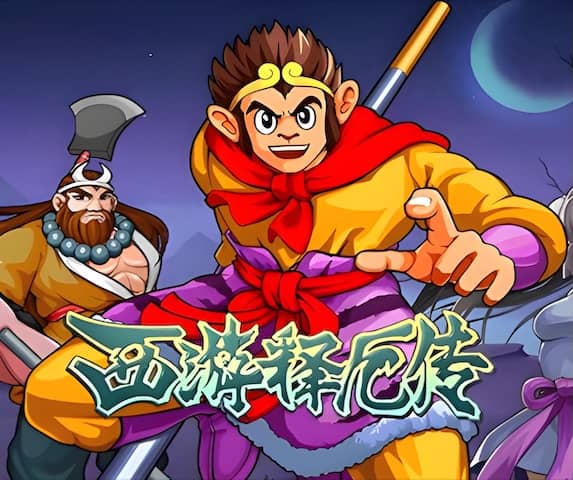
Gameplay and design
The core gameplay of Oriental Legend is side-scrolling beat 'em up action, where players control a character to fight through stages, defeating enemies and bosses along the way. The game blends Chinese mythology and fantasy elements, with settings ranging from mountain forests to caves, and enemies mostly being demons and monsters, which adds to the immersion. Controls include basic punches and kicks, as well as jumping, dashing, and special moves, offering a solid feel and fast pacing typical of 1990s arcade action games.
The game's most distinctive feature is the Five Elements system. The five characters correspond to the elements: Sun Wukong is Fire, Zhu Bajie is Earth, Sha Wujing is Water, Dragon Horse is Wood, and the Dragon Girl is Metal. This differs from the original novel's attributes, being the game's own design. In battle, enemies also have elemental attributes, and attacking with a counter element deals more damage, while the opposite is less effective. This adds a layer of strategic consideration when choosing characters and facing enemies.
The item system is another highlight. Most items have elemental properties, such as fire torches and water orbs. Players can pick up items and use them against enemies' weaknesses for greater effect. Timing and usage are up to the player; using them well can turn the tide, while poor use may waste resources. This design adds tactical depth beyond the fast-paced combat.
The combined special move is the game's most distinctive two-player mechanic. When two players are on screen and both have full power gauges, they can unleash a combined attack. Different character combinations produce different effects and deal significant damage, making it a powerful tool for clearing crowds and defeating bosses. This mechanic encourages cooperation and enhances the fun of two-player arcade play, a fond memory for many veteran players.
The game's overall difficulty is high, but the design is well-balanced. Enemy attack patterns are varied, and boss battles test players' reflexes and strategy. The Five Elements and item systems provide tools, but they require skillful execution and planning. This 'challenging but beatable' experience is what makes arcade games appealing, and it sets Oriental Legend apart among beat 'em ups.
Background and release
Oriental Legend was released in 1997 for arcades, with the English name 'Oriental Legend'. It was developed by Taiwan's IGS and was the first side-scrolling action game on their self-developed PGM board. In the mid-to-late 1990s, the arcade market was dominated by Japanese companies, so IGS releasing a high-quality action game of their own was significant.
The game's version history is noteworthy. The 105 version from 1997 was the earliest, followed by versions 111, 112, and 126. These versions made minor adjustments, such as bug fixes and character balance tweaks, but the core gameplay and content remained largely the same. For players, the differences between versions may be small, but the version numbers reflect the game's enduring presence in arcades.
The creation of Oriental Legend relied on IGS's technical expertise. In 1996, IGS successfully developed the 2D arcade board PolyGame Master (PGM), marking the first time a company outside Japan had its own arcade system board in Asia. The PGM board provided a solid hardware foundation for IGS's subsequent games, and Oriental Legend was the first side-scrolling action game on this board.
In terms of content, Oriental Legend is adapted from Journey to the West, one of China's four great classical novels, but it is not a direct adaptation. The game features classic episodes and characters from the journey, but adds an original character, the Dragon Girl, and makes its own choices in attribute settings. This approach makes the game familiar to fans of the novel while offering novelty, contributing to its success.
From 1996 to 1999, the PGM platform saw the release of several excellent games, including Oriental Legend, The Killing Blade, and Knights of Valour. These works together established IGS's position in the Chinese arcade market, and Oriental Legend, as a pioneer, accumulated experience and reputation for later titles, marking an important milestone in IGS's history.
Development
Oriental Legend was developed by Taiwan's IGS, a company officially founded in 1991 with the goal of becoming the most renowned arcade game developer in the Chinese-speaking region. In the 1990s, the arcade market was nearly monopolized by Japanese companies, but IGS carved out a niche by focusing on its strengths and developing its own hardware and software.
The game was built on IGS's self-developed PGM board. In 1996, IGS successfully created this 2D arcade board, which was not only a technical breakthrough but also saved licensing fees and offered greater creative freedom. As the first side-scrolling action game on PGM, Oriental Legend had the responsibility of showcasing the board's capabilities and attracting players, so the development team invested considerable effort in graphics and gameplay feel.
In game design, the team drew inspiration from Journey to the West but did not simply replicate it. They set up five characters: Sun Wukong, Zhu Bajie, Sha Wujing, and Dragon Horse from the original, plus the original character Dragon Girl. This addition enriched the story and gameplay, reflecting the team's creativity in adaptation.
The Five Elements system was an attempt to integrate traditional Chinese culture into the game. In the original novel, Sun Wukong is associated with Metal, but in the game, he is set as Fire for balance and gameplay reasons. This change was not arbitrary but based on game design considerations, giving each character a unique role and counter relationships. Such design thinking was uncommon in arcade games at the time.
In terms of development timeline, Oriental Legend began production shortly after the PGM board was completed in 1996 and was released in 1997. In just over a year, the team completed everything from hardware adaptation to game content design, showing high efficiency. This also reflects IGS's mature project management and the team's pursuit of quality.
Reception and legacy
Oriental Legend gained high popularity in arcades, with many players drawn to its unique Five Elements system and combined special moves. The game ranks 15th in the AllGamesGo local directory, which, while not fully representative of market performance, indicates its standing among players. For many born in the 1980s and 1990s, it is part of their childhood arcade memories.
The game's success led to sequels. In 1998, IGS released Oriental Legend Super, adding new characters and gameplay; in 2004, they released Oriental Legend: The Group Battle, further expanding the content. These sequels continued the original's settings and style, but the original remains irreplaceable as the series' first entry.
In 2008, IGS released Oriental Legend 2, bringing the series into a new era. Although the sequel evolved in graphics and systems, the core mechanics established in the original, such as the Five Elements and combined specials, were preserved and carried forward. The original set the tone for the entire series, and its design philosophy has had a lasting impact.
In IGS's corporate history, Oriental Legend is listed as an important work. It not only showcased the PGM board's capabilities but also earned the company reputation and market share. During 1996-1999, IGS, with this and other games, solidified its leading position in the Chinese arcade market, laying a solid foundation for future growth.
In the digital age, Oriental Legend is still remembered by players. It has an independent entity record in knowledge bases like Wikidata, described as 'a large-scale arcade beat 'em up game produced by IGS, adapted from the Chinese classic Journey to the West.' This is not only a testament to the game's history but also recognition of its cultural value. For arcade game enthusiasts, it remains a classic worth revisiting.





