
Gameplay and design
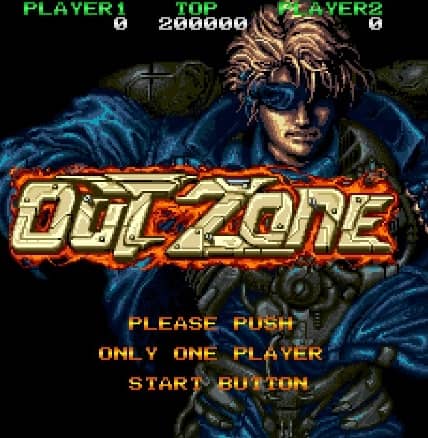
The core gameplay of Out Zone is a vertical-scrolling run-and-gun shooter, where the player character walks on the ground rather than flying like in traditional shooters. This design forces players to deal with enemies from both ground and air, making the controls closer to an action shooter. The game offers two cyborg mercenaries to choose from, and while their performance differences are minimal, the two-player co-op mode allows players to cooperate and share the firepower pressure.
The game's dual-weapon system is a signature feature. Players default to a semi-automatic forward-firing gun with a steady rate of fire, suitable for frontal suppression; by picking up the 'C' icon, they can switch to an omnidirectional laser that fires in eight directions, offering more flexibility but with weaker power. Both weapons can be upgraded by picking up the 'P' icon, increasing fire rate and bullet density. This switching mechanic requires players to adjust their tactics based on enemy configurations and boss fights.
The energy bar mechanic is another unique design. The on-screen energy bar continuously depletes, and players must constantly pick up 'E' icons to replenish it; otherwise, the character becomes vulnerable when energy runs out. However, the energy bar is not equivalent to health, as the character still dies instantly upon being hit. This design forces players to keep moving and actively collect supplies during combat, rather than camping in a safe spot, adding tension and pacing to the game.
The game also hides several easter eggs and cameo characters. In specific stages, players can find elements from Toaplan's own games such as Flying Shark, Truxton, and Zero Wing, which serve as a tribute to veteran players and enrich the game's world. Triggering hidden rewards often requires players to perform specific actions at specific locations, adding replay value for exploration.
The checkpoint system makes the difficulty curve hardcore but fair. In single-player mode, players restart from the nearest checkpoint upon death but lose current firepower upgrades and speed, meaning they need to recollect power-ups. After clearing the game, it loops back to the first stage, but with denser enemy bullets and significantly increased difficulty, a common design in the arcade era to extend playtime and attract skilled players to chase high scores.
Background and release
Out Zone was developed and released as an arcade game by Toaplan in August 1990. In Japan, it was distributed by Tecmo, while Romstar handled North American distribution, and it also hit European markets the same month. This multi-region release strategy was common for arcade games at the time, but the arcade cabinets differed slightly in board and instruction manuals across regions, though the core game content remained consistent.
The game's story is set in 2095, where an alien race from the fictional planet Owagira threatens to wipe out humanity. The United Nations recruits an elite mercenary unit called 'Out Zone', and players take on the role of cyborg warriors who infiltrate enemy territory, dismantling the alien conspiracy across seven stages. While simple, this setting provides a plausible backdrop for the run-and-gun gameplay, enhancing player immersion.
Out Zone was initially arcade-only and received no official home console port. In the 1990s, many arcade games struggled to be perfectly reproduced on home systems due to hardware differences and licensing issues, and this title was no exception. It wasn't until 2020 that the game first appeared digitally on the iiRcade home arcade machine, followed by inclusion in the Sega Astro City Mini V in 2022, giving more players a chance to experience this classic.
In 2020, M2 announced that it would release a new version of Out Zone as part of its ShotTriggers series, planned for the Nintendo Switch. M2 is known for high-quality ports and additional features, so this news excited many players. However, as of the latest update, this version has not yet been released, with specific release dates and content details still pending.
During the arcade era, Out Zone built a solid reputation among players thanks to its unique gameplay and hardcore difficulty. In August 1990, Japan's Game Machine magazine ranked it as the fifth most popular arcade game at the time, and Australia's Leisure Line reported a similar ranking in September of the same year. These achievements demonstrate the game's market performance and laid the groundwork for later ports and retrospectives.
Development
The music and sound effects for Out Zone were handled by Tatsuya Uemura, a veteran composer at Toaplan. Uemura later recalled that the development of this game was the most difficult of his career. Since the player controls a walking character rather than a flying vehicle, the design experience from previous vertical shooters was almost inapplicable, and the team had to start from scratch to balance movement, shooting, and enemy bullet patterns.
Uemura revealed that the main melody for the first stage music was initially inspired by the Japanese TV drama 'Taiyō ni Hoero!'. Incorporating pop culture elements into game music was not uncommon in the industry at the time, but Uemura's arrangement made the melody perfectly match the game's tense atmosphere, becoming a memorable classic for many players. He also handled sound effects, ensuring that shooting and explosion sounds were consistent with the musical style.
The game's designer was Naoki Ogihara, who was responsible for stage layouts and enemy placement. During development, the biggest challenge was making the run-and-gun gameplay both smooth and sufficiently challenging. Uemura noted that because the character moved slowly, the density and trajectories of enemy bullets needed careful adjustment to avoid feeling unfair. This attention to detail ultimately shaped the game's hardcore but not overly punishing nature.
On October 21, 1990, Scitron and Pony Canyon jointly released an album containing music from Out Zone and Snow Bros. The album included tracks arranged by Uemura, which not only complemented the game content but also showcased the composer's command of melody and rhythm. For players who couldn't hear the full soundtrack outside the arcade, this album was a valuable collectible.
The development team for Out Zone was small, but all members came from Toaplan, a company renowned for its shooters. The company fostered a creative atmosphere that encouraged experimentation with new gameplay. Although run-and-gun was not mainstream at the time, the team persisted in completing the project. Uemura later said that despite the difficult development, seeing players deeply engaged in the arcade made all the effort worthwhile.
Reception and legacy
Out Zone received several positive reviews upon release. The UK's Sinclair User praised its fast-paced gameplay and frantic action, calling it 'extremely challenging'; Your Sinclair's David Wilson compared it to Mercs and felt it was superior in some aspects. However, some critics noted that the high difficulty might deter some players.
Retro Gamer's Mike Bevan praised the graphics but lamented the lack of a home console version; Computer and Video Games' Julian Rignall gave an overall score of 80%, believing the game had highlights in both gameplay and audiovisual presentation. However, Hardcore Gaming 101's Nick Zverloff gave a mixed retrospective review, finding the game fun but lacking some innovative elements.
SHMUPS!'s Malcolm Laurie also regretted the absence of a home port but praised the graphics, sound, gameplay, and multiplayer mode. These reviews reflect the game's reputation among core players while also pointing out its limitations as an arcade title. Nevertheless, Out Zone was included in the 2010 book '1001 Video Games You Must Play Before You Die', which is undoubtedly a recognition of its historical significance.
The spiritual successor to Out Zone, FixEight, was released in arcades in July 1992, continuing the run-and-gun gameplay but not as a direct sequel. Also developed by Toaplan, it inherited many design concepts from Out Zone but featured a completely different world and characters. For fans of Out Zone, FixEight is a similar title worth trying.
As of 2019, the rights to Out Zone are held by Tatsujin, a company founded in 2017 by former Toaplan member Masahiro Yuge, and since 2022 it has been part of the Embracer Group. The clarification of rights ownership has made ports and remakes possible. The 2020 iiRcade port and the 2022 Astro City Mini V inclusion allow a new generation of players to experience this classic, proving its enduring appeal in gaming history.





