
Gameplay and design
Raiden's core gameplay is vertical scrolling shooting, where players control a fighter at the bottom of the screen, moving and firing upward at waves of enemy aircraft. The game has eight stages, but after clearing the final one, it doesn't end; instead, it loops back to the first stage with denser enemy formations and faster bullets, significantly raising the difficulty. This loop design wasn't uncommon at the time, but it kept the challenge alive even after players memorized the stages, pushing skilled players to chase higher scores and longer survival times.
The weapon system is Raiden's most appealing feature. The main weapon comes in two types: red and blue. Red bullets spread in a fan, ideal for clearing minor enemies, while blue bullets are concentrated and powerful, more effective against bosses. The sub-weapons include M-type and H-type: M-type is a homing missile, and H-type is a straight-piercing shot. Each weapon can be upgraded by picking up corresponding items, but getting hit reduces the weapon level. This penalty mechanic forces players to constantly weigh risk against caution.
Bombs are crucial for survival and clearing the screen. Players can carry a limited number of bombs, which when used, eliminate enemy bullets on screen and deal heavy damage to enemies in range. In bullet-dense boss battles, bombs are often the only way to turn the tide. However, since bombs are limited, deciding when to use them becomes a key differentiator between novices and experts.
Two-player cooperative play is a major highlight of Raiden. Each player pilots their own fighter, but interestingly, if one player aims at their teammate, the bullets are absorbed by the teammate's fighter and converted into a special fan-shaped barrage fired at enemies. This mechanic encourages players to cooperate rather than fight independently, adding a unique strategic depth to the co-op mode. Of course, accidentally hitting your partner still happens, requiring good teamwork.
The game also hides several secrets. For instance, a hidden item called Miclus, which is a nod to a boss from Seibu's 1985 game Wiz, serves as an Easter egg. There's also a fairy that appears when a player dies, releasing a power-up item. Additionally, when a player's fighter is destroyed, the wreckage scatters as shrapnel that can damage enemies, a detail that adds drama and gives players a small chance to retaliate.
Background and release
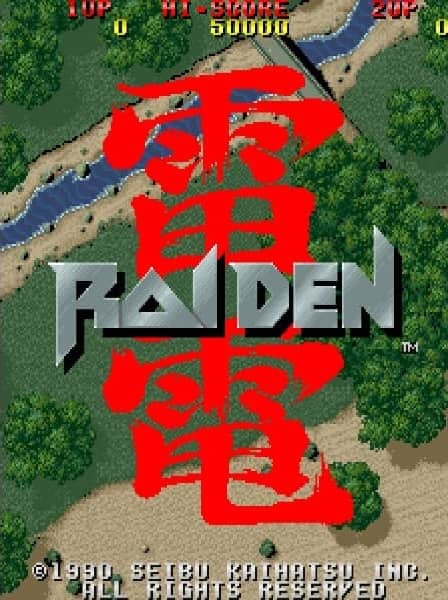
Raiden was released as an arcade game by Tecmo in Japan in April 1990, with North American distribution handled by Fabtek and Taiwanese distribution by Liang Hua Electronics. The game's story is set in 2090, when an alien race called Crystals invades Earth. Players take on the role of a pilot from the VCD organization, flying the Fighting Thunder fighter to counter the invasion. Though the plot is simple, it provides a complete backdrop and adds a sense of immersion during intense battles.
The arcade version of Raiden sold approximately 17,000 units worldwide. That number was quite impressive for the time, especially considering the company was facing financial pressure during development. Initial revenue was modest, but it grew steadily after a few months, eventually becoming a popular fixture in arcades. In North America, it was a hit for Fabtek, averaging $194.25 per week from November to December 1990, a solid performance back then.
In July 1990, the Japanese gaming magazine Game Machine listed Raiden as the most successful tabletop arcade game, a testament to its commercial success. It also held top positions on arcade charts for a long time, becoming a word-of-mouth classic. Its success not only helped Seibu Kaihatsu overcome financial difficulties but also laid the foundation for the series' future.
Raiden's success wasn't accidental. It drew from popular shooter designs of the time but added its own distinctive touches. Whether it was the balanced weapon system or the innovative two-player mechanic, it stood out among many shooters. The arcade version's popularity attracted the attention of multiple publishers, and over the following years, the game was ported to platforms like PC Engine, Mega Drive, and Super Nintendo, further expanding its reach.
It's worth noting that several versions emerged during the porting process. For example, the PC Engine version was developed by A.I Company and published by Hudson Soft; the Atari Jaguar version was developed by Imagitec Design and received mixed reviews; and the MS-DOS version was released only in North America. These versions had slight differences in content but all retained the core gameplay of the original. In 2021, the arcade version was released on modern consoles as part of the Arcade Archives series, allowing a new generation of players to experience this classic.
Development
The development of Raiden stemmed from the poor sales of the previous game, Dynamite Duke. That title failed to meet commercial expectations, putting financial strain on Seibu Kaihatsu. To recoup costs, the company decided to make a shooter, as this genre had short development cycles, relatively low costs, and a stable audience in the arcade market at the time. This decision seemed like a last resort but unexpectedly led to a classic.
Due to financial constraints, the development team had to work with weaker arcade hardware. This posed a significant challenge for programmers, but they didn't lower their standards. Instead, through code optimization and clever design, they achieved smooth graphics and rich bullet effects within the hardware's limits. This spirit of pushing through limitations is what gave birth to many classic games.
The team referenced popular shooters like 1942, Xevious, and Twin Cobra for design inspiration. Each of these games had unique features, and the team drew ideas from them, such as 1942's looping stages, Xevious's hidden elements, and Twin Cobra's weapon upgrade system. However, they didn't simply imitate; they blended these elements and innovated, creating Raiden's distinctive style.
The game was led by Seibu Kaihatsu president Hitoshi Hamada, with Tetsuya Kawaguchi serving as designer and programmer. Kawaguchi played a crucial role, designing the core mechanics and writing much of the code himself. The music was composed by Akira Sato, whose soundtrack added to the tense and exciting atmosphere. Later, these tracks were included in a soundtrack album featuring music from both Raiden and Raiden II.
There are also some interesting anecdotes from development. For instance, the hidden Miclus item was actually a tribute to the company's earlier game Wiz, while the fairy was a design that gave players a small compensation upon death, a feature uncommon in shooters at the time. These details may seem minor, but they reflect the team's dedication to the player experience, and they remain a topic of discussion among fans even years later.
Reception and legacy
Raiden received widespread acclaim upon release. Players and critics praised its smooth controls, rich weapon system, and intense stage design. It was included in the 2010 book 1001 Video Games You Must Play Before You Die, which features some of the most influential games in history, underscoring Raiden's significance in gaming.
Raiden's success spawned several sequels, including Raiden II and Raiden DX, which built on the original's core gameplay while adding new elements like more polished graphics, more complex bullet patterns, and new weapon systems. Seibu Kaihatsu established itself in the shooter genre with this series, but unfortunately, the company went bankrupt in 2005. The series rights were later acquired by MOSS, which continued to produce new installments.
Raiden left a lasting impact on later shooters. Its weapon upgrade system, two-player cooperative mechanics, and hidden element design were borrowed by many similar games. In particular, the mechanic where shooting your teammate generates a barrage was unique among shooters at the time and was later imitated by some games. In many ways, Raiden set a benchmark for vertical-scrolling shooters.
Commercially, Raiden sold about 17,000 arcade units. Although initial revenue was low, it climbed steadily thanks to word of mouth, becoming a hit for Fabtek in North America. In July 1990, it was listed by Game Machine magazine as the most successful tabletop arcade game, proving its popularity among players. For a company facing financial difficulties, such results were a lifeline.
Even today, Raiden is still regarded as a classic by many players. In 2021, the arcade version was released on modern consoles as part of the Arcade Archives series, allowing a new generation to experience the game. Though its graphics and sound may be dated, its gameplay still holds up. For fans of shooters, Raiden is not just a game but a memory of an era.





