
Gameplay and design
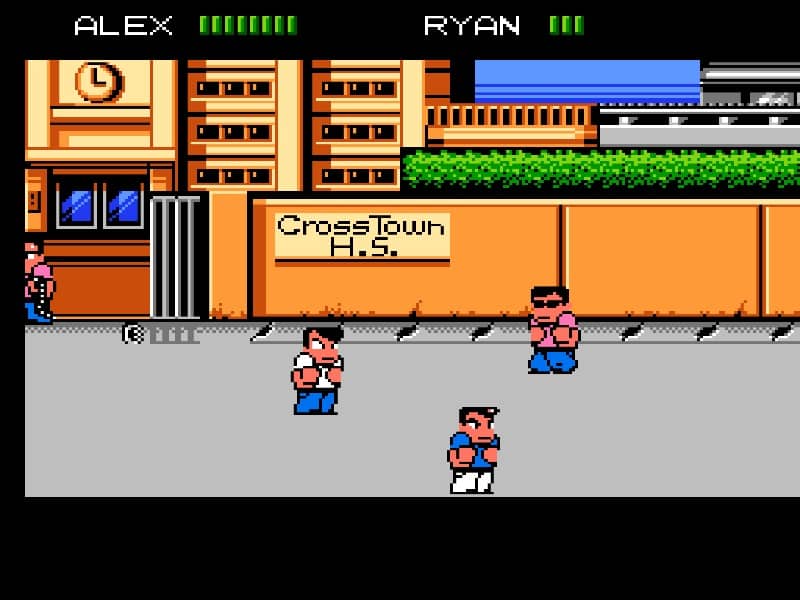
What makes River City Ransom stand out is that it doesn't lock players into a linear path like most beat 'em ups of its time. The game's River City is an open neighborhood that players can freely explore, with streets, malls, parks, and riverbanks all connected. You can go anywhere you want, with no fixed route or forced order. This design was quite rare on the NES in 1989, making players feel like they're wandering, picking fights, and causing trouble in a real town rather than just progressing through levels.
The combat looks similar to Double Dragon, but it feels more solid. The protagonist can punch and kick, pick up trash cans, wooden sticks, and chains to use as weapons, and even grab enemies and throw them. Enemies aren't just standing around; they swarm from all directions, and some will pick up weapons to fight back. Players need to learn positioning and timing, or they'll easily get overwhelmed. This tough, arcade-style combat, combined with the random thugs that appear on the streets, makes every street fight feel immediate and exciting.
What truly sets River City Ransom apart is how it integrates RPG growth systems into an action game. Fighting, taking hits, and eating food all gradually increase stats like strength, speed, and stamina. Money drops from enemies and can be spent at shops on various food and drinks to restore health, as well as on books to learn new moves like Grand Slam, Stone Hands, and Dragon Feet. This 'get stronger as you play' loop encourages players to explore the map and grind enemies rather than rushing to the end.
The game doesn't have a battery save; instead, it uses a password system. Every so often, the game gives you a password that you can write down and input later to continue. The password saves your character's level, skills, money, and which bosses you've defeated. This design seems inconvenient today, but it was common back then. It also made players value each playthrough more, because losing the password meant starting over. However, the password system also allowed players to share passwords with friends to experience each other's progress, a unique social feature of that era.
The map is populated by nine gangs, each with a name and members wearing different colored T-shirts, like The Generic Dudes and The Frat Guys. Players must defeat them one by one to finally face the mastermind, Slick. This 'clear the gangs' progression works well with the open map, letting players decide who to fight first. Each gang's members look and fight a bit differently, so battles don't feel repetitive. This design naturally blends exploration and combat, and it became a blueprint for many later open-world games.
Background and release
River City Ransom was released on April 25, 1989, for the Famicom in Japan, with the Japanese title Downtown Nekketsu Monogatari. It is the third Kunio-kun game on the Famicom, following Renegade and Super Dodge Ball, but those were arcade ports. Only River City Ransom was developed specifically for the Famicom, making it the series' first true home console original, and many design ideas started here.
The story is simple: high school students Kunio and Riki set out to rescue Kunio's girlfriend, Misako, by fighting through the entire city and finally confronting the villain, Slick. In the Japanese version, the protagonists are Kunio and Riki, the girlfriend is Misako, and the city is called Nekketsu Street. In the North American version, names were changed: the heroes become Alex and Ryan, the girlfriend becomes Cyndi, and the city is renamed River City. This kind of localization was common at the time, but River City Ransom went all out, even changing the game's title.
The North American version, titled River City Ransom, was published by American Technos, the North American subsidiary of Technos, rather than Taito, which had handled Renegade and Super Dodge Ball. This marked a significant shift in the series' overseas presence, as Technos began managing North American releases itself. However, the game sold poorly in the West, with weak initial sales. Interestingly, critics praised it highly, and this 'critically acclaimed but commercially unsuccessful' situation helped it build a cult following among players.
In PAL regions (Europe, Australia, etc.), the game was released as Street Gangs, with yet another name change. This version had similar character and location names to the North American version, but a different title, likely to appeal to local markets. The regional differences made River City Ransom somewhat mysterious to overseas players; many played it as kids without knowing it had other names. It wasn't until the internet became widespread that people realized the Street Gangs they played was actually River City Ransom.
Despite its poor initial commercial performance in the West, critical praise never stopped. French magazine Player One gave Street Gangs a 93% score, calling it unmissable. In contrast, the UK show GamesMaster gave it only 32%, with the reviewer even saying they'd rather sit in horse manure than play it. This polarized reception made the game even more talked about. IGN later gave it a 9/10 in a retrospective, praising its combat mechanics and RPG depth, which helped set the record straight.
Development
River City Ransom was developed by Technos Japan, a company known for tough action games like Renegade and Double Dragon. But River City Ransom wasn't just a simple copy of their previous work; they aimed to create something new. The team built on Renegade's foundation, adding an open world and RPG elements, allowing players to move freely around the city rather than progressing level by level. This design was very bold for its time and became a hallmark of the series.
The game's design was heavily inspired by Renegade, but the developers clearly weren't satisfied with just making a reskin. They wanted to give players more choices, like which gang to fight first, which skills to learn, and how to spend money. This level of freedom was rare in NES games and tested the team's ability to balance pacing. To make the city feel more real, they drew many details, such as shop signs, streetlights, trash cans, and even sewer entrances. These scenes were simple, but together they created an atmosphere of 'street life.'
The GBA remake, River City Ransom EX, was released in 2004, developed by Million and published by Atlus. It retained the original's open world and combat system but made some adjustments. Most notably, it removed true two-player co-op, replacing it with an AI partner that follows the player. This change disappointed some old fans, as the original's co-op was a cherished memory for many. However, the GBA version had its own advantages, like battery backup saves for up to 12 characters and data exchange for sharing progress.
The original NES version has been digitally re-released multiple times, appearing on Wii, 3DS, Wii U, and Switch. The Wii Virtual Console version launched in Japan in 2007 and reached North America and PAL regions in 2008. The 3DS version supports download play for two players but disables restore points. The Switch version, released in 2018 as part of the Nintendo Classics service, features HD graphics and save states. These ports largely preserve the original content, with adaptations to let new players enjoy the classic on modern consoles.
The developers also hid various easter eggs and details, like shops selling a variety of foods, from burgers to sushi, each with different healing effects. There's also a hot spring that restores health, a concept that seemed fresh to Western players. Additionally, the skill books have playful names, like 'Dragon Feet,' which sounds martial arts-inspired. These small touches enriched the game's world and gave players something new to discover during exploration.
Reception and legacy
Although River City Ransom initially sold poorly in the West, it gradually built a loyal fanbase through word of mouth, becoming a cult classic. In 2009, IGN ranked it the 15th best NES game, and in 2012, GamesRadar placed it 7th. In 2017, Polygon listed it at 461st on their 500 greatest games list, and Paste ranked it 16th among NES games. These rankings show that the game has maintained a high standing among critics and players, especially for its open-world design and RPG integration, which many consider ahead of its time.
The game's success also spurred the series' growth. In 1994, a prequel, Shin Nekketsu Kōha: Kunio-tachi no Banka, was released on the SNES, telling the story of Kunio and Riki's earlier days. In 2011, a sequel, Downtown Nekketsu Monogatari 2, came out on WiiWare, developed by Miracle Kidz. In 2017, another sequel, River City Ransom: Underground, was released, developed by Conatus Creative and funded via Kickstarter. These titles all carry on the core gameplay of River City Ransom, proving its design philosophy has stood the test of time.
Beyond direct sequels, there have been numerous spin-offs. River City Girls, developed by WayForward and released in 2019, is a beat 'em up with female protagonists, featuring a more modern style but rooted in the same mechanics as River City Ransom. Additionally, characters like Kunio, Riki, Goda, and the Hattori brothers appear as spirits in Super Smash Bros. Ultimate, giving the series exposure to a mainstream audience. These spin-offs and cameos have extended River City Ransom's influence beyond the NES era and into the present day.
River City Ransom's impact on the gaming industry is also significant. It demonstrated that action games don't have to be linear; open worlds and RPG elements can blend seamlessly. Many later games, such as the Grand Theft Auto series, show similar influences. Of course, it's not fair to say River City Ransom directly inspired them, but it provided a successful example. On the limited hardware of the NES, creating such a deep game was no small feat.
For players, River City Ransom holds a more personal meaning. Many grew up playing pirated cartridges, perhaps not knowing whether it was called River City Ransom or Street Gangs, but they all remember the game about street fighting, buying food, and learning skills. This shared memory transcends language and region. Even today, players discuss boss strategies, money farming spots, and some even create mods to expand the map. A game over thirty years old that still engages people so deeply is its greatest success.





