
Gameplay and design
Samurai Shodown II significantly improved the responsiveness of the controls compared to the original, and the number of moves increased noticeably. The most central change was the introduction of the rage gauge, also known as the POW gauge. As players take damage or attack aggressively, the gauge fills up, and when full, it allows them to unleash powerful super moves. This design adds unpredictability to battles, forcing players to weigh whether to conserve their rage for the right moment or use it early to pressure the opponent.
Super moves not only deal massive damage but also have a signature effect: they can break the opponent's weapon. Once a weapon is knocked away, the opponent must fight barehanded, with reduced range and damage. This mechanic forces players to be extra cautious when defending and turns every super move into a psychological battle. The weapon-breaking feature later became a hallmark of the series and was borrowed by many similar games.
The movement system also became more versatile. Players can roll forward or backward to quickly close in or retreat, crouch to avoid high attacks, and perform short hops to evade low attacks. These actions make the offensive and defensive rhythm more flexible, moving beyond simple stand-and-fight exchanges. Combined with the different body types and moves of each character, players can employ various tactical patterns, such as using rolls to bait attacks or short hops to interrupt the opponent's startup.
This game pioneered the "just defend" technique, where inputting a specific command at the last moment before an opponent's attack hits can deflect the attack and leave the opponent open. This move requires precise timing, but when successful, it offers a huge counterattack opportunity. The introduction of just defend made high-level matches more nuanced and influenced later works like Street Fighter III, becoming an important design in fighting game history.
Beyond the core mechanics, the game also included multiple movement options and hidden features. In terms of the character roster, all original characters except Tam Tam and Amakusa Shiro returned, and six new characters were added, including Haohmaru's rival Genjuro Kibagami, Tam Tam's sister Cham Cham, the Prussian knight Nienhalt Sieger, the monk Nicotine Caffeine, the referee Kuroko, and the final boss Zankuro Minazuki. Kuroko, as a hidden boss, mimics the moves of other characters in the game and other SNK fighting games, such as Ryo Sakazaki and Tung Fu Rue, providing a pleasant surprise for veteran players.
Background and release
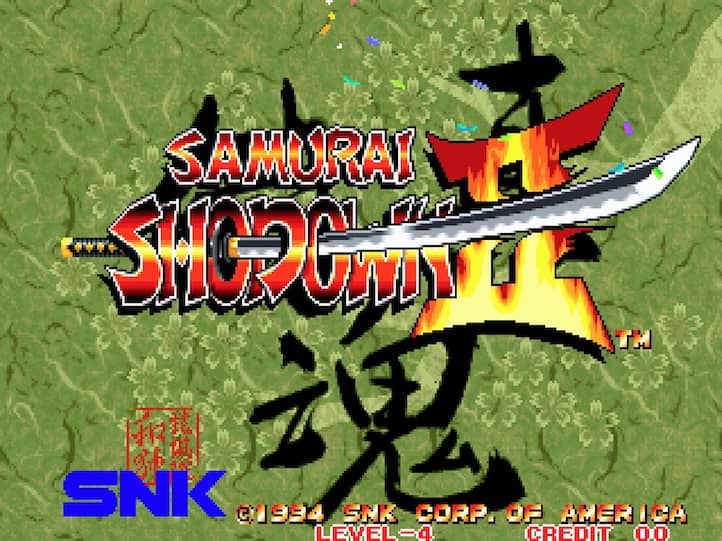
Samurai Shodown II was developed and published by SNK in 1994, as the second installment in the Samurai Shodown series. The original Samurai Shodown was released in 1993 and quickly gained popularity due to its unique weapon-based combat and bloody style. This sequel continues the original's worldview, with the story set one year after the defeat of Amakusa Shiro in the first game. A new threat, Zankuro Minazuki, appears and possesses a shrine maiden, intending to bring chaos. Players once again take on the role of various swordsmen to quell the disturbance.
The game was first released on the Neo Geo arcade platform in 1994, followed by a Neo Geo AES home console version. The arcade and home versions differ slightly in content; the AES version toned down some of the gore but offered a "blood code" for players to enable it. This code was provided by SNK to gaming magazines and customer service, and players could input it to unlock the full blood effects, becoming a classic cheat code that circulated among players at the time.
Commercially, the game was a huge success in the arcade market. According to RePlay, it became the 12th most popular arcade game in North America in October 1994, even while still in testing. In Japan, Game Machine listed it as the most successful tabletop arcade unit of the month in its December 1, 1994 issue. By 1995, the game had become the eighth highest-grossing arcade game of the year in Japan, showing its immense popularity.
The home console versions also performed well. According to Famitsu, the Neo Geo AES and CD versions sold over 75,066 and 20,487 units in their first week in Japan, with final total sales of 205,554 and 129,951 units, respectively. These figures were quite impressive for the Neo Geo platform and demonstrated player appreciation for the game. The success helped SNK establish a strong foothold in the fighting game genre, creating fierce competition with Capcom's Street Fighter series.
The game saw numerous ports with a complex release history. In 1996, a Windows port of the Neo Geo CD version was released in Japan, with a North American version following in 1999. In 1998, a PlayStation version was released exclusively in Japan as part of the Samurai Shodown Kenkaku Yubinan set, which included the first two games. In 2008, the game was re-released on Xbox Live Arcade and Wii Virtual Console. In 2012, it was included in the built-in storage of the Neo Geo X handheld. In June 2013, it was ported to iOS and Android. In December 2015, it was sold as part of a Humble Bundle featuring SNK Playmore Neo Geo emulated ports. In 2017, it was released on multiple platforms as part of the ACA Neo Geo series, and it was included in the 2020 Samurai Shodown NeoGeo Collection.
Development
The development of Samurai Shodown II was handled by an internal SNK team, who rebuilt the game engine from scratch rather than simply reusing the original code. This approach led to significant improvements in control responsiveness and visual presentation. The development team retained nearly all of the original characters and added six new ones, making the roster more diverse. This complete preservation of the original characters showed respect for player sentiment.
The hidden features and easter eggs in the game were carefully designed highlights. Besides the hidden boss Kuroko, the game includes cameos from other SNK characters, such as Ryo Sakazaki and Tung Fu Rue's moves appearing in Kuroko's moveset. These easter eggs not only added to the game's fun but also hinted at a shared universe among SNK's fighting games, laying the groundwork for the later King of Fighters series.
The censorship of blood content in the Neo Geo AES version was an episode during development. To pass censorship, the AES version had to remove some blood effects, but SNK did not completely abandon this content; instead, they provided it to players in the form of a "blood code." This code was given to gaming magazines and customer service, and players could unlock it by entering a command. This approach satisfied censorship requirements while preserving the game's original flavor, becoming a frequent topic among players.
In terms of localization, the game had some translation errors. At the time, SNK's overseas business had thin profit margins, so the company did not invest many resources in fixing them. These translation errors affected some players' understanding but did not hinder the game's popularity abroad. On the contrary, some errors became amusing anecdotes in the player community, such as mistranslated move names being used as memes.
The development team also put considerable effort into balance. Although the combo system had some imbalances, overall the game maintained a high level of competitiveness. GamePro mentioned the combo imbalance in its review but also praised the POW gauge and secret moves. This process of adjustment amid controversy reflected the common challenges in fighting game development at the time and provided experience for improving balance in subsequent titles.
Reception and legacy
Samurai Shodown II received unanimous praise from media and players upon release. Four reviewers from EGM all gave the Neo Geo home version a 9/10 and awarded it "Game of the Month." GamePro praised its improved POW gauge and secret moves, as well as "the best graphics in a hand-drawn animated fighting game." These reviews not only affirmed the game's quality but also solidified SNK's position in the fighting game genre.
The game has been listed by multiple outlets as one of the best fighting games of all time. GameSpot and EGM, among other authoritative sources, have included it in their classics lists, considering it to have reached the pinnacle of fighting games at the time in terms of controls, systems, and visuals. This long-term reputation has kept the game fondly remembered by players even years later, making it a milestone in fighting game history.
The game's pioneering "just defend" technique had a profound impact on later generations. This mechanic was adopted by works such as Street Fighter III and became a classic design in fighting games. The rage gauge and weapon-breaking systems were also used by many similar games, such as the Soulcalibur series, which was clearly influenced by this title. In short, the game's innovations in system design provided new ideas for the entire fighting game genre.
The game has seen numerous ports, from the Neo Geo to modern platforms, covering almost all major consoles. It was released as part of the ACA Neo Geo series in 2017 and included in the Samurai Shodown NeoGeo Collection in 2020, ensuring its playability in the modern era. This continuous porting and collection inclusion allow new generations of players to experience this classic, maintaining its vitality.
With both commercial and critical success, this game became a key title in SNK's competition with Capcom. It proved that SNK could not only produce excellent fighting games but also lead in innovation. The success of this game also laid the foundation for the subsequent Samurai Shodown series, making it one of SNK's flagship franchises. Even today, when classic fighting games are mentioned, players still think of Haohmaru and that hellish upheaval.





