
Gameplay and design
At its core, Spider-Man is a four-player cooperative beat 'em up, but it stands out from the typical games in the genre. Players can choose from four heroes—Spider-Man, Black Cat, Namor, and Hawkeye—and each player can pick freely without any order restrictions. This means all four can play as Spider-Man, or each can choose a different character, allowing for more flexible teamwork. The game supports one to four players simultaneously, and with more players, the action gets chaotic and lively, but it also means players can get in each other's way, requiring some coordination.
Each character plays quite differently, not just a palette swap. Spider-Man relies on web-swinging and web projectiles, with agile movements; Black Cat uses claws and a grappling hook, adding a bit of finesse to close combat; Hawkeye primarily uses a bow and arrow, giving him an advantage at range; Namor uses water-based attacks, such as hydro blasts. Each hero also has a unique special attack that costs health to use, so you can't spam them carelessly; you have to time them well. This design forces players to weigh risk versus reward, rather than just mashing buttons for powerful moves.
The high-score table is kept separately for each character, with individual rankings. This means players aiming for the top scores have to specialize in one character rather than using whichever is most convenient. This detail might seem minor, but it adds replay value and gives players of different characters something to compare. In the arcade era, high-score tables were a crucial mechanic to keep players feeding in coins.
In terms of level design, the game alternates between side-scrolling beat 'em up sections and platforming. Some scenes are traditional brawls with waves of enemies, while others require jumping across platforms and avoiding traps, testing your reflexes. The most distinctive feature is the camera zooming out and in, such as pulling back in large areas to show the whole scene, then zooming in on the characters. This zoom effect was quite fresh at the time, giving the visuals a dynamic feel and alleviating the monotony that beat 'em ups often suffer from.
The game has four levels in total, and the enemy roster is quite impressive, featuring classic Marvel villains. Kingpin, Venom, Doctor Octopus, Electro, Lizard, Scorpion, Sandman, Green Goblin, Hobgoblin, and finally Doctor Doom as the final boss. Each boss has different attack patterns, making the fights challenging. Between levels, there are cutscenes that advance the story, simple as they are, but they make players feel like they're on a complete adventure rather than just fighting endlessly.
Background and release
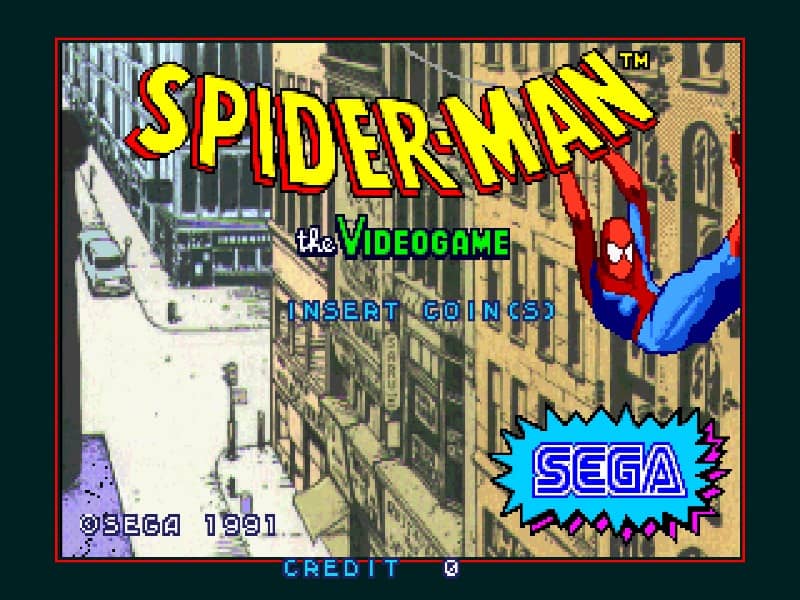
Spider-Man is an arcade game released by Sega in 1991, based on the Marvel Comics character Spider-Man. In that era, Marvel-licensed games weren't as common as they are today, so being able to play as Spider-Man in an arcade was a big deal for fans. Sega was a major force in the arcade scene at the time, and choosing the Spider-Man IP was clearly a move to capitalize on its appeal. The game was first shown at the 1991 Las Vegas Entertainment Expo, where it drew considerable attention.
After its release, the game performed quite well in the arcade market. In Japan, the authoritative magazine Game Machine, in its November 1, 1991 issue, listed the game as the fourteenth most successful arcade cabinet of the month. While that ranking isn't top-tier, in the fiercely competitive Japanese arcade market, making the list at all indicates it had a decent following. For a licensed game, this was a solid showing.
In the United States, the game fared even better. In November 1991, it topped the RePlay arcade charts as the highest-grossing new video game of the month. RePlay was a major barometer for the American arcade industry, and reaching that position shows that players were genuinely drawn to it. America is Spider-Man's home turf, with a deep fan base, so its popularity in arcades there made sense.
In Australia, the game also performed well. In November 1991, it was the highest-grossing arcade conversion kit on the Timezone charts. Timezone is a well-known arcade chain in Australia, and this ranking reflected the game's commercial success in that region. From Japan to the US to Australia, the game achieved good results in multiple markets, showing its appeal was cross-regional.
Notably, in the November 1991 issue of Sinclair User magazine, the game was awarded the "Most Likely to Save the Universe" prize, tied with Captain America and The Avengers and The Punisher. The award name sounds a bit tongue-in-cheek, but being grouped with those big titles indicates that the media held it in high regard. In an era when superhero games were still immature, this game set a precedent for future Marvel adaptations.
Development
Spider-Man runs on Sega's System 32 board, a high-performance arcade system introduced in the early 1990s. System 32 supported large sprites and scaling/rotation effects, which suited the game's visual needs. Compared to earlier boards, System 32 could handle more complex scenes and more enemies, ensuring that four-player simultaneous action didn't suffer from slowdown. Sega chose this board to guarantee a smooth gameplay experience.
An interesting detail in development: the music was partly taken from Sega's 1986 arcade game Quartet. Tracks like "Oki Rap" and "FM Funk" were reused from Quartet. This wasn't uncommon at the time; Sega often reused assets internally to save costs and ensure quality. However, not all of the game's music came from Quartet—only some tracks were borrowed, so the soundtrack feels both familiar and unique.
The game was exhibited at the 1991 Las Vegas Entertainment Expo, marking its first public appearance. The expo was an important gaming trade show in North America, and Sega's choice to showcase it there showed they had high hopes for the title. At the expo, players could try out the four-player cooperative mode, and the lively action was a big draw. Based on the feedback, the multiplayer and visual effects left a strong impression.
The development team put considerable effort into character design. Each of the four heroes has unique attack styles that fit their comic book counterparts. Spider-Man's web-swinging, Black Cat's claws, Hawkeye's arrows, and Namor's water attacks are all based on the characters' abilities, not just made up. The special attacks costing health was also designed to make players make strategic choices in critical moments. This attention to detail made the game feel more authentic to fans.
Although the game was developed by Sega, Marvel was involved in licensing and supervision. The enemy roster includes classic villains like Kingpin, Venom, and Doctor Octopus, and using these characters required Marvel's permission. Sega put a lot of thought into faithfully recreating the characters' looks and moves, aiming to make players feel like they were controlling the comic book heroes. This collaborative approach provided some lessons for future Marvel game development.
Reception and legacy
Spider-Man received high praise from the media. Dragon magazine gave it a perfect 5-star rating in issue 177 (1992), which was quite an honor at the time. Although Dragon primarily covered computer games, they gave this arcade title high marks. A perfect score meant the game achieved top-tier quality in gameplay, graphics, and overall experience, which is no small feat for a licensed game.
Computer and Video Games also gave a positive review in its January 1992 issue, specifically praising the four-player gameplay, the large and beautifully animated sprites, and the zoom effects. These were the game's core selling points. Four-player co-op allowed friends to play together, a huge draw in arcades; the sprite animation was top-notch for the time; and the zoom effects added dynamism to the visuals. These strengths were repeatedly mentioned by the press, indicating they left a lasting impression.
Among players, the game also earned a good reputation. While arcade games typically have short lifespans, this one maintained popularity in arcades for a longer period thanks to its multiplayer and diverse character selection. Many players recall the fun of choosing different heroes with friends. It didn't have the deep story of later console Spider-Man games, but as an arcade game, it excelled at delivering satisfying, action-packed combat.
The game also had an influence on later Marvel games. It proved that Marvel characters could work in arcade beat 'em ups, and subsequent games like Captain America and The Avengers adopted similar multiplayer cooperative modes. Although this game didn't have a direct sequel, its design ideas—multiple character choices, special attacks costing health, and camera zoom—can be seen in later arcade titles. It can be considered a milestone in Marvel arcade gaming.
However, the game had its limitations. As an arcade game, it had no save feature, so players had to finish it in one sitting, which was standard at the time but limited its reach. Later, the game was never ported to home consoles, so many players could only experience it in arcades. As the arcade industry declined, the game faded from memory, but among older players, it remains a fondly remembered classic. Today, through emulation, a new generation of players can also appreciate its charm.





