
Gameplay and design
The core innovation of Street Fight III - New Generation is the Parry system. By pushing the joystick forward just as an opponent's attack is about to land, players can deflect the attack without taking damage, including special moves and Super Arts. This mechanic gives the defender a proactive chance to counter, shifting the dynamic from passive blocking to active retaliation. A successful Parry allows an immediate counterattack, creating a rhythm of offense and defense that became the game's most iconic feature.
The game introduces the Super Art system, where each character can choose one of three exclusive moves at character select, powered by a gauge that fills during battle. These moves are powerful, some suited for combos and others for reversals, and players must choose based on their playstyle and the opponent's traits. The Super Art system adds strategic depth, making each match full of different possibilities.
The game also includes dashes, backsteps, super jumps, and quick getups, mechanics borrowed from Capcom's own Darkstalkers and X-Men: Children of the Atom. These actions make character movement more flexible, enriching both offensive and evasive options. Meanwhile, air blocking was removed, replaced by the Parry system, making aerial combat more about timing and prediction.
Character animation is a major highlight. Each character is composed of roughly 700 to 1,200 hand-drawn frames, running at 60 frames per second, resulting in smooth and detailed motion. These animations not only express character personality but also give every punch and kick a sense of impact. Compared to previous games, the characters' movements are richer and far more expressive.
The game also introduces a unique mechanic: when a character is hit by certain attacks, they enter a stunned state where they can be thrown repeatedly. This design increases combo possibilities and forces players to consider more strategies when attacking. However, it also makes some characters vulnerable to being pressured in certain situations, leading to some balance controversies.
Background and release
Street Fight III - New Generation was released in 1997 as the direct sequel to Street Fighter II. However, unlike its predecessor, it almost completely changed the character roster, keeping only Ryu and Ken and introducing a new cast led by Alex. This bold decision sparked widespread discussion among players at the time, with some welcoming fresh faces and others missing the classic characters.
The new antagonist, Gill, replaced M. Bison as the final boss. He is the leader of a secret organization, capable of controlling fire and ice, with immense power and a mysterious background. Gill's arrival brought a new threat to the series and hinted at a new direction for the story. His design is starkly different from M. Bison's, emphasizing supernatural abilities.
The game was first shown publicly at the JAMMA show in September 1996, presented via a Capcom promotional video. At the time, players and media were curious about the new title, but Capcom revealed few details. In January 1997, reports claimed the game would be demonstrated on the N64 and 64DD, but Capcom quickly denied this, calling it a 'rumor.'
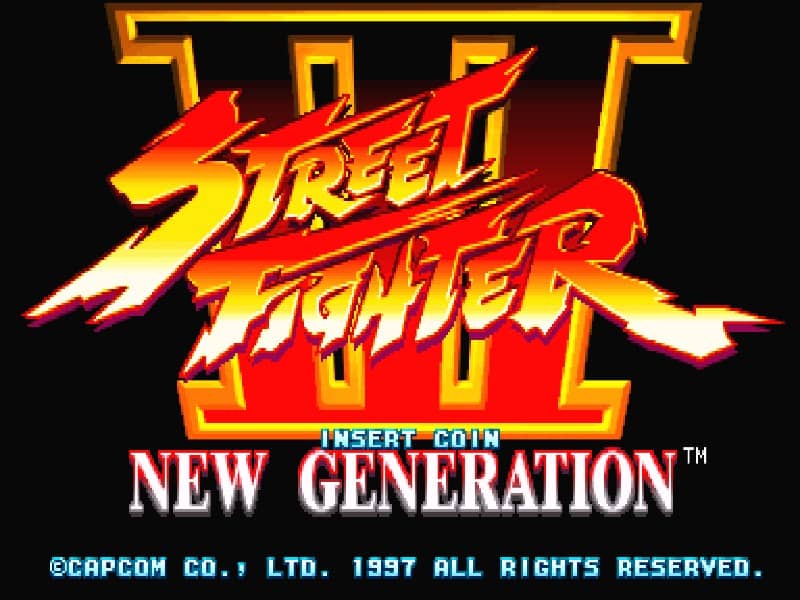
The arcade version was titled 'Three: A New Generation of Street Fighters,' emphasizing the 'new generation' theme. The game was initially released as a coin-operated arcade game, running on the CD-ROM-based CP System III board, which supported more detailed 2D graphics than CPS II. This board was powerful but also came with high development costs.
The game was later ported to the Dreamcast as part of a compilation with 2nd Impact, titled Street Fighter III: Double Impact. In 2018, it was re-released as part of the Street Fighter 30th Anniversary Collection on PS4, Xbox One, PC, and Switch, allowing new players to experience this classic.
Development
Development began in 1994, initially planned as a standalone fighting game series unrelated to Street Fighter. However, Capcom executives believed the 'Street Fighter' brand had more commercial value, so it was eventually renamed Street Fight III - New Generation. This decision affected the entire development direction, forcing the team to adjust character and story settings.
Producer Noritaka Funamizu was feeling fatigued with the series at the time due to declining home console sales and the rise of 3D fighting games, but Capcom insisted on the 2D sprite approach. He believed 2D fighting still had potential but needed innovation. This conflicted mindset is reflected in the game, which retains traditional 2D feel while introducing new mechanics like Parry.
Character designer Akira Yasuda initially felt the roster lacked personality and suggested adding Ryu, predicting the game would be turned into a Street Fighter title. His suggestion was adopted, making Ryu and Ken the only returning characters. Yasuda also suggested creating a ninja character, leading to Ibuki's birth; another inspiration came from model Yuki Uchida, creating Elena.
During development, each character was balanced by different developers, resulting in some characters feeling more like Darkstalkers. This division of labor improved efficiency but caused imbalance among characters, with some being too strong and others relatively weak. These differences were gradually corrected in later versions.
The development budget was as high as 1 billion yen (about $8 million), but Japanese sales were only around 1,000 arcade cabinets, failing to recoup costs. This commercial failure made Capcom realize that relying solely on graphics and system innovation was not enough to attract players, and subsequent versions, 2nd Impact and 3rd Strike, made extensive adjustments to characters and systems in an attempt to win back the market.
Reception and legacy
Street Fight III - New Generation performed poorly commercially, but the Parry system left a lasting impact on subsequent fighting games. This mechanic has been borrowed by many other fighting games, becoming a classic example of offensive-defensive interplay. Despite poor sales, its design philosophy left an important mark in fighting game history.
Critical reception was mixed. Next Generation gave the arcade version 4 out of 5 stars, saying the game was good but lacked innovation. GamePro commented that the graphics were excellent and the controls perfect, but the new characters mixed in Darkstalkers style, lacking evolution for the series. These reviews reflected the controversy over the new roster.
The game's follow-ups, 2nd Impact and 3rd Strike, expanded the characters and systems, with 3rd Strike being considered by many players as the pinnacle of 2D fighting. However, these achievements cannot be credited to this game; it was merely the starting point of the series' transformation, and its immaturity was improved in later versions.
Despite commercial failure, the game was re-released in the Street Fighter 30th Anniversary Collection, giving a new generation of players the chance to experience it. This re-release brought new evaluations, with some players appreciating its bold innovation and beautiful animation, while others still found the roster unappealing.
The game's place in fighting game history is complex. It was both a gamble for the series and a showcase of 2D fighting technology. Although it did not achieve commercial success, its Parry system and animation quality left a lasting influence on later fighting games, becoming a symbol of Capcom's technical prowess.





