
Gameplay and design
The core gameplay of Super Double Dragon is side-scrolling beat 'em up action, where players control either Billy or Jimmy, fighting through the Shadow Warriors' minions and bosses to rescue Marian. The game consists of seven stages, with settings ranging from a casino and airport to a dojo and moving truck, then to a slum, forest, and enemy headquarters, offering variety that keeps players engaged. The combat system builds on the series' tradition by adding a guard button, allowing players to block enemy attacks, and with precise timing, they can counterattack certain enemies, changing the pace from mindless aggression to a more strategic exchange.
Another notable feature is the introduction of the Dragon Power gauge. By holding the L or R button, players can charge up, and when full, their normal attacks become significantly stronger, and they can unleash special Dragon Power attacks. This mechanic encourages players to find safe moments to charge during battle, rather than just mashing the attack button, injecting strategy into the typical 'stand and fight' pattern of beat 'em ups. The gauge adds a resource management element to each fight, requiring players to decide whether to unleash it immediately or save it for critical moments, a design that was uncommon in similar games at the time.
Series veterans may notice that this game is one of the few to clearly differentiate Billy and Jimmy. Not only do they have different hairstyles—Jimmy debuts a blond flat-top—but their basic fighting techniques also differ. Billy is a master of Southern style Double Dragon fist, agile and flexible, while Jimmy is a master of Northern style, with heavier, more powerful punches. This distinction goes beyond appearance, affecting the feel of gameplay, giving players more consideration when choosing a character, and echoing the in-game claim by the Chen brothers that they are the 'true Double Dragons.'
The enemy design also shows effort. Common enemies include Williams, Roper, and Baker, with Baker using dual knives that cannot be disarmed, requiring extra caution. The sub-boss Jeff appears repeatedly in early stages, a palette swap of Billy with similar skills, serving as a warm-up. Stage bosses each have unique traits, such as Steve, Jackson, the Chen brothers, McGuire, Callum, and the final boss Duke. The Chen brothers, who claim to be the true Double Dragons, one specializing in kicks and the other in punches, are quite challenging when working together.
It's worth noting that the Japanese version, Return of Double Dragon, made several gameplay adjustments. In the Japanese version, players can perform new moves like recovering boomerangs and consecutive kicks, enemy placement differs, weapon damage is reduced, Jimmy's punches are slower but more powerful, and his spinning kick is faster. Additionally, enemies in the Japanese version sometimes randomly crouch to dodge attacks, more frequently at higher difficulties, and the final stage has two extra levels. These changes make the Japanese version noticeably different in difficulty and pacing, and it's a frequent topic of discussion among players.
Background and release
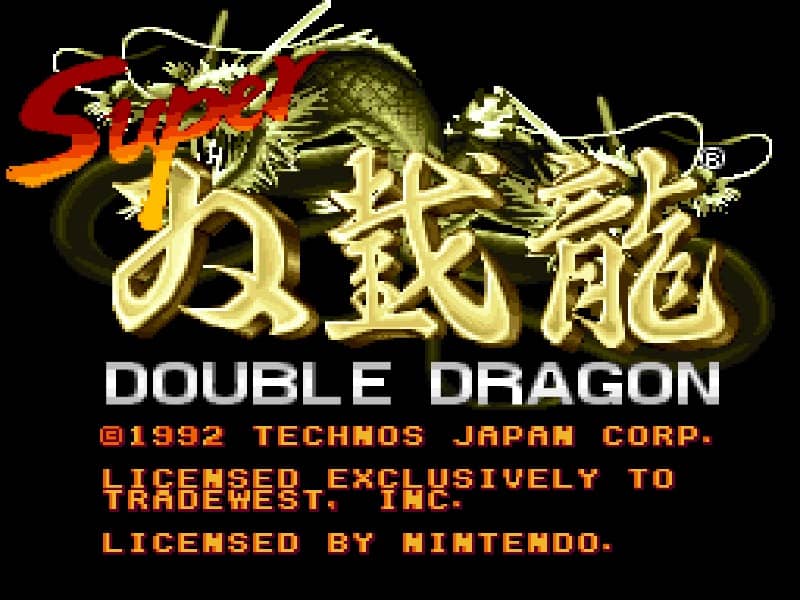
Super Double Dragon is the fourth home console game in the Double Dragon series, following the NES version of Double Dragon III. Unlike previous entries, this game did not have an arcade version, being made exclusively for the home market, which was a significant shift at the time. Developed by Technōs Japan, it was released in Japan for the Super Nintendo in 1992, in North America by Tradewest the same year, and in PAL regions in 1993. This release schedule meant players in different regions experienced the game at different times, affecting subsequent version comparisons.
The game's story continues the series' standard premise: Billy and Jimmy, the Double Dragon brothers, fight against the Shadow Warriors to rescue the kidnapped Marian. However, the retail version lacks story cutscenes, with no animations or dialogue explaining why the brothers are fighting, and Marian only appears in the manual and packaging. This narrative absence left many players confused about the plot after finishing the game, and it later prompted designers to reveal unimplemented story plans.
The game holds a special place in the series. Without the constraints of an arcade version, it could more freely design levels and systems, but it also lost the lively atmosphere of arcade halls. For players accustomed to playing Double Dragon in arcades, the home console version required adapting to a new pace and control scheme. Nevertheless, the game attracted many players with its solid gameplay and varied level design, becoming a classic beat 'em up on the SNES.
In terms of distribution, the game has seen multiple re-releases. In 2018, the Japanese version, Return of Double Dragon, was re-released by Tommo under the Retroism brand in Japan and North America, though this release was only guaranteed to run on third-party hardware, with some compatibility issues. In 2023, Arc System Works ported the game to modern platforms like Steam, PlayStation, Xbox, and Switch, including both the original and Japanese versions, allowing players to easily experience the differences between the two.
In the 2023 port, a detail caught players' attention: all references to ATI America in the airport stage (Stage 2) were removed. ATI America was Technōs's American division at the time, possibly due to copyright or trademark issues, but the specific reason was not disclosed. While this change doesn't affect the core gameplay, it piqued the curiosity of some veteran players and became a topic in version comparisons.
Development
The development of Super Double Dragon is most notable for the unimplemented plans revealed by designer Muneki Ebinuma in 2004. According to him, the original game was supposed to include cutscenes and a full ending, but these were cut due to time constraints. This means the narrative gaps in the retail version were a compromise made under development pressure, not an intentional choice. If these elements had been kept, the game's narrative experience might have been completely different.
The planned story was quite detailed: the brothers were to investigate the Shadow Warriors organization, the final boss Duke was actually their childhood friend, and Marian would assist them as a police officer. This setup would have added emotional depth to the final battle, making Duke more than just a simple villain. Unfortunately, these story elements remained only in the design phase, and players could only infer the background from the manual and packaging.
In addition to the story, some stages in the original plan had more traps and obstacles, and there was an extra boss after Duke. If implemented, these would have enriched the level design and difficulty curve. But again, due to time constraints, these designs were simplified or cut. These unimplemented plans show that the development team had ambitious intentions, but ultimately had to compromise with reality, a common regret in game development.
During development, the Double Dragon series was transitioning from arcade to home consoles. Technōs had already released three Double Dragon games on the NES, accumulating experience in home console development. This game boldly innovated with the guard button and Dragon Power gauge, attempting to add depth while preserving the series' satisfying action. Such attempts were rare in beat 'em ups at the time, reflecting the team's thoughts on the series' future direction.
It's worth noting that this game is one of the few in the series to differentiate Billy and Jimmy. Previously, they had differences in cutscenes and promotional art, but in gameplay they were often just palette swaps. This game was the first to give them substantive differences in hairstyle and fighting techniques, possibly an effort to increase character individuality. Although this distinction wasn't fully carried forward in later games, this attempt provided new ideas for character design in the series.
Reception and legacy
Super Double Dragon received positive reviews upon release, with IGN listing it as the 92nd best SNES game of all time, indicating its lasting influence among players. While not a top ranking, given the many classic games on the SNES, being included is a recognition of the game's quality. Additionally, AllGame gave it 2.5 out of 5 stars, a more moderate rating, reflecting varying reception at the time.
The game's position in the series is somewhat nuanced. It's neither the most iconic nor the best-selling, but its gameplay innovations—the guard button and Dragon Power gauge—added new elements to the series and influenced later beat 'em up design. It's also one of the few games in the series to differentiate character fighting styles, a design approach uncommon in similar games at the time, providing a reference for character differentiation.
The differences between the Japanese version, Return of Double Dragon, and the international version have become a case study for version comparison among players and researchers. The rearranged music, different enemy placement, reduced weapon damage, and new moves make the two versions feel completely different. For players interested in studying version differences, this game offers an excellent sample and has sparked long-standing debates about which version is better.
The 2023 port has allowed the game to continue on modern platforms, enabling new players to easily experience this classic. The port includes both the original and Japanese versions, allowing players to directly compare the differences. However, the removal of ATI America content in the airport stage has also sparked some discussion. Although the reason is unknown, this change has disappointed some veteran players and added an interesting detail to version comparisons.
Overall, Super Double Dragon is a memorable game. It represents the series' transition from arcade to home consoles and showcases Technōs's exploration in beat 'em up design. While it didn't reach the heights of the series' peak, its innovations and unique features have earned it a place in the SNES library. For fans of beat 'em up action games, this game is still worth trying, especially to experience the differences between the Japanese and international versions, which offer a glimpse into the diversity of game development in that era.





