
Gameplay and design
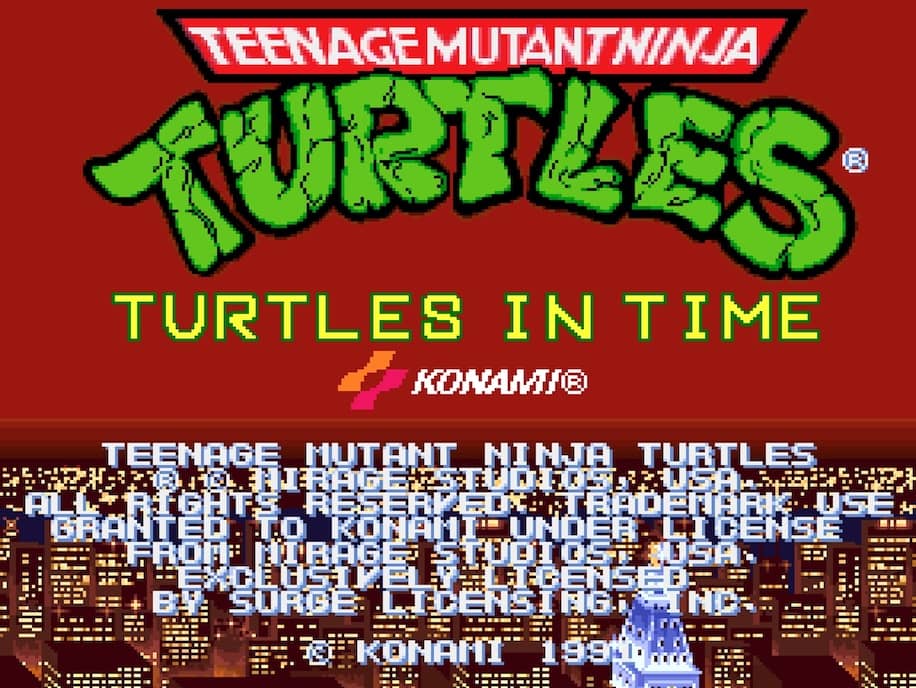
"Teenage Mutant Ninja Turtles - Turtles in Time" continues the beat 'em up gameplay of its predecessor, but the cooperative experience is even more chaotic. The arcade version came in two-player and four-player cabinets; the two-player version let you choose any character, while the four-player version assigned Turtles in order of controller position. This design accommodated arcades of different sizes and ensured character variety in multiplayer sessions.
The combat system received a major upgrade with the addition of combos and the ability to throw enemies. You can chain attacks into combos, and also grab enemies to hurl them into others, causing area damage. This mechanic not only made combat more satisfying but also encouraged players to think about positioning and timing rather than just mashing buttons.
Controls involve a joystick for movement, with attack and jump buttons as the core; combining them allows for running, sliding, dash attacks, and other moves. These techniques make the Turtles more agile in the fray and add depth to the controls. Players need to choose the right move based on enemy types and the environment, such as using a slide to close in on ranged enemies or a dash attack to break through a surround.
The levels span multiple eras, from New York streets to prehistoric jungles, pirate ships, and futuristic cities, offering rich variety. Each stage features unique enemies and hazards, like dinosaurs in the prehistoric level and cannonballs on the pirate ship, keeping the time-traveling journey fresh.
Boss battles are a highlight. The arcade version features fly-form Baxter Stockman, Metalhead, the Pizza Monster, Cement Man, Tokka and Razhar, Leatherhead, Super Krang, Krang's UFO, and Shredder. Each boss has distinct attack patterns and weaknesses, requiring players to skillfully use combos and throws to win, especially the final boss, Shredder, which tests your overall skill.
Background and release
"Teenage Mutant Ninja Turtles - Turtles in Time" is the sequel to Konami's 1989 arcade game "Teenage Mutant Ninja Turtles," based primarily on the 1987 animated series. The show's popularity made the Turtles a global phenomenon, and Konami capitalized on it with a sequel that continued the beat 'em up gameplay while adding the creative time-travel premise, enriching the game's content.
In the game's opening animation, Super Krang steals the Statue of Liberty while Shredder taunts the Turtles, who then pursue him across time. This intro sets up the story and showcases the animated series' humor and exaggeration, quickly immersing players in the Turtles' world.
The arcade version was not released in Japan, which is somewhat unusual. Although developed by Konami, the Japanese market may have preferred other genres at the time, or the release strategy differed. Thus, Japanese players initially could only experience the game through overseas versions or later ports.
In 1992, the game was ported to the Super Nintendo (SNES), titled "Teenage Mutant Ninja Turtles IV: Turtles in Time" in North America and Australia, while Europe renamed it "Teenage Mutant Hero Turtles IV" due to censorship. The SNES version kept an unnumbered title in Japan, avoiding numbering confusion.
The SNES version was not a simple port; it added substantial new content. For example, the "Neon Night-Riders" level used Mode 7 effects, but the enemy-throwing mechanic was not used; new stages like the Technodrome and bosses like Rat King, Slash, Bebop, and Rocksteady were added, with the final boss changed to Super Shredder. These changes made the SNES version a classic in its own right, but the arcade original's status remains unshakable.
Development
The game's music was composed by Mutsuhiko Izumi, who had scored the previous arcade game. Izumi's style blends rock and electronic elements with strong rhythms, perfectly matching the fast-paced combat. The music not only heightened the tense atmosphere but also became memorable melodies for players.
Early in development, the working title was "TMNT Time Travelers," as revealed by Konami America employee Steve Kaufman. This title directly pointed to the time-travel theme, later simplified to "Turtles in Time," but the "Time Travelers" concept was fully realized in the level design.
The arcade version's title screen used the song "Pizza Power," from the "Coming Out of Their Shells" tour, a pop-rock tune themed around the Turtles. Incorporating a pop song into the title screen was quite innovative at the time and enhanced the game's entertainment vibe.
The game's music was later included in the 1992 compilation album "Konami All-Stars 1993," released by King Records. This album gathered music from multiple Konami games, and the inclusion of "Turtles in Time"'s soundtrack speaks to its quality and popularity.
The arcade version had dedicated conversion kits for four-player and two-player setups, allowing arcades to adjust according to demand. This hardware design reflected Konami's careful consideration of the arcade market, enabling smooth operation in venues of different sizes.
Reception and legacy
"Teenage Mutant Ninja Turtles - Turtles in Time" became one of Konami's best-selling arcade games, holding a significant place in arcades of the time. Its successful gameplay design and multiplayer cooperative experience set a benchmark for subsequent beat 'em ups and solidified Konami's position in the arcade market.
The SNES version received high praise from media and players. Four reviewers from Electronic Gaming Monthly all gave it 9/10, praising its gameplay, new moves, and two-player versus mode, but criticized the low difficulty. Nintendo Power ranked it seventh in its top ten games of 1992, and IGN and GamesRadar listed it among the best SNES games of all time, at 39th and 24th, respectively.
In 2005, the arcade version was included as an unlockable in "Teenage Mutant Ninja Turtles 3: Mutant Nightmare," allowing new players to experience the original arcade gameplay. This inclusion was both a tribute to the classic and a nod to nostalgic veterans.
In 2009, Ubisoft released a 3D remake, "Turtles in Time Re-Shelled," based on the arcade version. The remake featured modern 3D graphics but retained the original levels and gameplay, letting a new generation enjoy the classic charm. However, the remake's changes sparked some controversy, with some old fans feeling the original's pixel art and feel were superior.
In 2022, the arcade and SNES versions were included in "Teenage Mutant Ninja Turtles: The Cowabunga Collection," allowing players to revisit these classics on modern platforms. The collection also included other Turtles games and added conveniences like save states and rewind, further enhancing playability. This collection's release proves the enduring status of "Turtles in Time" within the Turtles game series.





