
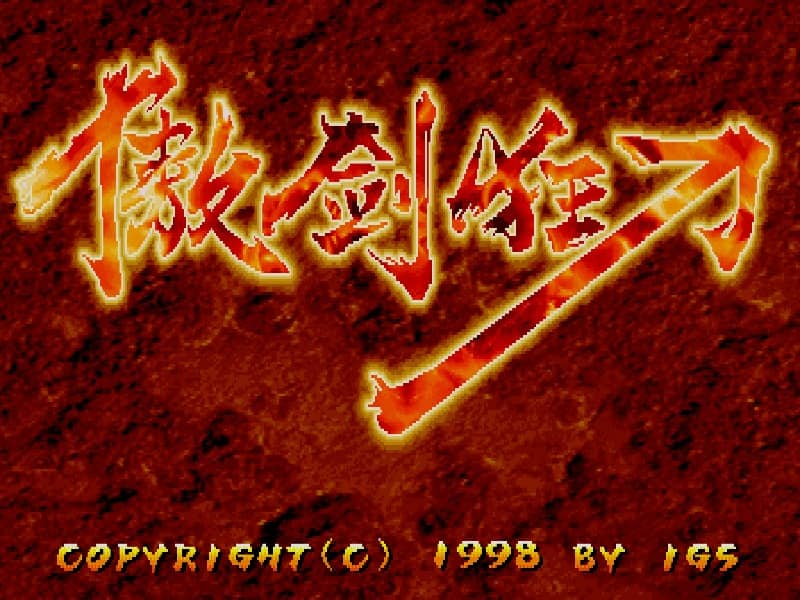
Gameplay and design
At its core, "傲剑狂刀" is a 2D weapon-based fighting game where characters wield swords, blades, and other armaments. Combat is fast-paced, with attack ranges and hitboxes centered around the weapons. Unlike typical hand-to-hand fighters, weapon combat emphasizes distance control and timing, making each exchange feel like a duel between ancient martial artists.
The game's standout feature is its two-character tag team system. Before a match, players select two fighters and can switch between them at any time during battle. The inactive character gradually recovers health. This adds a strategic layer, as players must manage both characters' conditions and decide the optimal moment to swap, keeping every match dynamic and unpredictable.
Twelve playable warriors are available, each with unique weapons and fighting styles. Some excel at rapid advances, while others favor defensive counterattacks. The arsenal includes swords, sabers, spears, whips, and more, catering to diverse player preferences. Differences go beyond appearance; attack properties and combo routes vary significantly, rewarding dedicated practice.
Weapon-based special combat is another highlight. Weapons are not just extensions of normal attacks but enable special actions like blocking and disarming. Players can parry opponent strikes with precise defense or even knock the weapon out of their hands, leaving them at a disadvantage against an armed foe. This mechanic deepens the offensive-defensive interplay and makes high-level matches more spectacular.
Overall, the gameplay design of "傲剑狂刀" was quite bold for its time. The tag team and weapon systems are not mere gimmicks but work together to create a fast-paced, highly strategic combat experience. For players who enjoy mastering systems, the game offers ample depth, and its design ideas remain distinctive even by today's standards.
Background and release
"傲剑狂刀" was developed and published by Taiwan's IGS (International Games System), marking one of the company's significant early ventures in the arcade scene. IGS holds a prominent position in Taiwan's gaming industry, with its titles popular domestically and abroad. As an original IP, this game embodies IGS's exploration of the fighting game genre.
The game runs on IGS's proprietary PGM arcade board, a hardware platform designed specifically for the company's games. The PGM board was known for its stable performance and low cost, ensuring smooth operation of "傲剑狂刀". It was also one of the early titles on the PGM board, witnessing IGS's simultaneous development in arcade hardware and software.
Regarding the release date, there are minor discrepancies in available records. The title screen displays the year 1998, but preserved release records indicate a launch in late 1997. Such differences are not uncommon in the arcade industry, likely due to a gap between development completion and actual market release. In any case, the game reached players between late 1997 and 1998.
In IGS's product lineup, "傲剑狂刀" stands alongside notable titles like the "三国战记" series, reflecting its importance in the company's portfolio. Although it did not spawn a large franchise like "三国战记", it carved a niche as a fighting game within IGS's arcade matrix, showcasing the company's diverse development strategy.
From a historical perspective, "傲剑狂刀" emerged during a fiercely competitive era for arcade fighting games. Japanese developers dominated the market, but IGS found its footing with this Chinese-themed, systemically unique title. It not only demonstrated Taiwan's game development prowess but also offered Chinese-speaking players a localized fighting experience.
Development
"傲剑狂刀" was crafted by a full IGS development team, with credits listing roles in production, programming, animation, music, and voice acting. This indicates a well-organized project rather than a small-scale effort. The team managed to deliver comprehensive work from system design to art and audio within limited resources.
The game was developed in Taiwan, and as a local company, IGS naturally infused the project with local cultural elements. Set in ancient China, the characters and stages exude a strong wuxia (martial arts) atmosphere, reflecting the popularity of wuxia culture in Taiwan at the time. The team integrated this cultural backdrop, allowing players to feel a familiar jianghu (martial world) ambiance while fighting.
Using the PGM board was a key development decision. As IGS's self-developed hardware, the team was intimately familiar with its capabilities, enabling better performance optimization. Additionally, the proprietary board reduced licensing costs, giving the company more flexibility in controlling the development timeline and release strategy, facilitating a smooth launch.
Implementing the tag team system posed technical challenges. The arcade board's processing power was limited, requiring careful programming and memory management to handle two characters' states and switching logic. The final product runs smoothly with no noticeable lag during switches, reflecting the team's technical dedication.
Notably, the game is classified under IGS's horizontal action-scrolling game list as a PGM platform title, hinting at the team's experience in action games. Although "傲剑狂刀" is a fighting game, the shared principles of action design allowed the team to draw on prior experience, resulting in solid character animation and impactful hit feedback.
Reception and legacy
"傲剑狂刀" left a lasting impression on arcade players, particularly in Chinese-speaking regions, where it is regarded as a representative local fighting game. Its unique tag team system and weapon-based combat set it apart from the many clones of Japanese titles, offering fresh ideas for future fighting game design.
In IGS's horizontal action game list, "傲剑狂刀" is explicitly mentioned, indicating its enduring presence in the company's catalog. Although it did not grow into a large franchise like "三国战记", it served as an early fighting game experiment that provided valuable experience for IGS's subsequent action game development.
In the AllGamesGo local directory, "傲剑狂刀" is recorded at rank 29. While this ranking does not represent an official evaluation, it at least shows that the game has a certain level of recognition in the player community. For an arcade game without massive marketing, being spontaneously recorded and discussed by players is itself a sign of influence.
In terms of impact, the tag team system was uncommon in fighting games at the time, and similar designs have appeared in later titles. While a direct influence chain cannot be proven, it at least indicates that IGS was at the forefront of gameplay innovation. The emphasis on weapon combat also enriched the diversity of the fighting game genre.
Unfortunately, there is no mention of any subsequent ports or remakes of "傲剑狂刀". This means the game remained primarily on arcade platforms, gradually fading from the mainstream as arcades declined. Nevertheless, for players who experienced it in arcades, it remains a memorable chapter and a notable footnote in Taiwan's game development history.





