
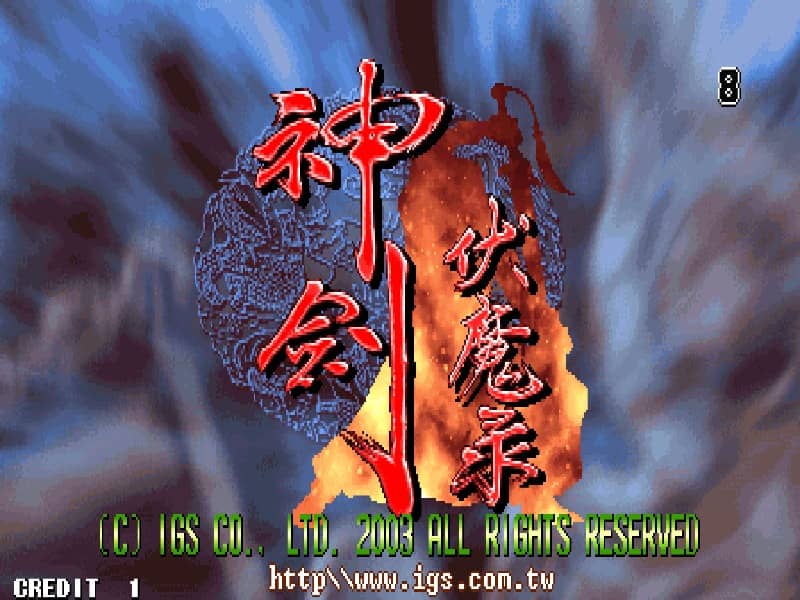
Gameplay and design
The core gameplay of Shen Jian Fu Mo Lu is classic side-scrolling beat 'em up action, where players advance through levels, defeating enemies along the way and facing off against a boss at the end. The controls feel solid, with responsive movement, jumping, and attacking that are direct and without unnecessary lag. Players need to learn enemy attack patterns and strike at the right moment to pull off smooth combos, and this "counter and strike" experience is what makes beat 'em ups so addictive.
The game's standout feature is its combat system that combines weapons with combos. During battle, players can acquire different weapons, each with unique attack ranges and hit properties. For example, swords and blades have fast attack speed and moderate range, while polearms have longer reach but slower swings. Weapons not only change the basic attack animations but can also be integrated into combos, allowing players to weave weapon attacks into their chains for flashier damage. This design encourages players to switch weapons flexibly based on the situation rather than relying solely on fists and feet.
The game offers multiple playable martial artists, each with their own move sets and attribute tendencies. Some characters have high strength and deal heavy damage but are slower, while others are agile and can chain more hits but have lower per-hit damage. Players can choose characters based on their preferences, and the distinct playstyles add to the game's replay value. In multiplayer, different character combinations can complement each other, making battles easier and more fun.
In addition to normal attacks and weapons, the game features a special move system. Players can consume a spirit gauge to unleash powerful special moves, which often have wide-area hitboxes or invincibility frames, capable of turning the tide in critical moments. The visual effects of these moves are quite spectacular, enhanced by the arcade hardware's graphics, delivering a strong visual impact. However, building the spirit gauge requires aggressive play, so efficiently accumulating and wisely using special moves becomes a dividing line between novices and experts.
The level design is also thoughtful, with scenes inspired by ancient Chinese towns, mountains, forests, and palaces, rich in background details that create a strong wuxia atmosphere. Levels feature not only regular enemies and bosses but also traps and mechanisms like rolling boulders and arrow volleys, adding challenge. Players must watch out for these environmental hazards to avoid being caught off guard. Overall, the game's pacing is well-balanced, with intense combat interspersed with brief exploration and breathing room, keeping players engaged.
Background and release
Shen Jian Fu Mo Lu was developed by Taiwan's IGS and officially released in 2003. IGS had been deeply involved in the arcade scene for years, having previously built up extensive experience in beat 'em up development with the Sangoku Senki series and the Saiyūki Sekiiden series. This game can be seen as another attempt by IGS in a similar genre, continuing the company's signature wuxia and mythological style but with several system innovations, aiming to bring a fresh experience within a mature framework.
The game was released under different names in various regions, reflecting common practices in the global distribution of arcade games. In Chinese-speaking regions, the game primarily used the names "Shen Jian Fu Mo Lu" and "Shen Jian Feng Yun," with "Shen Jian Fu Mo Lu" being the most familiar to players. In North America, it was released as "The Gladiator" in January 2003, a name that literally translates to "gladiator," evoking ancient Roman arenas, but the game's actual setting is ancient China. Such naming discrepancies were not uncommon in arcade game imports at the time.
The Japanese name "Tougenkyou Road of the Sword" carries a more Eastern fantasy flavor, with "Tougenkyou" suggesting a wild and mysterious aura, while the subtitle "Road of the Sword" points to the game's core theme: a journey to find a legendary sword. The different regional names reflect localizations tailored to each market, but the core content remains consistent across versions.
The game runs on IGS's own PGM arcade board, which also powered other well-known titles like the Sangoku Senki series. The PGM board was quite common in arcades at the time, with performance sufficient for smooth 2D action games, and it was also convenient for arcade operators to maintain and swap out. By using its own board, IGS could better control hardware costs and also optimize the software deeply to ensure the game runs well.
From a historical perspective, 2003 marked a period when the arcade market was gradually declining, with home consoles and PC games drawing away many players, but arcades still retained considerable popularity in Asia. IGS released Shen Jian Fu Mo Lu at this time, partly to continue its dominance in the beat 'em up genre and partly to respond to market demand. The game's release in North America and Japan also shows IGS's intention to expand overseas, even though arcade games' influence abroad was waning.
Development
IGS (International Games System) was founded in Taiwan in 1989 and is a well-known arcade game developer in Asia. The company started with mahjong machines and puzzle games, later shifting to action games and establishing a foothold in the Chinese arcade market with the Sangoku Senki series. The development team behind Shen Jian Fu Mo Lu came from this experienced company, knowing well what players expected from beat 'em ups and how to innovate within the existing framework.
During development, the team invested significant effort into the combat system. The combination of weapons and combos was not a simple addition but required careful design of each weapon's hit properties and combo links to ensure smooth transitions when switching weapons. According to available information, the game is playable in the MAME emulator and has been ROM-dumped, meaning its code and assets have been preserved intact for players and researchers to experience and study via emulation.
The PGM board was IGS's self-developed hardware platform, giving the team great freedom. They could adjust hardware performance to suit the game's needs, such as adding memory or optimizing graphics processing, without being constrained by third-party hardware vendors. Additionally, the PGM board supported cartridge-based media, making it easy for arcades to swap games. This integrated software-hardware development model allowed IGS to iterate quickly and, after the Sangoku Senki series, continue to release new titles like Shen Jian Fu Mo Lu on the PGM platform.
The game was also developed with overseas markets in mind, leading to the North American title "The Gladiator" and the Japanese title "Tougenkyou Road of the Sword." Creating these multi-language versions required extra localization work, including translating interface text and adjusting character names. Although arcade games typically have minimal text, these details still needed careful polishing to suit different cultural preferences.
Notably, the game has detailed records in game databases like MobyGames and Arcade-History, which provide valuable resources for future research. Although IGS's official website is no longer active, players can still access the game through emulators and databases. The development team likely didn't anticipate that years later, the game would be preserved and discussed in this way, but it is these digital archives that have extended the life of Shen Jian Fu Mo Lu.
Reception and legacy
Shen Jian Fu Mo Lu holds a place in IGS's list of side-scrolling action games, alongside the Sangoku Senki and Saiyūki Sekiiden series. For arcade players, this game may not be as well-known as Sangoku Senki, but it has a solid reputation among core fans. Its solid controls and unique weapon system make it stand out among similar titles, and many players still find joy in revisiting it on emulators.
The game's records in databases like MobyGames and Arcade-History attest to its value in gaming history. These databases not only document basic information but also preserve regional names and release details, aiding researchers. Although the game never won major awards or achieved impressive sales figures, its place in arcade culture is real, forming part of countless players' memories from that era.
In terms of influence, Shen Jian Fu Mo Lu did not spawn numerous sequels or spin-offs like Sangoku Senki, but it holds significance for IGS's own game development. It showcases IGS's continued exploration in the beat 'em up genre, particularly its attempts at weapon systems and multi-character design, providing reference for later works. For players, it also offered a wuxia experience distinct from the Three Kingdoms theme, enriching the variety of arcade game genres.
As the arcade market declined, many arcade games from that time faded into obscurity, but Shen Jian Fu Mo Lu has been preserved through emulators like MAME. Players can run the game on their computers and relive the arcade days. The emulation community's support for the game's ROM dump and playability reflects players' appreciation. Although the official website is gone, grassroots preservation and sharing have kept the game alive, which is perhaps its most tangible legacy.
Overall, Shen Jian Fu Mo Lu is a beat 'em up worth remembering. It didn't introduce groundbreaking innovations, but it carved out its own identity within a mature genre, providing players with solid entertainment. For fans of beat 'em ups, it's a hidden gem buried by time, worth savoring on an emulator. For game historians, it's also a snapshot of IGS during a specific period, reflecting the rise and fall of Taiwan's arcade game industry.





