
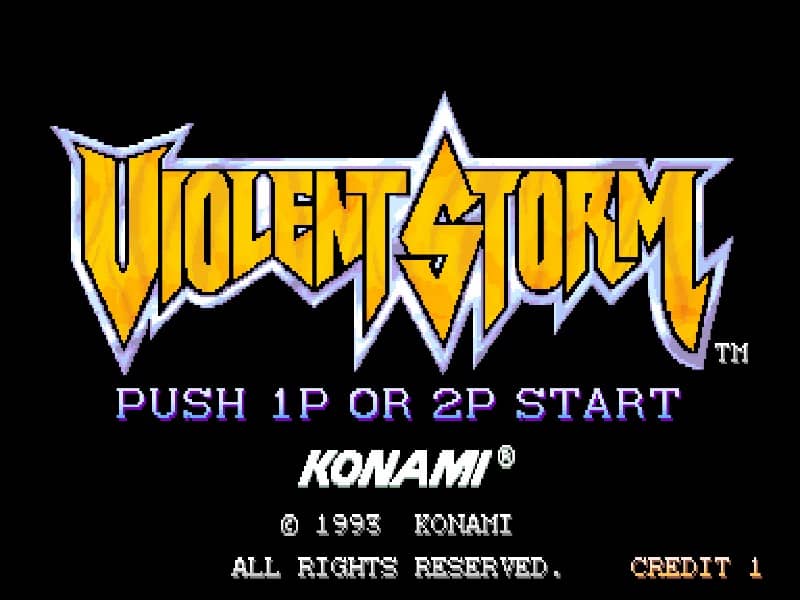
Gameplay and design
At its core, Violent Storm is a classic arcade beat 'em up: you fight through side-scrolling stages, mowing down waves of enemies. The game supports up to three players dropping in with coins, which was a major draw at the time. Each of the three characters has a distinct fighting style, so players of different tastes can find a character that suits them. The controls feel solid, with basic attacks, jumps, and throws all present; it's easy to pick up, but there's depth to discover for those who dig deeper.
The three playable characters are a highlight of the game's design. Wade is the balanced type, with well-rounded stats and a mean uppercut; he's the unofficial leader of the group and a good pick for newcomers. Boris is the powerhouse, dealing heavy damage and boasting four different throws and suplexes; he can even use a pipe to hit downed enemies, making him the go-to for players who like to get up close and personal. Kyle is the speedster, with lower damage but blazing speed; his quick kicks can stop enemy charges, and he handles very nimbly. This differentiation encourages complementary teamwork and adds replay value.
The game spans seven stages with varied settings, from a decaying town to a runaway train, a tavern with trap doors, a metal foundry, a botanical garden, a bay area, and finally Gerd's museum. Each stage has its own visual style and enemy layouts, keeping things fresh as you progress. Weapons appear throughout, such as knives, lead pipes, bombs, electric prods, and spiked balls on chains, which you can pick up and use, adding a layer of strategy to combat.
The throw mechanic is a standout feature of the combat system, but not all characters can use it freely. Wade and Kyle may find their throws on heavy enemies or bosses broken, with the enemy counterattacking unless you mash buttons to overpower them. Boris, however, has a unique ability: he can lift all enemies overhead and hurl or slam them wherever he chooses, a powerful control move that's very handy in a brawl. This design makes each character feel distinct and encourages players to pick based on the enemy types they face.
The enemy roster is varied and thoughtfully designed. From purple-haired, leather-clad thugs with chains to defensive types using manhole covers as shields, martial artists, and elite foes with orange mohawks, each enemy has different attack patterns and behaviors. Enemies also wield a range of weapons, including trash cans, vises, and molten metal, causing plenty of trouble. This rich variety keeps battles unpredictable and tests your ability to adapt to different foes.
Background and release
Violent Storm was released by Konami in 1993, during the golden age of arcade beat 'em ups. In the early '90s, this genre was hugely popular in arcades, and Konami rode the wave with this three-player cooperative title. The game's post-apocalyptic setting was not mainstream at the time, but Konami blended it with beat 'em up gameplay to create a unique atmosphere.
The story is set in the 1990s after World War III, where society has collapsed, thugs run rampant, and the world is rebuilding. The three protagonists—Boris, Wade, and Kyle—are righteous fighters who protect civilians. They take on a criminal organization called the Gerd Gang, which exploits the chaos to oppress the people. This setup adds a sense of saving the world to the brawling.
The plot revolves around a rescue mission. Gerd, the gang's leader, has his underling Red Freddy kidnap the heroes' friend Sheena. To save her, the trio embarks on a perilous journey. This simple storyline runs through the game, giving players a clear goal for their fights. For an arcade game, that's enough to fuel the adventure.
The game achieved a measure of commercial success. In Japan, the November 1, 1993 issue of Game Machine magazine listed it as the 21st most successful arcade cabinet. In Europe, sales were good through January 1994. In North America, RePlay magazine reported in July 1994 that it was the tenth most popular arcade game. These figures show that the game was well received in multiple regions, though not a top-tier hit, it performed steadily.
It's worth noting that popularity varied by region. The Japanese market was relatively saturated with beat 'em ups, so ranking 21st was respectable. Europe and North America fared better, especially North America, where it cracked the top ten, indicating stronger local appeal. These regional differences may reflect player preferences and Konami's global distribution strategy.
Development
Violent Storm was developed and published by Konami, marking a significant attempt in the company's arcade output during the 1990s. Konami had already released several successful arcade games, amassing considerable experience. This title blended fighting and post-apocalyptic themes, showcasing Konami's versatility in genre choices. However, public details about the specific development process are scarce, so we can only glean insights from the game itself and known information.
The music was composed by Kenichiro Fukui, a well-known Konami composer who worked on many classic games. Fukui's score for Violent Storm complements the post-apocalyptic mood, with strong rhythms that heighten the tension of battles. While music is often overlooked in arcade games, a good soundtrack can significantly enhance immersion.
From the game's design, Konami put considerable effort into character differentiation. The three characters not only look different but also play completely differently, requiring extensive balance tuning. Boris's powerful throws, Kyle's speed, and Wade's balance all reflect the team's pursuit of gameplay depth. This design approach was uncommon in beat 'em ups at the time, showing Konami's intent to offer a distinct experience.
The enemy and stage designs also show the team's dedication. The seven stages each have unique themes, from town to train, tavern, foundry, and more, with distinct visual elements and gimmicks. The wide variety of enemies with different attack patterns demanded significant art resources and programming support. Konami's investment in development resources ensured the game's content richness.
While specific development details are limited, it's plausible that Konami looked at popular beat 'em ups of the time and tried to add its own innovations. The post-apocalyptic theme may have been influenced by contemporary films, and the three-player co-op was a push for multiplayer fun. These design decisions collectively shaped the game's unique identity.
Reception and legacy
Violent Storm enjoyed a degree of success in the arcade market, as reflected in magazine rankings of the era. Japan's Game Machine, in its November 1, 1993 issue, listed it as the 21st most successful arcade cabinet—not top-tier, but making the top thirty among many arcade games was no small feat. In Europe, sales were good through January 1994, indicating a solid following among European players.
In North America, RePlay magazine reported in July 1994 that the game was the tenth most popular arcade game, its best commercial showing. The North American market had a high appetite for beat 'em ups, and Violent Storm's solid gameplay and cooperative mode won over players. This ranking underscored the game's popularity in North American arcades.
Among players, Violent Storm left a positive impression. Many praised the differentiated character designs and the fun of cooperative play. While it didn't become a phenomenon like Final Fight or Streets of Rage, it remains a fondly remembered classic for arcade enthusiasts.
The game's influence is seen in its impact on Konami and the genre. Konami solidified its position in the arcade scene with this title and gained experience for future projects. For beat 'em ups, Violent Storm's character differentiation offered a reference for later games.
Today, though the arcade era has passed, Violent Storm is still cherished by many older players. It represents a slice of 1990s arcade gaming, carrying the memories of that time. For fans of retro games, it's still worth a try to experience the excitement and passion of the arcade days.





