
Gameplay and design
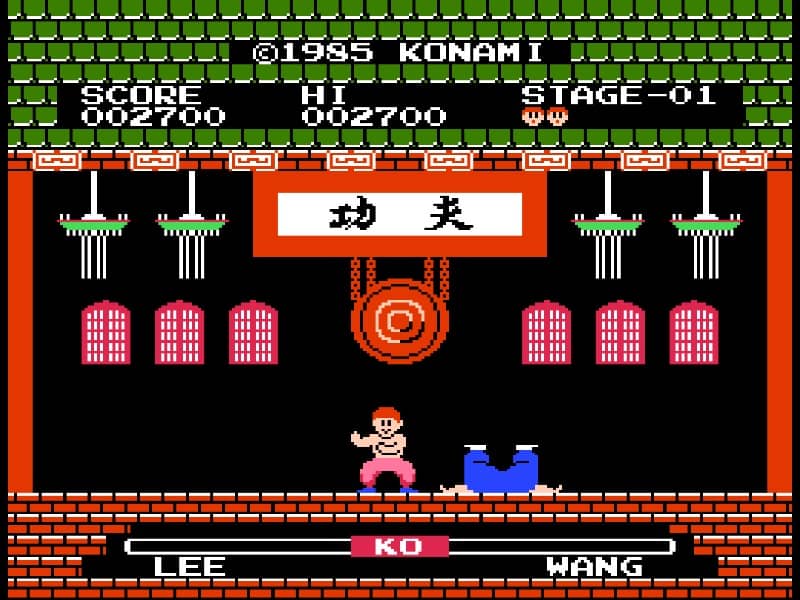
In the Famicom version of Yie Ar Kung-Fu, the player controls the protagonist Lee, whose goal is to infiltrate the Tower of Mianma and defeat the 'Clan of the Zako' that resides there. The game is a side-scrolling one-on-one fighting game, with Lee standing in a fixed arena, facing opponents who appear from one side of the screen. The player can make Lee stand, crouch, or jump, and in each stance, throw punches or kicks, combining them into various attack patterns. Compared to the arcade version, the Famicom version has a reduced set of moves, but the core rhythm of attack and defense, along with distance control, remains intact, allowing players to experience the joy of fighting through simple controls.
In the Famicom version, Lee must face five opponents in sequence: Wang, Tao, Chen, Lang, and Wu (spelled 'Mu' in the Famicom version). Each opponent has a unique attack pattern and weakness; for example, some are skilled at fast punching, others use long weapons, and some excel at jumping attacks. The player must observe the opponent's movements, find openings, and strike at the right moment. This structure of challenging strong enemies one by one keeps the game fresh and challenging within a simple framework, and it laid the groundwork for the common 'boss rush' mode in later fighting games.
The game introduced a health bar system, which is a significant contribution to the fighting game genre. In the Famicom version, both Lee and his opponents have health bars; attacks deplete the opponent's health, and the match ends when one reaches zero. Unlike earlier fighting games where a single hit could defeat an opponent, the health bar system allows players to absorb some damage and encourages more strategic offense and defense. This design later became a standard feature in fighting games, influencing countless subsequent titles.
The Famicom version also includes bonus stages that appear after defeating a certain number of opponents. In these stages, Lee must hit projectiles flying in from both sides of the screen, such as vases or throwing knives, earning points for each hit. These stages are fast-paced and provide a change of pace from the main battles, as well as an opportunity to earn extra lives. The bonus stages add to the game's fun and replayability, and they are a distinctive feature of the Famicom version compared to the arcade original.
After Lee defeats the final boss, Wu, the game does not end but loops back to the beginning, with increased difficulty: opponents attack more frequently, have more health, and the background colors change. This looping design was common in early games, aiming to extend playtime and challenge players' limits. For many players, seeing the ending screen and then taking on the higher difficulty again was a major source of enjoyment in the Famicom version.
Background and release
Yie Ar Kung-Fu was originally released by Konami as a limited arcade release in Japan in October 1984, followed by a nationwide release in January 1985 and an international release in March of the same year. The arcade version's protagonist is named Oolong, modeled after Bruce Lee, and the game was directly inspired by Bruce Lee's Hong Kong martial arts films. Compared to contemporary fighting games like Karate Champ, Yie Ar Kung-Fu introduced a health bar system and adopted a more fantastical, fast-paced action style, giving players a unique fighting experience in arcades.
In the arcade version, the player controls Oolong and must defeat 11 opponents, including Buchu, Star, Nuncha, Pole, Feedle, Chain, Club, Fan, Sword, Tonfun, and Blues. Each opponent has distinct characteristics; some use nunchaku, some use long staffs, some use chains, and there are even characters who use fans and swords. This diverse enemy design kept each battle fresh and showcased Konami's creativity in character design.
The Famicom version of Yie Ar Kung-Fu was released in Japan on April 22, 1985, developed by Konami, with music composed by Miki Higashino. Unlike the arcade version, the Famicom version's protagonist is renamed Lee, and the story is changed to infiltrating the 'Tower of Mianma' to defeat the 'Clan of the Zako'. This change may have been made to adapt to the Famicom's hardware limitations and the home console audience, while also giving the game a clearer narrative framework. In the Famicom version, Lee faces only five opponents, but each has a more distinct personality, and the combat pace is better suited for the home console environment.
The creation of Yie Ar Kung-Fu is closely tied to the development of the fighting game genre at the time. Before it, fighting games mostly simulated real martial arts, with stiff movements and little variety. Yie Ar Kung-Fu boldly adopted exaggerated moves and flashy effects, making the combat more visually appealing. Additionally, the introduction of the health bar system meant that battles were no longer 'one-hit kills' but required strategy and skill. These design concepts pointed the way for the future of fighting games and established Yie Ar Kung-Fu's important place in gaming history.
The arcade version of Yie Ar Kung-Fu was a huge commercial success, becoming the best-selling arcade conversion kit in the United States in 1985 and also popular in Japan and Europe. In March 1985, Japan's Game Machine magazine listed it as the second most successful arcade game of the month; in December of the same year, it ranked seventh on the RePlay arcade software conversion kit chart in the U.S. These achievements demonstrate the game's influence at the time and prompted Konami to port it to multiple home platforms, allowing more players to experience this classic.
Development
Yie Ar Kung-Fu was developed by Konami, with music composed by Miki Higashino. Higashino later became famous for her work on games like Contra, but in Yie Ar Kung-Fu, she already showed her ability to capture the rhythm and atmosphere of game music. The Famicom version's music, though simple, has catchy melodies that complement the fighting scenes, becoming memorable tunes for many players. The development team achieved smooth action and rich game content through clever programming and design within the limited hardware constraints.
The Famicom version's story, which involves defeating the 'Clan of the Zako', differs significantly from the arcade version's 'Throne Cup' tournament. In the arcade version, Oolong challenges various masters to compete for the throne; in the Famicom version, Lee must infiltrate the Tower of Mianma to eliminate an evil gang. This change not only made the story more appealing to home console players but also shifted the setting from an arena to a tower, adding an adventurous atmosphere. The five opponents Lee faces in the Famicom version also have different names and appearances compared to the arcade version, reflecting the differences in character design between the two versions.
The porting process for Yie Ar Kung-Fu involved multiple platforms, including MSX, Famicom, Commodore 64, ZX Spectrum, Amstrad CPC, and BBC Micro. Each platform version had adjustments in graphics, sound, and controls to suit its hardware characteristics. For example, the MSX version is similar to the Famicom version, with the protagonist named Lee and the story of defeating the 'Clan of the Zako'; the home computer versions are closer to the arcade original, retaining the 11 opponents and the 'Throne Cup' setting. This multi-platform porting strategy allowed Yie Ar Kung-Fu to reach a wider audience.
During development, the Konami team drew heavy inspiration from Bruce Lee's films, including the character's moves, clothing, and fighting style. The protagonist Oolong (or Lee) clearly references Bruce Lee, and the opponents' designs incorporate various martial arts styles and weapons. This homage to kung fu culture gave the game a unique appeal to both Japanese and Western players at the time. Additionally, the in-game Chinese voice saying 'thank you' reflects Konami's use of Chinese cultural elements, a detail often mentioned by players.
The development of Yie Ar Kung-Fu also reflects Konami's pursuit of game quality. In the arcade version, the player could perform 16 different actions, including punch and kick combinations while standing, crouching, or jumping, which was a fairly rich action system for its time. Furthermore, the game paid careful attention to the knockdown animations: female characters fall on their side, male characters (except Feedle) fall on their backs, and Feedle disappears. These small details, though minor, show the development team's dedication and add a sense of realism and fun to the game.
Reception and legacy
Yie Ar Kung-Fu was a huge commercial success, with the arcade version becoming the best-selling arcade conversion kit in the United States in 1985, and the home computer version becoming the best-selling home game in the United Kingdom in 1986. These achievements not only prove the game's appeal but also reflect the popularity of fighting games among players at the time. As a representative early fighting game, Yie Ar Kung-Fu brought prestige to Konami and laid the foundation for the development of subsequent fighting games.
The foundational role of Yie Ar Kung-Fu in the fighting game genre cannot be overstated. It introduced the health bar system, which later became a core mechanic in fighting games; its diverse opponents and fast-paced combat also provided a design template for later fighting games. Many later classic fighting games, such as Street Fighter and The King of Fighters, drew inspiration from Yie Ar Kung-Fu. It is fair to say that Yie Ar Kung-Fu is a significant milestone in the history of fighting games.
Yie Ar Kung-Fu has been re-released and ported multiple times since its initial release. In 2002, the arcade version was included in the Game Boy Advance compilation Konami Collector's Series: Arcade Advanced; in 2005, the arcade version was released in Japan as part of the Oretachi Gēsen Zoku series for PlayStation 2; and in 2019, the arcade version was released for Switch and PS4 through the Arcade Archives series. Additionally, the Famicom version has been re-released on Game Boy Color, Sega Saturn, and PlayStation. These ports and re-releases allow new generations of players to experience this classic game.
A sequel, Yie Ar Kung-Fu II, was released a year later, but only for home computer platforms. The sequel expanded on the gameplay but had less impact than its predecessor. Additionally, Konami once planned to release Martial Champion as Yie Ar Kung-Fu 2, but this never materialized. Although these later works did not replicate the success of Yie Ar Kung-Fu, they reflect Konami's continued exploration of the fighting game genre.
Yie Ar Kung-Fu has left a deep impression on players, especially the Famicom version, which became part of the childhood memories of many Chinese players. The game's simple yet challenging gameplay and unique 'Tower of Mianma' story made it stand out among many Famicom games. Even today, players revisit this classic through emulators or re-releases, and its place in gaming history is widely recognized. As a game born in the 1980s, Yie Ar Kung-Fu's influence has spanned decades and is still remembered by players and the industry alike.





