Gameplay and design
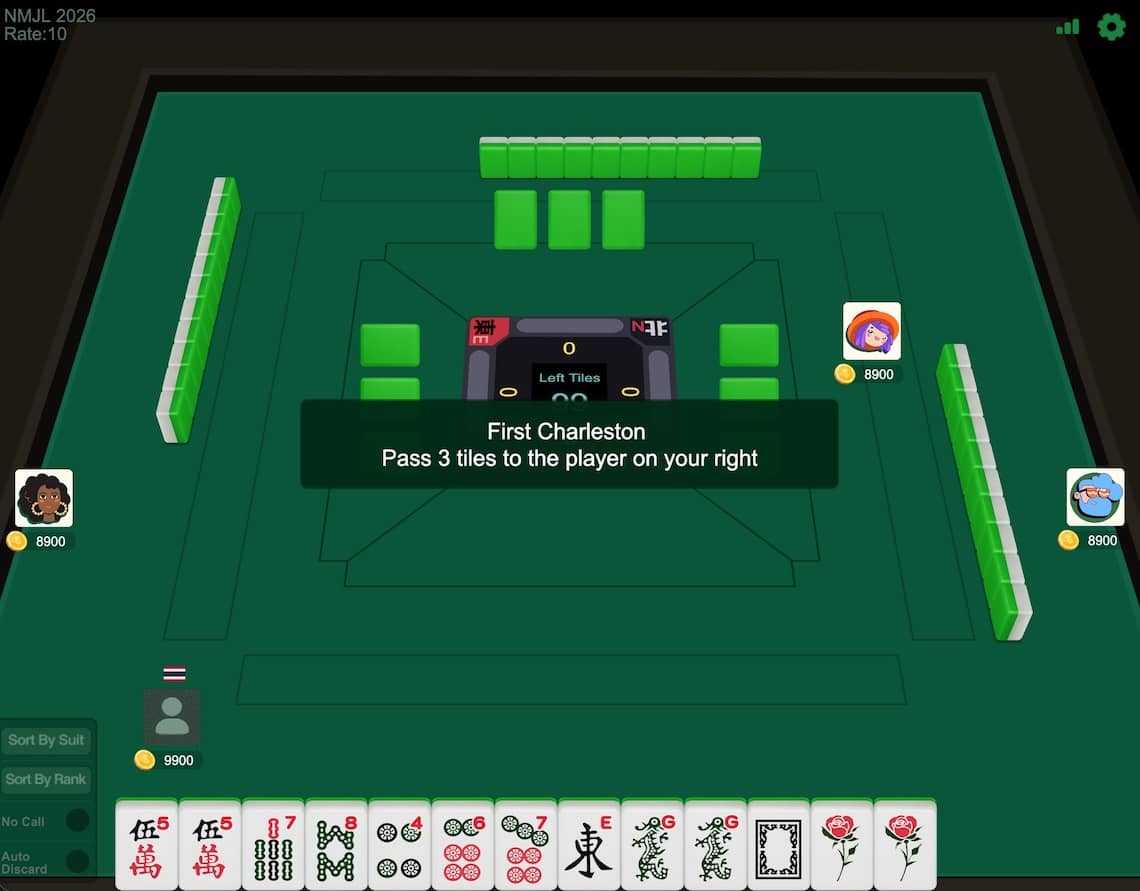
American Mahjong is an American mahjong game that runs in a browser. It uses the classic four-player draw-and-discard flow rather than the tile-matching, pair-clearing style of play often associated with mahjong. American mahjong typically uses a set that includes jokers, which can stand in for needed tiles and make hand combinations more flexible. Play revolves around drawing, discarding, and building a hand, with the goal of completing a valid pattern by the time your turn comes around.
One distinctive feature of American mahjong is the pre-game tile exchange known as the Charleston. Before drawing begins, players pass unwanted tiles in a set order to reshape their hands. This step appears in many American mahjong sessions and is part of what sets the variant apart from other mahjong rulesets. In addition, the legal target hands in American mahjong are not fixed; they are defined by the card the National Mah Jongg League issues each year, so the valid hands can shift from one year to the next.
It is worth noting that American mahjong is a different ruleset from official Chinese mahjong, Hong Kong mahjong, and Japanese riichi mahjong, with differences in tile composition, scoring, and special procedures. This browser title presents the basic framework of American mahjong, but the available information does not confirm whether it implements every optional procedure, such as specific Charleston variants or the full contents of the annual card. Players can treat it as an entry point for getting to know American mahjong rules rather than a complete and flawless rules simulation.
Background and release
American Mahjong is a game presented in browser form, with a title that points directly at the American mahjong variant. The available information indicates that the work was previously tagged with the developer label "134x" and the year "2012," but neither item can be independently verified. As a result, its original development team and initial release date can only be treated as uncertain and should not be cited as established fact.
From a platform standpoint, the work currently exists as a browser implementation that players can run directly through a web page. It is important to distinguish, however, that a browser being able to run an older game does not mean it was originally designed as an HTML5 game for the web. The available information does not provide the original release platform, so it cannot be determined whether it began as desktop software, a mobile app, or something else. This gap in platform information is a blank spot in the work's history that should be clearly acknowledged.
In addition, the work's relationship to any official body has not been confirmed. There is no evidence that it is an official product of the National Mah Jongg League, so it should not be treated as officially licensed software. Although its title and gameplay point to American mahjong, its author, first publication date, licensing status, and commercial history are all unconfirmed. These unknowns are a significant part of the work's background and a reminder to be careful when citing related information.
Development
Very little verifiable information is available about the development of American Mahjong. The available information does not provide specific hardware requirements, development tools, or technical details, so its underlying implementation and optimization cannot be discussed. The only thing that can be established is that it is now presented as a browser implementation, meaning players can access it directly through a modern web browser without installing additional software or plugins.
When it comes to translating the rules, American mahjong itself involves some complex procedures, such as the use of jokers, the Charleston tile exchange, and target hands defined by the annual card. The available information does not give a clear answer on whether this browser title fully implements those rules. It may cover only the basic draw-and-discard flow, or it may include some optional steps, but the exact scope cannot be confirmed. Therefore, any discussion of its rules implementation can go no further than saying that it presents the basic framework of American mahjong; it cannot be assumed to support all variants or options.
Another point to keep in mind is licensing. The card the National Mah Jongg League issues each year is the basis for many American players' games, but this work has not been shown to have any connection to the league. It may simply be a game made by an independent developer based on public rules, or it may have drawn on some publicly available material, but there is no evidence either way. In terms of development background, all that can be confirmed is that it is a browser-based American mahjong game; other details, such as the author's identity, development motivations, and rules sources, cannot be verified.
Reception and legacy
As a browser-based American mahjong game, American Mahjong's value lies more in offering a convenient digital way to encounter the game. For players unfamiliar with American mahjong, it may be a low-barrier entry point that lets them experience basic rules such as four-player draw-and-discard and jokers right on a web page. That accessibility has meaning in itself, especially when physical games or dedicated software are not easy to come by.
However, the work's historical standing and influence are difficult to assess at present. The available information does not provide sales figures, user reviews, or industry awards, so its reception among player communities cannot be judged. At the same time, because author and publication information are unconfirmed, it cannot be placed within a particular developer's body of work. Its existence is more like an isolated web application than part of a series with a clear lineage.
In terms of how representative it is of the rules, the work shows some common elements of American mahjong but cannot stand in for the whole of it. The National Mah Jongg League's annual card, the specific rules of the Charleston, and regional variants may all fall outside what it implements. When assessing how representative its rules are, then, restraint is warranted: it should be seen as one particular implementation rather than a standard model of American mahjong. Its main value may be that it gives players a digital entry point while also reminding us to be mindful of the limits of the information about its origins.