
Gameplay and design
The core gameplay of Harmony of Dissonance continues the exploration-based action framework established by Symphony of the Night. Players control Juste as he freely moves through a vast castle, defeating enemies to gain experience and level up, while collecting weapons and equipment to strengthen himself. Unlike pure action games, this title incorporates role-playing elements: character abilities grow with level, and equipping different weapons and armor affects combat performance, giving players more depth in character building and loadout customization as they progress through the map.
The most striking design feature is the dual-castle system. The game's castle exists in two versions, A and B, which are largely similar in map structure but differ in enemy placement, item distribution, and the connectivity of certain rooms. Players must repeatedly travel between the two castles, using keys or abilities obtained in one to open paths in the other. This interconnected mechanic makes exploration more convoluted and layered, and causes the same map to present distinctly different strategies in its two forms.
In combat, Juste wields the traditional whip but can also carry sub-weapons and combine them with five spellbooks scattered throughout the castle. Each spellbook corresponds to an elemental attribute, and when paired with different sub-weapons, produces varied magical attacks. For example, combining the holy book with the fireball creates a ring of flame around the player, while pairing the cross with the ice book launches a screen-piercing ice pillar. This system encourages players to switch combinations flexibly based on enemy types and combat scenarios, adding strategic depth and experimental fun to battles.
To satisfy hardcore players, the game offers several extra modes. After clearing the game, players can tackle Boss Rush mode, facing all bosses consecutively within a time limit. Maxim mode lets players control the other protagonist, Maxim, who has a different fighting style from Juste. Additionally, entering the classic Konami code unlocks an 8-bit pixel-art version of Simon Belmont, allowing veteran players to relive the simple, brutal action of the original Castlevania.
Overall, Harmony of Dissonance attempts to replicate the exploration experience of Symphony of the Night within the GBA's limited hardware. While the dual-castle design may feel repetitive to some players in the later stages, the rich combat variety from the spellbook combination system and the replayability offered by multiple modes ensure the game retains sufficient depth and longevity in the action-RPG dimension.
Background and release
Castlevania: Harmony of Dissonance was first released in Japan on June 6, 2002, followed by North America on September 17 and Europe on October 11. As the second Castlevania game on the Game Boy Advance, it came right after 2001's Circle of the Moon, offering handheld players another chance to adventure through Dracula's castle. At the time, the GBA had been on the market for just over a year, and Konami's commitment to the platform was evident.
The story is set in 1748, fifty years after Simon Belmont, the original protagonist, defeated Dracula and lifted the curse. Players take on the role of Juste Belmont, Simon's grandson and a young vampire hunter who inherits the family's sacred whip. The plot begins when Juste's childhood friend Lydie is mysteriously abducted, and her fiancé Maxim returns gravely wounded. To rescue Lydie, Juste steps into the suddenly appearing castle.
In the series timeline, Harmony of Dissonance occupies a bridging position. It connects the classic era centered on Simon and also plants seeds for later works. Details such as Juste's relationship to the Belmont family and the cyclical resurrection of Dracula feel familiar to veteran players, while also providing background for the series' subsequent narrative developments.
On the GBA, Harmony of Dissonance, along with Circle of the Moon and the later Aria of Sorrow, forms a complete handheld trilogy. Although the three games differ in style and systems, they collectively witness the evolution of the Castlevania series on handhelds. As the middle entry, this game continues the exploration gameplay of its predecessor while innovating in graphics and systems, laying the groundwork for the mature presentation of Aria of Sorrow.
It is worth noting that the English subtitle "Harmony of Dissonance" literally translates to "harmony of discord," which may hint at a certain contradiction in the game's design and execution—it attempts to recreate the glory of Symphony of the Night on the GBA, yet falls short due to hardware limitations and design trade-offs. This contradiction is also reflected in the game's post-release reception, becoming a focal point of discussion among players and critics.
Development
Harmony of Dissonance was developed by Konami Computer Entertainment Tokyo, with Koji Igarashi as producer, who later became renowned for the Castlevania series. Before development, Igarashi explicitly stated his goal of creating a game that would recreate the Symphony of the Night experience on the GBA. To this end, he led the team in compressing console-level graphics and systems into the handheld under limited hardware conditions, a goal that directly influenced the overall design direction.
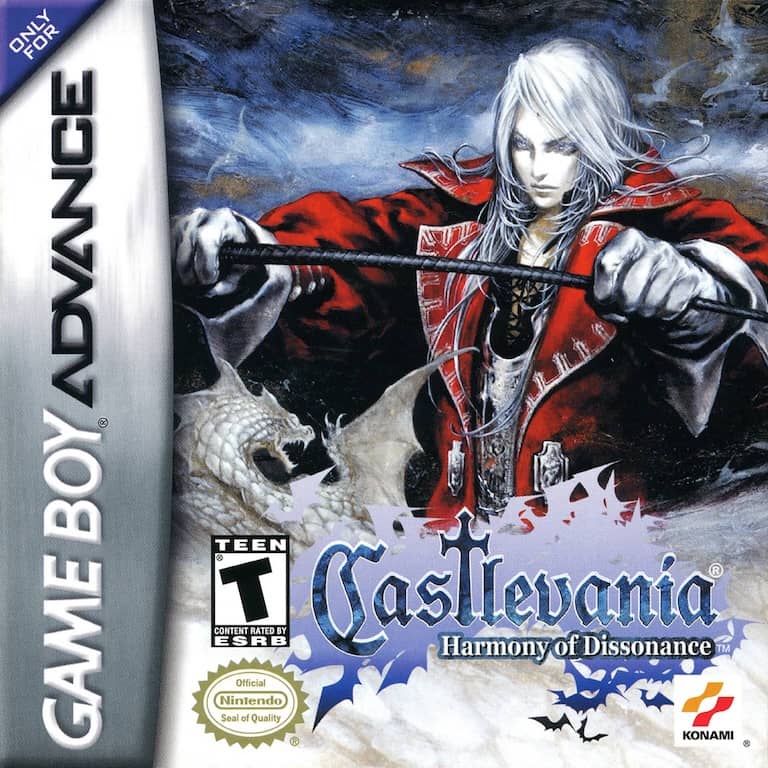
For character design, Konami enlisted Ayami Kojima, who had handled character art for Symphony of the Night. Kojima's distinctive gothic style gave characters like Juste, Lydie, and Maxim a striking visual presence, and maintained the series' characteristic elegance and mystique in character portrayal. Her involvement was seen as a significant marker of the game's artistic alignment with Symphony of the Night.
The game's music was primarily composed by Souhei Nanba, with Michiru Yamane contributing tracks for some stages. Yamane, a veteran composer for the Castlevania series, was expected to infuse the soundtrack with series flavor, but the actual result was diminished by hardware limitations. Igarashi later admitted in interviews that they had to sacrifice music quality to ensure smooth graphics and performance, leading to the game's music being poorly received among players.
During development, this game was produced almost concurrently with Aria of Sorrow, and the two titles shared some engine and program code. This parallel development model improved efficiency but also left Harmony of Dissonance seeming less polished in certain aspects, such as map design being criticized for lacking innovation and the story being relatively thin. However, it was this technical accumulation that provided experience for further optimization in Aria of Sorrow's systems and graphics.
Despite the challenges, Konami had high hopes for the game, marketing it as the "rebirth of the handheld legend." The release also included some fun easter eggs, such as unlocking 8-bit Simon via the Konami code, which served as a tribute to the series' classics and reflected the development team's playful side amid serious production. These details left a unique memory of the game among fans.
Reception and legacy
Upon release, Harmony of Dissonance received generally positive reviews from the media, with a Metacritic score of 87 and a GameRankings score of 84%. Critics widely praised the game for achieving near-Symphony of the Night visuals on the GBA, and the spellbook combination system was lauded for adding rich combat fun. However, the repetitive map design, bland story, and compressed music quality became focal points of criticism. Famitsu magazine gave it a score of 31/40, reflecting a more cautious attitude from Japanese media.
Commercially, the game sold approximately 126,000 units in the United States in its first three months, a respectable performance, but sales in Japan were poor. This disparity in market reception reflected the GBA's strong presence in Western markets at the time, while also indicating that Japanese players were less receptive to the series' transition to handhelds. Nevertheless, the game won the runner-up spot for GameSpot's Best GBA Graphics award in 2002 and received an AIAS nomination for Handheld Game of the Year, indicating industry recognition of its technical achievements.
In series retrospectives, Harmony of Dissonance is often viewed as a precursor to Aria of Sorrow. Its dual-castle design and spellbook system did not become series staples, but they provided experimental directions for later works. Many players believe that it was through this game's attempts and accumulated experience that Konami was able to achieve more mature systems and storytelling in Aria of Sorrow a year later, giving this title a significant transitional role in the series' development history.
In the years following its release, the game has been re-released multiple times. In January 2006, it was bundled with Aria of Sorrow as the Castlevania Double Pack for North America. In October 2014, it was released on the Wii U Virtual Console. In September 2021, it was included in the Castlevania Advance Collection, allowing players on multiple modern platforms to experience it anew. These re-releases have enabled a new generation of players to enjoy this GBA-era title and have extended its longevity.
Looking back at Harmony of Dissonance, it may not be the most dazzling entry in the Castlevania series, but its exploration and experimentation on the GBA left a unique mark on the series' handheld evolution. Its strengths and weaknesses are equally pronounced, and it is this imperfection that makes it an interesting topic of discussion among players. For those interested in Castlevania history, this game is a memorable transitional chapter and an important piece in understanding the series' evolution.





