Gameplay and design
Castlevania is a classic platform action game where players control vampire hunter Simon Belmont as he fights through Dracula's castle. The game is divided into six blocks, each containing three stages, for a total of eighteen levels. Level design focuses on jumping, climbing, and combat, with Simon traversing ramparts, clock towers, catacombs, and other locales before facing Dracula at the castle's peak. This block structure gives the journey a sense of progression while maintaining overall cohesion.
Simon's primary weapon is the ancestral magical whip, the Vampire Killer, which has limited range and a brief recovery period after each swing, requiring players to anticipate enemy positions and timing. Sub-weapons include the dagger, axe, holy water, pocket watch, and cross, each with distinct attack trajectories and effects, but using them consumes heart icons, which are obtained by destroying candles or defeating enemies. This resource management forces players to weigh sub-weapon usage during combat, adding strategic depth.
The game introduces a health system; Simon loses health when hit, and the game ends if health reaches zero. Each stage has a time limit, and running out of time also ends the game, compelling players to be efficient in exploration and combat. Hidden throughout the stages are food items that restore health, such as roast meat and chicken legs, which can be found by breaking specific walls or candles, offering a breather during intense battles. A scoring system encourages players to defeat enemies and collect treasures for higher rankings.
Each block ends with a boss battle against classic horror movie monsters, such as the bat, Medusa, Frankenstein's monster, and Death. These bosses have varied attack patterns, requiring players to observe and exploit the whip and sub-weapons' properties. Boss fights not only test skill but also create a strong sense of pressure, making victory deeply satisfying.
The game is notably difficult, with dense enemy placement, unforgiving platforming, and the whip's delayed attack, meaning newcomers often need repeated attempts to progress. Yet this hardcore style made Castlevania stand out among action games, becoming synonymous with challenging gameplay. The game lacks a save feature (except for the Famicom Disk System version), so players must complete it in one sitting or use a password system, further reinforcing its hardcore nature.
Background and release
Castlevania was first released in Japan on September 26, 1986, for the Famicom Disk System, with the Japanese title Akumajō Dracula. At the time, the FDS had just launched, and its rewritable disk media allowed for saving progress, which was convenient for a long game like this. Developed and published by Konami, it was the inaugural entry in the Castlevania series, establishing the series' core world and gameplay framework.
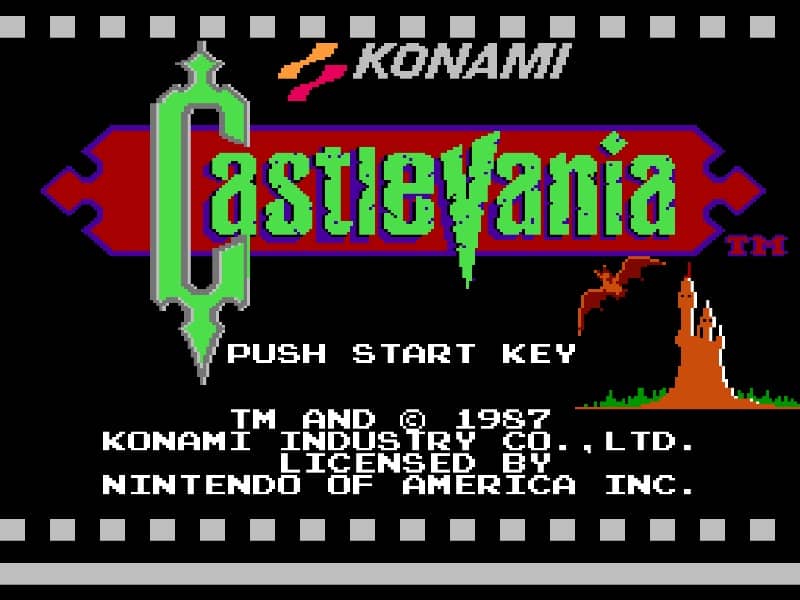
On April 30, 1987, the game was released in North America as Castlevania on NES cartridge, with a European release following in 1988. The Western name originated with Emil Heidkamp, a senior vice president at Konami America, who believed the Japanese title's reference to Dracula had religious connotations that might be controversial, so he changed it to Castlevania, a portmanteau of 'castle' and 'Transylvania.' This renaming not only avoided potential issues but also shaped the series' iconic image in Western markets.
In 1993, the game was re-released on the Famicom in cartridge form. This version removed the original's opening registration screen and save feature, and added an 'Easy' mode to lower difficulty, making it more accessible. This version differed functionally from the FDS original, but the core gameplay remained the same, offering Japanese players another way to experience the title.
Beyond home console versions, an arcade version titled VS. Castlevania was released by Nintendo in April 1987. Based on the NES version, it adjusted difficulty and controls for the arcade environment and supported two-player alternating play. In 2019, Hamster Corporation included it in the Arcade Archives series, re-releasing it on Switch and PS4, allowing modern players to enjoy the arcade version's unique appeal.
The game achieved commercial success upon release, selling over one million copies, laying a solid foundation for the series' future. Its success wasn't just in sales; it pioneered a blend of Gothic horror and action gameplay that influenced countless later works. From FDS to NES cartridge, to arcade and re-releases, the game's version history also reflects the industry's transition from disk to cartridge media.
Development
The director of Castlevania was Hitoshi Akamatsu, who was heavily influenced by classic horror films and wanted players to feel the atmosphere of movies like Dracula. This cinematic approach is evident in the game's stage design, enemy designs, and music, with the castle's eerie interiors, classic monsters like vampires, werewolves, and mummies, and Gothic melodies that create a strong sense of dread.
The protagonist Simon Belmont's naming went through some changes. Initially, he was set to be Peter Dante, grandson of Christopher Dante, but the team later decided to rename him Simon Belmont. This change not only made the character's name more distinctive but also established the Belmont family as hereditary vampire hunters, setting the stage for future series entries.
During development, the team planned to allow the whip to attack in multiple directions and designed sub-weapons like garlic, wooden stakes, and a werewolf transformation, but these ideas were ultimately not implemented. The whip ended up attacking only horizontally, and sub-weapons were trimmed to five, but this simplification made the controls more focused, requiring players to time attacks and judge distances more precisely, which ironically increased the game's challenge and depth.
Castlevania was developed concurrently with the MSX2 version, Vampire Killer, which was released a month later and also titled Vampire Killer in the West. While they share the same world and some characters, the gameplay is quite different: the MSX2 version emphasizes exploration and item collection, with non-linear level structure. Thus, the MSX2 version is considered a separate work rather than a port, and this parallel development reflects Konami's flexible multi-platform strategy at the time.
The game fully utilized the FDS's hardware capabilities, such as disk read/write for saving, and the FDS version included an opening registration screen where players could enter their name. These features were removed in the 1993 Famicom cartridge re-release because cartridges lacked save functionality. Additionally, the development team put great effort into music and graphics, using the Famicom's limited hardware to create an impressive audiovisual experience, making it a showcase of the era's technical prowess.
Reception and legacy
Castlevania received positive reviews from the media upon release. Japanese magazine Beep praised its graphics and controls but noted the game's short length; Famitsu gave it a high score and ranked it as the highest-scoring game of 1986. Western outlets like Computer and Video Games also gave positive reviews in 1989, praising its large game areas and detail, though with minor criticism of the graphics' flashiness. These reviews established the game's reputation.
The game was also a commercial success, selling over one million copies and becoming one of Konami's flagship titles. Its influence extended beyond sales, as it set a design benchmark for action games. In 2001, Game Informer ranked it 48th on its list of the best games ever, stating its gameplay set the standard for the industry; IGN placed it 19th on its list of best NES games, praising its difficulty, gameplay, music, and graphics. These retrospective accolades further cemented its classic status.
Castlevania left a lasting impact on subsequent games, particularly Ninja Gaiden (1988), which borrowed elements like items and special abilities. This influence wasn't limited to Konami but spread across the action genre, with many later titles drawing inspiration from its sub-weapon system, boss fight design, and Gothic stage aesthetics. In essence, it created a subgenre and continued to inspire developers for years.
The game has been ported and re-released multiple times, demonstrating its enduring appeal. In 2002, it was included in the Windows compilation Konami Collector's Series: Castlevania & Contra; in 2004, it was released on Game Boy Advance as part of the Classic NES Series, though the original ending credits were removed; in 2016, it appeared among the 30 games on the NES Classic Edition. Additionally, it was included in the Castlevania Anniversary Collection, with the Japanese version using the 1993 Famicom port, while the Virtual Console Japanese version used the FDS original.
Despite its age, the game still holds a special place in players' hearts. In 2011, IGN's 25th anniversary retrospective called it 'forgotten,' but this remark ironically sparked renewed interest in the original. On Metacritic and GameRankings, the Classic NES Series version scored averages of 74/100 and 71%, respectively, which aren't top-tier but reflect recognition of its historical importance given its age. As the series' starting point, Castlevania not only paved the way for future entries but also left an indelible mark on gaming history.