
Gameplay and design
The level design in Contra III - The Alien Wars stands out within the series. Four of the six levels are traditional side-scrollers, while the other two adopt a top-down perspective and make use of the SNES's Mode 7 graphics mode. This alternation between side-scrolling and overhead views keeps the familiar run-and-gun experience fresh. In the top-down levels, players face enemies from all directions, and the controls are adjusted accordingly, adding a layer of strategy.
The weapon system is a core element of the game. Players start with two machine guns, which can be switched at any time, and can pick up power-ups to upgrade to homing missiles, torpedoes, flamethrowers, lasers, and spread shots. Each weapon has unique trajectories and power, requiring players to choose flexibly based on the situation. Additionally, the rotating jump mechanic allows players to shoot in two directions while airborne, but at the cost of losing both weapon upgrades if they lose a life during the jump, creating a high-risk, high-reward decision.
The game supports both single-player and two-player cooperative modes, with players controlling Bill Rizer and Lance Bean. In co-op, the two players can complement each other's weapon loadouts, but they must also be careful not to interfere with each other. The difficulty curve is steep, with dense enemy formations and massive bosses that test players' reflexes and positioning. However, the Japanese version offers unlimited continues, and the final boss appears on normal difficulty, making it generally easier than other regional versions.
The visual presentation fully utilizes the SNES's hardware capabilities. In addition to the Mode 7 top-down levels, the side-scrolling levels feature extensive sprite scaling and rotation effects, creating an arcade-like spectacle. The boss battles are particularly impressive, with huge bosses often occupying half the screen and employing varied attack patterns, requiring players to observe and find weaknesses. The overall pacing is tight, with interesting events occurring every three screens, avoiding any sense of tedium.
The game maintains the series' signature smooth controls, with responsive character movement, jumping, and shooting. Players can switch weapons at any time but must keep an eye on ammunition. The rotating jump is powerful but risky, and balancing offense and survival is what separates experts from novices. These design elements together form a gameplay system that is both hardcore and appealing.
Background and release
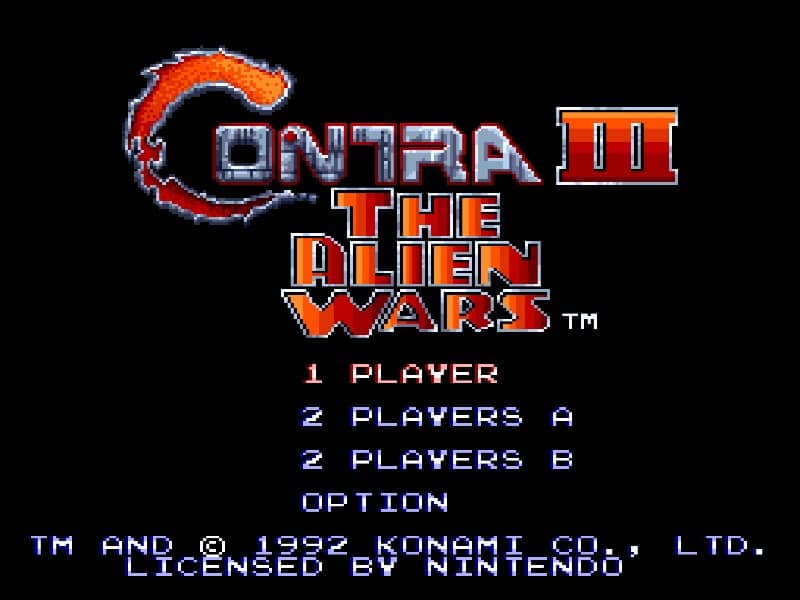
Contra III - The Alien Wars was released in 1992, with the Japanese version launching first on February 28, followed by the North American version on March 26, and the European version on September 12. As the third home console installment in the Contra series, it followed the NES titles Contra (1988) and Super Contra (1990), but achieved a qualitative leap in graphics and gameplay, becoming one of the representative titles of the 16-bit era.
In early coverage, the game was referred to as Contra IV, until Nintendo Power reported its renaming to Contra III at the winter 1992 CES. This name change may reflect Konami's adjustment of the series' positioning, treating it as a proper sequel rather than a spin-off. The Japanese title is Contra Spirits, which differs from the overseas name, but the game content is essentially the same.
The European version is a unique variant in the game's history. Due to technical differences in the PAL region and censorship practices, the game was renamed Super Probotector: Alien Rebels, and the player characters were replaced with robots. This change affected not only the title and character appearance but also resulted in a slightly lower frame rate compared to other versions. The existence of the European version influenced later ports, such as the Game Boy version, which also adopted the robot setting in Europe.
The game's release coincided with the golden age of the SNES. Konami had accumulated extensive experience in the action genre, and Contra III further solidified its position. The game was highly anticipated before release and quickly became a hot topic afterward. Its arcade-quality graphics and sound, along with the innovative Mode 7 levels, impressed both players and the media.
From a series perspective, Contra III represents a significant evolution on home consoles. It did not simply replicate the previous games' formula but boldly introduced new perspectives and mechanics, injecting vitality into the series. Although later installments varied in style, the level structure and weapon system established in this game left a lasting impact on subsequent action games.
Development
The game was directed by Shinya Nakae, marking his first involvement in the Contra series. Previously, he had only informally played Super Contra, so his understanding of the series came more from a player's perspective. Nakae felt that the early Contra games were too realistic in their action and lacked fun, so he added more comedic elements to this installment, such as the ability to hang onto flying missiles, a design never seen before in the series.
The development team was based in a new office in Tokyo, which may have influenced the creative atmosphere. Nakae set a principle: something interesting should happen every three screens to increase density and prevent the game from feeling tedious. This design philosophy runs throughout the game, filling levels with various unexpected situations and visual spectacles, from exploding helicopters to massive bosses, keeping players constantly engaged.
The hanging missile scene was a technical challenge during development. Due to the SNES's limited sprite capabilities, it was impossible to render the helicopter, missile, and character simultaneously. The team decided to draw the helicopter and missile using background tiles and implemented foreground sprite effects through programming tricks like raster scrolling. This clever workaround showcased the developers' technical skill and their spirit of innovation within constraints.
The game's soundtrack was composed by internal Konami composers, with a cinematic style that complements the game's tense atmosphere. Nakae emphasized that the music should enhance the drama, so the score incorporates orchestral elements, which was uncommon in action games at the time. In terms of sound effects, the gunshots and explosions are powerful but sometimes overpower the music, a point noted in media reviews.
The game's programmers, Hideyuki Suganami and Hikaru Yada, left Konami after development and joined Treasure, where they contributed to classic games like Gunstar Heroes and Alien Soldier. These works clearly show the influence of Contra III in their action design and creativity. Thus, this game not only stands as an excellent title but also nurtured a generation of industry talent.
Reception and legacy
Contra III - The Alien Wars received widespread acclaim upon release, with critics praising its arcade-quality graphics and sound, and noting that Mode 7, sprite scaling, and rotation effects were well integrated with gameplay. Electronic Gaming Monthly named it Game of the Month and said its quality rivaled arcade games. Mean Machines particularly praised the soundtrack, comparing it favorably to ActRaiser, but also noted that gunshots and explosions sometimes drowned out the music.
In subsequent retrospectives, the game has frequently appeared on lists of the greatest games of all time. In 1997, Electronic Gaming Monthly ranked it the eighth-best console game ever, citing its huge bosses, Mode 7 levels, and deep gameplay. In 2009, Official Nintendo Magazine placed it 51st on its list of the greatest Nintendo games, describing it as "busy, relentless, and extremely challenging." These accolades reflect the game's standing among players and the media.
The game has had a lasting influence on later titles. Its innovative level design and weapon system inspired many similar works, especially Treasure's Gunstar Heroes and Alien Soldier, which clearly bear the mark of Contra III in their action design and creativity. In this sense, the game is not only a classic but also an important milestone in the history of action games.
The game has been ported and re-released multiple times. In 1994, a Game Boy version titled Contra: The Alien Wars was developed by Factor 5, but it was not a complete port, lacking some levels, the ability to switch weapons, and the rotating attack, though it supported Super Game Boy enhancements. In 2002, a remake for the Game Boy Advance, Contra Advance: The Alien Wars EX, was released, but it removed the sub-weapon slot and bombs, and the Mode 7 levels were replaced with side-scrolling stages from Contra: Hard Corps.
The SNES version itself has been re-released several times, including on the SNES Classic Edition in 2017, the Contra Anniversary Collection in 2019, and various online distribution services. These re-releases allow a new generation of players to experience this classic. Despite differences in later versions, the original SNES version remains regarded as one of the best in the series, with an unshakable status.





