
Gameplay and design
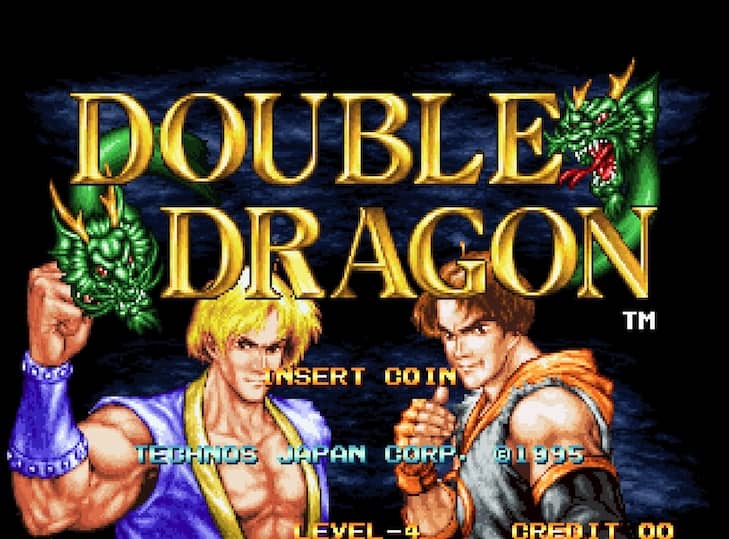
The core gameplay of Double Dragon is side-scrolling beat 'em up, where players fight waves of enemies on screen and progress through stages. The game's standout feature is its two-player cooperative mode, allowing two players to fight side by side and coordinate their attacks. For example, one player can grab an enemy while the other lands hits, a mechanic that was quite novel at the time and greatly enhanced the game's interactivity and fun.
In addition to hand-to-hand combat, players can pick up weapons dropped by enemies, including baseball bats, whips, throwing knives, and dynamite. These weapons offer greater range and power but have limited uses, requiring players to manage them wisely. The inclusion of weapons enriches the combat strategy, giving players the choice between fighting barehanded or with weapons, adding depth to the gameplay.
The game is divided into four missions, with settings progressing through a slum, a factory, a forest, and a gang hideout. Each mission features different enemy configurations and terrain designs, from narrow streets to open forests and factory floors filled with hazards, providing a constant sense of novelty. Each mission ends with a boss battle that tests the players' skills and adaptability.
Enemy types are varied, including ordinary thugs Williams and Roper, the knife-wielding female rogue Linda, and the burly Abobo brothers and Jeff. Each enemy has different attack patterns and behaviors, requiring players to adapt. The final boss is Willie, the leader of the Black Warriors, who possesses greater strength and speed, making him the most challenging opponent in the game.
The most distinctive design is the ending after two-player cooperative play: the two players must fight each other, and only the winner can win Marian's heart. This setup breaks the convention of cooperative games, cleverly combining cooperation and competition, leaving a lasting impression on players. Such a design was extremely rare in games at the time and became one of Double Dragon's signature features.
Background and release
Double Dragon was developed by Technōs Japan and published by Taito, released on arcade platforms in 1987. The game was an immediate hit; in Japan, it became the best-selling arcade cabinet in June 1987 and was the third highest-grossing arcade game of the year in Japan. This success solidified Technōs's position in the arcade market.
In North America, the game performed equally well. According to Taito America, the game sold over 10,000 dedicated arcade cabinets in the United States, with global sales reaching 40,000 units. In 1988 and 1989, it was the highest-grossing dedicated arcade game in the U.S. for two consecutive years, demonstrating its enduring appeal and commercial value.
The game's success spawned numerous ports, including versions for the NES, Master System, Atari 2600, Amiga, and Commodore 64. Notably, the NES version removed the two-player cooperative mode due to technical limitations, replacing it with alternating play, and added a level-up system, making it significantly different from the arcade original. The Master System version retained two-player co-op and was co-developed by Arc System Works.
Beyond ports, the game also gave rise to comic books, an animated series, and a live-action film, further expanding the brand's influence. In 2003, the Game Boy Advance version Double Dragon Advance was released as a remake of the original, and in 2013, the arcade original and its two sequels were re-released as Double Dragon Trilogy, allowing both new and old players to revisit the classics.
The success of Double Dragon also spawned a series of sequels, including two arcade sequels and several spin-offs. These works continued the beat 'em up gameplay of the original while evolving in graphics, systems, and story, making Double Dragon one of the most influential series in the history of beat 'em up action games.
Development
Double Dragon was led by Yoshihisa Kishimoto, a core member of Technōs's previous game, Nekketsu Kōha Kunio-kun (Renegade). Initially, the game was conceived as a direct sequel to Renegade, but during development it gradually evolved into an independent work. Kishimoto wanted to create a game that emphasized cooperation and martial arts action, thus establishing Double Dragon's unique tone.
The 'Double' in the title directly refers to the two-player cooperative gameplay, while 'Dragon' pays homage to Bruce Lee's classic film Enter the Dragon. This naming reflects both the core mechanic and the developers' respect for martial arts cinema. The game's martial arts moves are also heavily influenced by Bruce Lee's style, emphasizing fast, powerful strikes.
The game's art style and setting were deeply influenced by the film Mad Max and the manga/anime Fist of the North Star. The post-apocalyptic scenes, violent street gangs, and muscular character designs all bear the imprint of these works. This style was unique among games at the time, creating a gritty and dangerous game world for players.
On the technical side, the arcade version used multiple 8-bit microprocessors running in parallel and employed a Yamaha YM2151 FM synthesis chip, providing smooth animation and impactful sound effects. The screen could display 384 colors from a 4096-color palette, making the visuals particularly vibrant and detailed compared to contemporary arcade games.
The development team invested considerable effort in the two-player cooperative mechanics, designing interactive actions such as grabbing and throwing to ensure smooth coordination between players. They also carefully designed enemy AI to challenge players, increasing the difficulty of combat. These details reflect the developers' craftsmanship and are key reasons the game stood out.
Reception and legacy
Double Dragon received widespread acclaim upon release. Electronic Gaming Monthly awarded it Game of the Year in 1988, and Commodore User gave it a high score of 9/10, calling it 'the hottest beat 'em up.' These accolades affirmed the game's excellence in gameplay, graphics, and sound, and reflected its popularity among players.
The game had a pioneering influence on the beat 'em up genre, helping to usher in its golden age from the late 1980s to the 1990s. Many later games in the genre, such as Final Fight and Streets of Rage, borrowed elements from Double Dragon, including two-player co-op, weapon pickups, and level design. In essence, it established the basic paradigm for beat 'em up action games.
The success of Double Dragon spawned a vast series, including two arcade sequels and numerous spin-offs. These works continuously innovated while preserving the core gameplay, ensuring the series' longevity. Additionally, the game gave rise to comic books, an animated series, and a live-action film, further expanding its cultural influence.
Despite its age, Double Dragon's historical status remains solid. It is regarded by many players and critics as a classic of the beat 'em up genre, and its two-player cooperative mechanics and competitive ending are still frequently discussed. The 2013 re-release of Double Dragon Trilogy allowed a new generation of players to experience this classic.
In retrospect, Double Dragon is not just a great game but a significant milestone in gaming history. It proved that cooperation and competition can be cleverly combined, and it showcased the immense potential of arcade games both commercially and artistically. For fans of action games, it is an unmissable piece of history.





