Gameplay and design
The most striking feature of Dragon Quest V is the monster-recruitment system. After battles, monsters occasionally ask to join your party, breaking the convention that monsters are always enemies. Players can take these monsters on adventures, and they participate in battles and gain experience just like human companions. In the Super Nintendo version, 40 types of monsters can become allies, and this mechanic later became a hallmark of the series, making monster collecting and raising a favorite topic among players.
In terms of combat, the game continues the series' traditional turn-based system with a first-person perspective, where players see only the enemies, not their own party. However, a practical wagon system allows players to keep inactive party members in a wagon and swap them in at any time. The tactical system also returns, letting players set individual AI for each companion, such as focusing on healing, attacking aggressively, or conserving MP, so battles can be managed without issuing commands every turn, making fights more convenient.
This game is also the first in the series to include a hidden dungeon. After clearing the game, players can enter an extra dungeon filled with stronger enemies and rarer treasures. This design was novel at the time, providing post-game motivation for players, and later became a common feature in the Dragon Quest series. For players who enjoy exploration, the hidden dungeon is a pleasant surprise.
In terms of party size, the Super Nintendo version allows only three members on the battlefield, but the PS2 and Nintendo DS remakes increase this limit to four. This one-person difference may seem small, but it changes tactical arrangements and difficulty balance. The original's smaller party makes battles more compact, while the remakes allow players to bring more favorite characters and offer more flexible team compositions.
The game's story spans a long period, from the protagonist's childhood to marriage and parenthood, with a timeline stretching over thirty years. This generational narrative was rare in RPGs at the time, allowing players to see the hero grow from a boy to a father and then adventure with his own children. The plot also includes a bride-selection segment, where players choose between Bianca and Nera to marry, and this choice affects some later dialogue and events, making players feel their decisions truly change the story.
Background and release
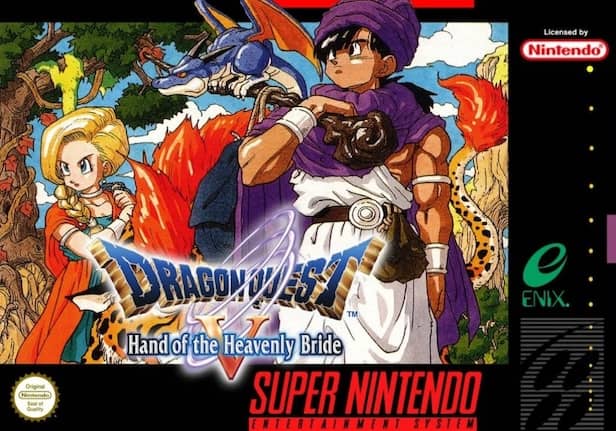
Dragon Quest V was originally released on the Super Nintendo in 1992, more than two years after the fourth game in the series. As the first game in the series to appear on the SFC, it benefited from the new console's capabilities, with improved graphics and music compared to earlier entries. However, the game was not released in North America at the time, making it the only mainline game in the series without an official English version until the Nintendo DS remake years later, leaving Western players unable to play it.
On the day of release, Japanese players' enthusiasm was astonishing. The game cartridges sold extremely quickly, with over 1.3 million copies sold on the first day, surpassing the SFC version of Street Fighter II released earlier that year. Pre-orders had already reached 300,000 copies, and on release day, lines stretched up to 3 miles long, with 10 incidents of cartridge theft. This scale is hard to imagine today, but it shows the immense influence of Dragon Quest in Japan at the time.
In 2004, a remake was released for the PS2, developed by ArtePiazza and Matrix Software. This version featured fully 3D graphics, increased the number of recruitable monsters from 40 to 71, and added new story elements and features. However, the PS2 version was also only released in Japan, so overseas players still missed out. The PS2 version sold well, with 722,000 copies on its first day and over 1.5 million by April 2004.
The version that truly brought Dragon Quest V to players worldwide was the Nintendo DS remake in 2008. Developed by ArtePiazza, it used the same engine as the DS version of Dragon Quest IV, with a blend of 2D and 3D graphics. The DS version was first released in Japan on July 17, 2008, then in North America on February 17, 2009, and in Europe on February 20, with the European title changed to Dragon Quest: The Hand of the Heavenly Bride. This was the first official English version of the game.
Later, in December 2014, iOS and Android versions were released in Japan, followed by a global release the next month. The mobile versions are based on the DS port, with touch controls adapted. Thus, this classic that missed North America finally reached all players in various forms. From 1992 to 2014, over two decades, the game transitioned from cartridges to digital versions, but the thirty-year adventure story remained unchanged.
Development
The core development team for Dragon Quest V consisted of the series' usual trio: Yuji Horii handled scenario design, Akira Toriyama did character design, and Koichi Sugiyama composed the music. These three had been collaborating since the first game, and by the fifth installment, they worked together seamlessly. Horii later stated that this is his favorite Dragon Quest game, showing his fondness for the story.
The development was handled by Chunsoft, which had been involved in the Dragon Quest series since the first game. However, after completing this title, Chunsoft temporarily left the series to work on their own original games. Thus, Dragon Quest V was Chunsoft's last work in the series, after which they focused on new projects like Mystery Dungeon.
During development, the hardware upgrade brought noticeable changes. The Super Nintendo, compared to the previous Famicom, offered richer colors and better sound, allowing Toriyama's character designs to be rendered with more detail and Sugiyama's orchestral music to have more impact. The monsters and environments in the game looked much more vibrant on the SFC, which was a technical foundation for the game's classic status.
The PS2 remake was developed by ArtePiazza and Matrix Software, both of which later worked on other series titles. The PS2 version retained the original story framework but added new companions and story details, such as increasing the types of recruitable monsters and adjusting the battle system. However, the PS2 version still did not leave Japan, which was somewhat regrettable.
The Nintendo DS remake was developed solely by ArtePiazza, which directly used the engine from the DS version of Dragon Quest IV, so the two games have similar visual styles and controls. The DS version also added a new marriageable character, Deborah, giving players a third choice. This change was fresh for many players and made the DS version richer in content than the original.
Reception and legacy
Dragon Quest V has always held a high status among players and critics. Famitsu's four reviewers gave the original scores of 9, 10, 9, and 8, totaling 36/40, which was impressive at the time. The PS2 remake received 34/40, and the DS remake returned to 36/40. In multiple Japanese player polls for 'most wanted remake' or 'favorite Dragon Quest,' this game often ranks high, showing its significance in fans' hearts.
The monster-recruitment system pioneered in this game had a deep influence on later games. This mechanic not only became a signature feature of the Dragon Quest series but also spawned the dedicated Dragon Quest Monsters spin-off series. Other games also adopted similar mechanics of 'capturing monsters as allies,' so this game can be seen as a pioneer in monster-collecting gameplay.
The game's playable pregnancy scene has also become a frequently discussed topic in gaming history. After the protagonist marries, his wife becomes pregnant and gives birth, allowing players to experience the transition from husband to father. This element was rare in games at the time and was later borrowed by games like Harvest Moon and The Sims 2, becoming a common family element in simulation games.
On August 2, 2019, a 3DCG animated film based on this game, Dragon Quest: Your Story, was released in Japan. The film reinterprets the protagonist's adventure with modern technology, and although the plot is not exactly the same as the game, the core emotions remain. The film's release also introduced this classic to audiences who had not played the game, adding another chapter to its legendary story.
Overall, Dragon Quest V is a work that bridges the past and future in the series. It inherits the classic gameplay of previous entries while boldly introducing new elements like monster companions and generational storytelling, influencing many later games. Although the original was not released in North America, through multiple remakes on PS2, DS, and mobile, it eventually became known to players worldwide. For RPG fans, this is a game worth playing again and again.