Gameplay and design
The most significant innovation in Final Fantasy IV is the Active Time Battle (ATB) system. This system moves away from the traditional turn-based combat where each side takes turns, instead giving every character and enemy an individual action gauge that fills over time. Once full, the player can issue a command. The fill rate depends on the character's Speed stat, making battles faster and more timing-sensitive. Players must keep an eye on the gauges while planning their strategy, adding a layer of tension that traditional turn-based combat lacked. This design was adopted by the next five games in the series and became a hallmark of Final Fantasy.
This installment is the first in the series to feature five party members in battle, whereas previous games allowed a maximum of four. The larger party size expands tactical options. Additionally, each character has a fixed job class, unlike the previous games where players could freely change jobs. Cecil is a dark knight, Rosa is a white mage, Rydia is a summoner, and Kain is a dragoon, each with unique abilities and roles. This design gives each character a distinct identity and requires players to carefully consider party composition.
Visually, the game utilizes the Super Nintendo's Mode 7 graphics technology, which allows background images to rotate and scale. This is particularly impressive during magic effects and airship travel. For instance, when the airship soars through the sky, the ground tilts and rotates with the camera, creating a sense of depth that was striking at the time. Magic spells also have more impactful visual effects, making battles more spectacular. These technical innovations elevate Final Fantasy IV's visuals significantly compared to its predecessors.
The magic system is also categorized into white magic, black magic, and summon magic. White magic is for healing and support, black magic focuses on offense, and summon magic calls powerful creatures to aid in battle. Each spell has a level, and characters learn higher-level spells as they gain levels. Summon magic is a highlight of this game, with each summon having a dedicated animation that feels grand. This categorization became a series staple.
Beyond combat, the game offers exploration elements. Players can pilot the airship to travel between the surface of the Blue Planet, the underworld, and the artificial moon, each with distinct environments and enemies. The underworld and moon settings expand the game's world and provide more adventure space. There are also mini-games and hidden features, such as rare items found in specific locations, which enrich the content and encourage replayability.
Background and release
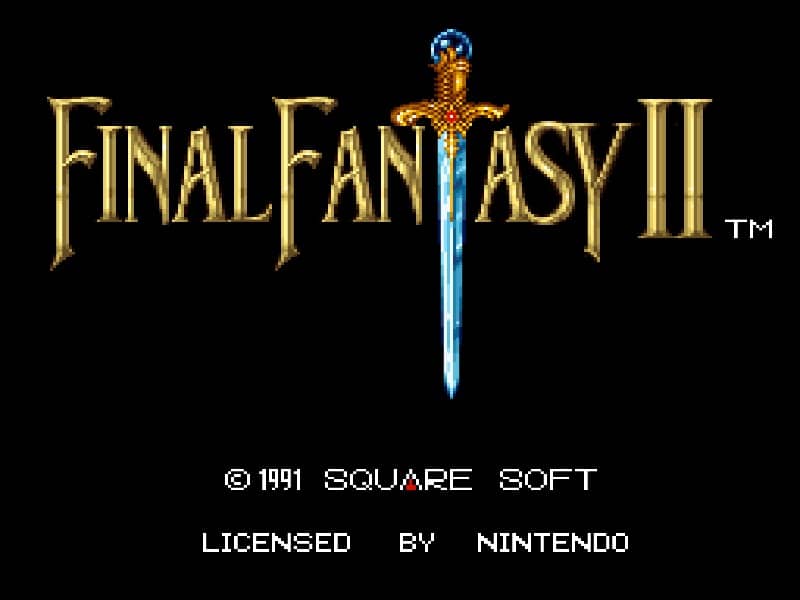
Final Fantasy IV was released on July 19, 1991, in Japan for the Super Nintendo Entertainment System, as the fourth mainline entry in the series. However, in North America, it was released under the title Final Fantasy II. The reason is simple: the second and third games in the series had not been released in North America, so Square decided to market the fourth game as the second to give North American players the impression that it was a fresh start for the series. This naming strategy facilitated marketing but caused considerable confusion among players, many of whom assumed that the North American Final Fantasy II was the same as the Japanese second game.
The game's story is set on a fictional planet called the Blue Planet, and the protagonist is Cecil, a dark knight and captain of the Red Wings. At the beginning, Cecil is ordered to steal a crystal from the village of Mysidia, but he begins to question the mission and is stripped of his command by the king. He then embarks on a journey and gradually uncovers a larger conspiracy: the sorcerer Golbez seeks to seize the crystals, and the true mastermind is Zemus, who plans to use the Giant of Babel to destroy humanity. The story revolves around Cecil's redemption and his fight against evil, with a plot full of twists and turns.
The game's world is vast, including the surface world, the underworld, and the artificial moon. The surface world is the main stage, featuring multiple kingdoms and towns; the underworld is home to the Dwarves and the Fire Crystal; and the moon is inhabited by the Lunarians, who are closely tied to the game's final plot. This multi-world setting was uncommon in RPGs at the time and offered players a fresh experience. The game also features twelve playable characters, each with their own backgrounds and motivations, making the story richer.
On its release day in Japan, the game sold approximately 200,000 copies, and the Super Nintendo version eventually sold 1.44 million copies. This was an impressive performance in the RPG market at the time and demonstrated the series' popularity. The North American release came later, with no exact date recorded, but it also received recognition from players. As of 2007, the game's various versions had sold nearly 3 million copies worldwide, making it one of the most successful early entries in the series.
The success of Final Fantasy IV laid the foundation for the series' future development. It established the ATB system and the style of dramatic storytelling, which were carried forward and expanded in subsequent games like Final Fantasy V and Final Fantasy VI. The game has been ported to multiple platforms, including PlayStation, Game Boy Advance, and Nintendo DS, with a 3D remake for the DS in 2007. In 2021, it was re-released as part of the Final Fantasy Pixel Remaster series, allowing a new generation of players to experience this classic.
Development
The development team for Final Fantasy IV consisted of only 14 people, which seems incredible by today's standards but was common at the time. The project took about a year to complete, a tight schedule for such a content-rich RPG. With a small team, everyone had to wear multiple hats, and the workload was intense. Despite this, they managed to create a work that was both technically and design-wise innovative, thanks to the talent and dedication of the core members.
Series creator Hironobu Sakaguchi provided the initial concept, including the overall story framework and the name of the Red Wings. The Red Wings are Cecil's unit, and the name has a powerful ring to it, setting the tone for the game's epic feel. Sakaguchi had high standards for the story, wanting it to be as dramatic as a film, so the script is filled with betrayal, sacrifice, and redemption. These elements became some of the most praised aspects of Final Fantasy IV.
The ATB system was conceived by Hiroyuki Ito, who later worked on several other Final Fantasy titles. The idea came from watching Formula One races, where the varying speeds of the cars create a dynamic pace, and he thought of applying this speed difference to a battle system. The ATB system made combat dynamic and real-time, a very forward-thinking design at the time, and it became a major hallmark of the series.
The game's script was significantly reduced due to cartridge capacity limitations, ultimately retaining only about a quarter of the original plan. This meant many story details and side content were cut, but the core story remained intact. The development team tried to fit as much as possible into the limited space, and this constraint actually made the story more concise and the pacing faster. For the music, Nobuo Uematsu composed the score, and he mentioned that the process was arduous, with the team often staying overnight at the office. Despite this, the music he created was widely praised, especially the theme and battle music, which became classics in the series.
During the North American localization, Square made some adjustments. To cater to North American players, the game's difficulty was reduced, such as weakening enemies and adjusting the effects of some items. Additionally, the North American version removed religious content and direct references to death, such as modifying images involving churches and crosses, and making character death lines more subtle. These changes were made to avoid controversy at the time, but they also created differences in experience between the North American and Japanese versions.
Reception and legacy
Final Fantasy IV received widespread acclaim upon release. Japanese gaming magazine Famitsu gave it a high score of 36/40, and Nintendo Power praised it for 'setting a new standard for RPGs.' These accolades were not exaggerated; the game showcased the pinnacle of RPG quality at the time in its battle system, story, and visuals. Players and critics alike felt it elevated role-playing games to a new level, especially with its dramatic narrative, which made many players feel for the first time that games could be as emotionally moving as films.
The ATB system had the most profound impact. It was adopted by the next five Final Fantasy games and became one of the series' core mechanics. Other RPGs also followed suit, making battles more dynamic and tense. It can be said that the ATB system changed the direction of RPG battle design, taking a significant step from turn-based to real-time. Additionally, the five-character party and fixed job classes added more strategic depth to party composition and character development, and these designs were later borrowed by many RPGs.
The game's narrative breakthrough is also worth remembering. It used extensive cutscenes and dialogue to develop characters, allowing players to empathize with the fates of Cecil, Kain, Rosa, and others. This narrative style, focusing on character emotions and dramatic conflict, influenced later works such as Final Fantasy VI and Chrono Trigger, and pushed RPG storytelling toward more mature directions. Many players still remember iconic scenes years later, such as Cecil's transformation from dark knight to paladin, and the touching moments at the ending.
The game also spawned sequels and spin-offs. In 2008, Final Fantasy IV: The After Years was released on Japanese mobile phones, set after the original story and following the adventures of Ceodore, the son of Cecil and Rosa. Additionally, the game's characters and world have appeared in other Final Fantasy spin-offs, such as the Dissidia Final Fantasy series. These works demonstrate the important position of Final Fantasy IV in the series, as its story and characters remain beloved by players.
In the long term, Final Fantasy IV has been listed among the best games of all time by multiple media outlets. IGN, Nintendo Power, and Famitsu reader polls have all ranked it highly. These honors attest to its classic status. The game's multiple ports and remakes have allowed players of different generations to experience it. Whether in the original pixel art or the 3D remake on the DS, the core appeal—the moving story and innovative combat—has never faded. For RPG enthusiasts, it is a work worth revisiting.