
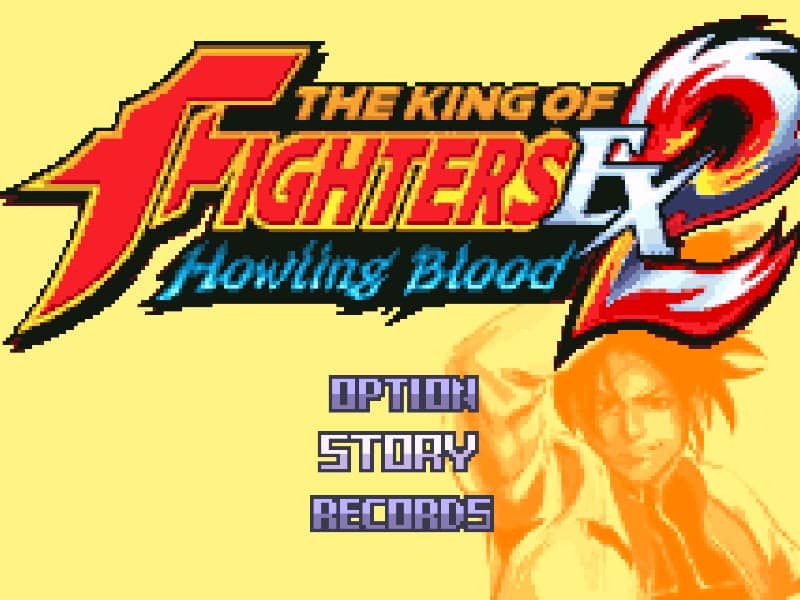
Gameplay and design
The King of Fighters EX2: Howling Blood continues the series' classic 3-on-3 team battle format, where players select three characters before a match and send them into battle in sequence. This design keeps the pacing tight and tests players' understanding of character synergy. One of the core systems is the Striker support mechanic, which lets players call in a benched teammate for a special attack, adding an extra layer of strategy. This mechanic originates from the arcade game The King of Fighters 2000, but it has been adjusted for the GBA's button layout.
The controls have been noticeably improved over the previous game, The King of Fighters EX: Neo Blood, with more responsive command inputs and smoother combo linking. The development team optimized the input detection for the handheld, allowing players to achieve a feel close to the arcade version on a portable device. The game also offers multiple modes, including Arcade, Story, Single, and Versus, catering to different player preferences. The Story mode follows an original narrative where players experience the adventure of Kyo Kusanagi and others as they try to prevent Orochi's resurrection.
The character roster is a major highlight, featuring 21 playable characters, including series favorites like Kyo Kusanagi, Iori Yagami, Terry Bogard, and Mai Shiranui, as well as original characters from the previous game, Moe Habana and Reiji Oogami. Each character retains their signature move sets, from Kyo's fiery punches to Mai's fan attacks, faithfully recreated. For fans of the King of Fighters series, these characters offer a sense of familiarity, while the new additions bring freshness to the game.
The visuals and audio are sourced from The King of Fighters 2000, with character portraits and battle stages maintaining a high standard. Despite the GBA's hardware limitations, the game achieves near-arcade visuals through detailed pixel art and smooth animations. The audio, including background music and sound effects, largely follows the arcade version, and while limited by the handheld's speakers, it still creates a good atmosphere. However, some media outlets noted audio quality issues, likely due to hardware constraints.
The N-Gage port, titled The King of Fighters Extreme, made adjustments to the gameplay, most notably changing the final boss battle to a single-character fight, possibly to accommodate the N-Gage's button layout. The port also fixed some bugs from the GBA version but introduced new issues, such as unstable frame rates and character animation stuttering. Despite these problems, the core combat experience remains intact, offering an alternative for players without a GBA.
Background and release
The King of Fighters EX2: Howling Blood is the second entry in the King of Fighters EX series, following The King of Fighters EX: Neo Blood, which was released in 2002 as SNK's first King of Fighters game on the GBA. This sequel was released in Japan on December 11, 2003, and later in Western markets by Atlus. As a handheld spin-off, it is not part of the main arcade numbering but rather a separate series independent of the main storyline, designed to offer a unique King of Fighters experience for portable gamers.
The story is set after The King of Fighters EX: Neo Blood but does not continue the NESTS saga from the arcade games The King of Fighters 2000 or 2001. Instead, it returns to the Orochi saga. The plot revolves around Kyo Kusanagi and his allies as they enter a new tournament hosted by a mysterious figure named Sinobu Amou, with the goal of preventing Orochi's resurrection. This setting contrasts with the main arcade storyline, offering a mix of familiarity and novelty for series fans.
The narrative is original, focusing on Kyo and the members of the 'Three Sacred Treasures' team who sealed Orochi. They learn that Sinobu Amou plans to revive Goenitz, so they decide to participate in the tournament to thwart the scheme. This choice to revisit the Orochi saga was uncommon in handheld games at the time, as the arcade series had already moved on to the NESTS saga. By returning to a classic arc, the game provided nostalgic satisfaction for veteran players.
The game was released in the West during the peak of the GBA's lifecycle, when fighting games on handhelds were relatively scarce, thus filling a market gap. Atlus, as the publisher, emphasized the original story and character roster in Western marketing, attracting attention from King of Fighters fans. However, due to the GBA's hardware limitations, the game could not fully match the arcade versions in graphics and sound, but its overall presentation was still well received.
In 2004, the game was ported to the N-Gage platform under the title The King of Fighters Extreme. This port was developed by Hudson Soft and published by Nokia in Europe, differing from the GBA version in both developer and publisher. The N-Gage version largely retained the gameplay of the GBA version but made platform-specific adjustments, such as the single-character final boss fight. This port extended the game's reach to N-Gage users.
Development
The King of Fighters EX2: Howling Blood was developed by Marvelous Entertainment, a company that had previously worked on The King of Fighters EX: Neo Blood, making them familiar with the GBA development environment. During development, the game directly used assets from The King of Fighters 2000, including character portraits, backgrounds, and audio, which significantly shortened the development cycle and ensured visual consistency. However, this also meant the game did not push technical boundaries, instead refining the foundation laid by its predecessor.
The development team focused on improving the control feel and system balance. The previous game, The King of Fighters EX: Neo Blood, had been criticized for sluggish controls, so this sequel saw extensive adjustments to command input and combo detection. The introduction of the Striker system added strategic depth but also increased the difficulty of balancing. Through repeated testing, the team aimed to recreate the arcade's exhilarating feel on the handheld.
There are some discrepancies in developer credits. Wikidata lists SNK Playmore as the developer, while other sources clearly state Marvelous Entertainment. This may be because SNK, as the rights holder, provided supervision and asset support, while Marvelous handled the actual development. Such collaboration was not uncommon in handheld games at the time, but the specific division of labor was not publicly disclosed.
The N-Gage version was developed by Hudson Soft, an experienced game company known for series like Bomberman. Hudson Soft had to adapt the GBA code to the N-Gage's hardware architecture, which was no easy task. Due to differences in screen and button layout, the team had to adjust some control schemes, such as the single-character final boss fight, to accommodate the N-Gage's button count.
The development also considered the needs of players in different regions. The Japanese version was published by Marvelous, while the Western version was handled by Atlus, with slightly different marketing strategies. Atlus emphasized the original story and character roster in the West, while the Japanese version focused more on meeting series fans' expectations. Additionally, the game supported two-player versus battles via the GBA link cable, a common feature in handheld games at the time, but the development team optimized the link stability.
Reception and legacy
The King of Fighters EX2: Howling Blood received generally favorable reviews upon release, with Metacritic scores indicating 'generally favorable' reception. Many outlets praised the graphics and character models; GameSpy commended the visual presentation and recommended it to all King of Fighters fans. IGN gave it an 8 out of 10, noting significant improvements over the previous game and more responsive controls. GameSpot awarded an 8.5, praising the presentation and amount of dialogue but criticizing the audio quality.
GameSpot also named it the best Game Boy Advance game of January 2004, reflecting its popularity at the time. However, some outlets offered differing opinions. Game Informer considered it a port of The King of Fighters 2001, lacking innovation despite exclusive characters and improved controls. GameZone pointed out a tendency to rely on button mashing, which might affect the experience for hardcore players.
The N-Gage version, The King of Fighters Extreme, received more mixed reviews. GameSpot gave a positive review but criticized bugs; IGN gave it a 7.2, citing frame rate issues; MeriStation gave it an 8, praising its rich content and excellent gameplay; while Jeuxvideo criticized the poor character animations, which made battles feel slow, and felt the series was not well served on the N-Gage. This disparity in reviews reflects the technical shortcomings of the port.
As a handheld spin-off, this game played an important role in the King of Fighters series. It proved that a near-arcade fighting experience could be delivered on a portable platform, paving the way for future handheld entries. Although it did not continue the NESTS storyline but returned to the Orochi saga, this choice resonated with veteran players and added diversity to the series' narrative.
Overall, The King of Fighters EX2: Howling Blood was a success on the GBA, with its improved controls and character roster earning recognition. Despite some technical flaws, they were outweighed by its strengths. It remains one of the representative handheld entries in the King of Fighters series and is still fondly remembered by some players. For fans of the series, this game is a classic worth trying.





