
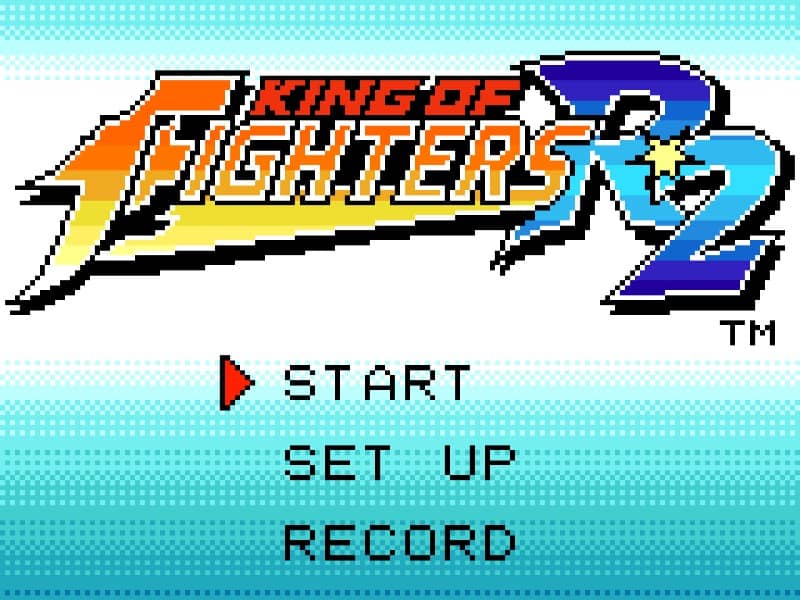
Gameplay and design
The core gameplay of King of Fighters R-2 builds on the design of its predecessor, King of Fighters R-1, offering both single-player and team battle modes. In single-player, you control one fighter against opponents; team mode uses a three-on-three elimination format similar to the arcade King of Fighters '98. The controls are simplified for the handheld, but the basic punches, kicks, jumps, and special move commands remain, letting players enjoy the series' signature fighting feel on a portable device.
VS mode is a key part of the game, allowing two Neo Geo Pocket Color units to be linked via cable for head-to-head matches. This local multiplayer was uncommon in handheld games at the time, providing a chance to compete with friends. The link cable supports not only standard one-on-one fights but also team battles, adding strategic depth and fun.
The biggest highlight is the new "Creation Mode." In this mode, you can customize a character, adjusting appearance, moves, and ability parameters. Once your custom fighter is ready, you guide them on a journey to defeat the final boss, Rugal. Creation Mode adds role-playing and character-building elements, letting players enjoy creativity beyond fighting—a distinctive feature that sets this game apart from other handheld fighters.
Beyond Creation Mode, the game offers various challenge missions centered on your custom character, requiring battles under specific conditions, such as time limits or using designated moves. Completing these tasks earns rewards that further strengthen your character. This design encourages repeated play and extends the single-player content, making it more substantial.
King of Fighters R-2 also supports connectivity with the Dreamcast version of King of Fighters '99 Dream Match. Through a link cable, you can transfer your custom character data from the handheld to the home console and use those fighters in battles there. This cross-platform feature was quite innovative for its time, breaking down barriers between handheld and console gaming and showcasing SNK's exploration of a connected game ecosystem.
Background and release
King of Fighters R-2 was released by SNK on March 19, 1999, for the Neo Geo Pocket Color. As the sequel to King of Fighters R-1, it builds on the previous game's framework but expands the content and systems. Based on King of Fighters '98, the story aligns with that game, following the protagonists as they battle Rugal Bernstein, who is attempting to create clones. However, this is not a direct port; it was redesigned specifically for the handheld.
The character roster was adjusted from King of Fighters R-1. Chizuru Kagura and Kim Kaphwan from the previous game were removed, replaced by Saisyu Kusanagi and Kasumi Todoh. Saisyu is Kyo Kusanagi's father, while Kasumi comes from the Art of Fighting series; their inclusion brings new fighting styles and story elements. This change makes the roster slightly different from King of Fighters '98, offering a fresh experience for players.
As a handheld spin-off, King of Fighters R-2 serves as a complement rather than a replacement for the main series. It aims to let players enjoy King of Fighters on a portable device while attracting them with unique modes. Compared to the mainline games, it focuses more on single-player and customization, reflecting the design trends of handheld games at the time, which emphasized portability and replayability.
The release came early in the Neo Geo Pocket Color's lifecycle, and SNK hoped to promote its handheld platform with this title. As a fighting game, it demonstrated the system's potential for action games and drew in King of Fighters fans. Despite fierce competition in the handheld market, the game gained attention thanks to the series brand and its distinctive features.
In the broader series, King of Fighters R-2 represents an important attempt by SNK in the handheld arena. It inherits the foundation of King of Fighters R-1 and expands gameplay through Creation Mode and connectivity, providing a reference for future portable entries. While it doesn't significantly impact the main storyline, its roster and system adjustments offer another way to experience King of Fighters.
Development
King of Fighters R-2 was developed by SNK in Japan. As a 2D fighting game, the team had to achieve smooth battle animations and responsive controls within the Neo Geo Pocket Color's limited hardware. The small screen and few buttons constrained the control scheme, so while preserving the core fighting mechanics, the developers simplified command inputs—for example, reducing complex special move commands—to fit the handheld's button layout.
The release date is recorded as March 19, 1999, according to Wikidata, but sources may vary. This reflects the sometimes inconsistent release information of the era, possibly due to regional versions. Nevertheless, the game definitely launched within 1999, and as a sequel to King of Fighters R-1, it likely had a short development cycle, reusing the previous game's engine and assets to speed up production.
The addition of Creation Mode was an innovative attempt by the development team. Allowing players to customize characters, including appearance and moves, required extra data storage and processing. With limited cartridge capacity, the developers optimized code and compressed data to make this feature possible. The mode may have been inspired by other games' character customization systems, but combining it with a fighting game was uncommon at the time.
The connectivity with the Dreamcast version of King of Fighters '99 Dream Match was part of SNK's cross-platform strategy. The Dreamcast was SNK's primary home console then, and linking the handheld could boost both platforms' appeal. Implementing this required solving data transfer and compatibility issues; the team used a dedicated link cable and data format to allow custom characters to move from handheld to console, a technically advanced feature for its day.
During development, the team also considered roster balance. Removing Chizuru Kagura and Kim Kaphwan and adding Saisyu Kusanagi and Kasumi Todoh may have been to adjust character performance or increase story connections. Saisyu, as Kyo's father, ties closely to King of Fighters '98's plot; Kasumi, from another SNK series, might have been included to attract a wider audience. These changes reflect the developers' careful choices in character selection.
Reception and legacy
King of Fighters R-2 was ported to the Nintendo Switch on August 7, 2020, and received "mixed or average" reviews on Metacritic. Critics generally found the core gameplay still enjoyable, but the handheld-era graphics and controls felt dated on the Switch. Still, for nostalgic players and series fans, revisiting the game on a modern platform held appeal.
In 2021, the port was included in the Neo Geo Pocket Color Selection Vol. 1 compilation, alongside other classic titles from the system. This collection gave more players access to Neo Geo Pocket Color games and raised the profile of King of Fighters R-2. Its inclusion shows SNK's commitment to its handheld legacy and provided a wider distribution channel for the game.
In 2023, Time Extension listed the game among the best Neo Geo Pocket Color titles. This recognition affirmed its standing in handheld gaming, particularly for the innovative Creation Mode and connectivity features. Although the original release didn't receive such accolades, this honor indicates that the game's value has been rediscovered over time, making it a representative handheld fighting game.
King of Fighters R-2's influence on the series is mainly seen in the development of handheld spin-offs. Its Creation Mode offered design ideas for later titles, and the connectivity feature demonstrated the possibilities of cross-platform interaction. While it didn't directly alter the mainline direction, its exploration in the handheld space provided SNK with experience and gave players a more diverse King of Fighters experience.
Overall, King of Fighters R-2 successfully brought the core experience of King of Fighters '98 to a portable platform and attracted players with its unique features. Despite technical limitations of its time, its innovative spirit and playability have kept it remembered by players and media alike. For fans of the series or those interested in handheld gaming history, this is a title worth trying.





