
Gameplay and design
The core gameplay of Kirby's Dream Land 3 follows the series' established side-scrolling platforming formula. Kirby can walk, swim, fly, and use his signature inhale ability to swallow enemies and copy their powers. In this installment, Kirby also gains moves like the star bullet and air gun, which form the basis of his moveset. Players must use these abilities flexibly to navigate the levels of Pop Star, defeat enemies, and solve puzzles.
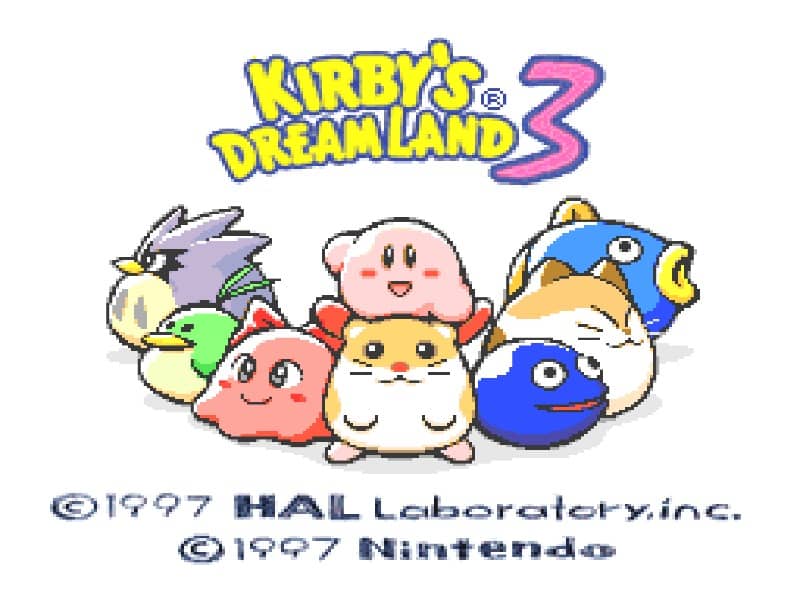
The game's biggest feature is the animal friend system. Six animal friends are available: Rick, Coo, Kine, and newcomers Nago, Pitch, and Chuchu. Each animal has unique movement abilities—for example, Rick can climb walls, Coo can fly, and Kine excels in water. Kirby can ride these friends, and combining them with copy abilities produces special moves, such as Rick spitting fireballs when paired with the Fire ability. Some puzzles require specific friends or abilities to solve, adding a layer of strategy.
In addition to animal friends, Kirby can summon Gooey as a companion. Gooey can use his tongue to swallow enemies and copy abilities, but summoning him costs two of Kirby's health points. This mechanic introduces a pseudo-cooperative play style, allowing players to control both Kirby and Gooey simultaneously and use their combined abilities to solve puzzles. Gooey adds depth to combat and exploration, but requires careful health management.
The game features six worlds, each with a Heart Star mission. These missions require Kirby to escort an animal friend to a familiar character, and completing them is necessary to collect Heart Stars. The number of Heart Stars collected directly affects the ending: if the player fails to collect all of them, Kirby fights King Dedede, who is possessed by Dark Matter; if all Heart Stars are collected, the true masterminds, Dark Matter and Zero, are revealed as the final bosses. This dual-ending design encourages thorough exploration and completion of all side objectives.
The level design emphasizes a blend of exploration and puzzle-solving, with many hidden areas accessible only by using specific animal friends or abilities. The game's difficulty is moderate, but Heart Star missions often require careful observation of the environment and experimentation with different friend combinations. This design keeps the game's lighthearted tone while offering enough challenge to motivate players to try different approaches after finishing the main story.
Background and release
Kirby's Dream Land 3 is the fifth game in the Kirby series and the third to bear that name, following the original Kirby's Dream Land and Kirby's Dream Land 2. It was first released in North America on November 27, 1997, with the Japanese version following on March 27, 1998. As a direct sequel to Kirby's Dream Land 2, it shares many characters and settings, but has little connection to the original Kirby's Dream Land, instead continuing the series' core gameplay and world.
This game holds special historical significance as the last SNES game Nintendo published in North America. By 1997, the Nintendo 64 had already launched, and the SNES was at the end of its life cycle, yet Nintendo still chose to release this first-party title in North America, showing final support for the 16-bit platform. This release context influenced the game's audience and reception, with many players viewing it as the swan song of the Kirby series on the SNES.
Due to PAL conversion issues, the game was not released in Europe and Australia for many years. It wasn't until July 24, 2009, that it was made available on the Wii Virtual Console in its North American version, allowing European players to experience it for the first time. This delayed release meant the game had relatively low visibility in Europe, but it also helped it gain renewed attention on the Virtual Console. On May 8, 2013, it was also released on the Wii U Virtual Console in North America and Japan, further expanding its audience.
Beyond Virtual Console, the game was included in the 2012 Wii compilation Kirby's Dream Collection: Special Edition. This collection features several classic games from the series, making it easy for new and old players alike to revisit Kirby's history. Through these re-releases, Kirby's Dream Land 3 continued to circulate after the SNES hardware was retired, becoming a collectible and study subject for series fans.
The game's story is set on Pop Star, where Kirby and his friend Gooey are fishing when a mysterious dark cloud appears and wreaks havoc on the planet. Kirby and his companions set out to protect the world, a simple narrative framework that provides motivation for the adventure. The game's two endings correspond to different final bosses: fighting King Dedede if not all Heart Stars are collected, or facing Dark Matter and Zero if they are. This narrative structure is somewhat unique in the series, adding replay value.
Development
Kirby's Dream Land 3 was developed by HAL Laboratory and published by Nintendo. HAL Laboratory is the creator of the Kirby series and has long been responsible for its development. During development, the SNES was already facing competition from newer consoles, but HAL Laboratory made full use of the SNES's hardware capabilities to create a game with a distinctive visual style. The game cartridge includes the SA-1 coprocessor chip, which enhances processing speed, allowing for smoother rendering of complex graphics.
A major technical highlight of the game is its use of the SNES's "pseudo-high-resolution" mode. This technique blends adjacent pixels' colors to merge dithered sprites, creating a watercolor-like visual effect. This gives the game a soft, picture-book quality that contrasts sharply with the bright, cartoonish style of other series entries. This visual style became one of Kirby's Dream Land 3's most notable features and a key reason for its popularity among fans.
The development team made bold choices in visual presentation, designing backgrounds with greater detail and more natural color transitions. The pseudo-high-resolution mode made the game's scenes and characters look as if they came straight out of a picture book, a style rarely seen in platformers of the time. Although this technique was not new, HAL Laboratory cleverly combined it with Kirby's world to create a unique visual experience.
In terms of gameplay design, the team introduced three new animal friends—Nago, Pitch, and Chuchu—joining Rick, Coo, and Kine from previous games to form a roster of six. Each friend has unique movement abilities and combination moves with copy abilities, requiring the developers to carefully design levels that accommodate different friends' strengths. This design philosophy continued the animal friend system from Kirby's Dream Land 2 but deepened the interaction between friends and abilities.
Not many details about the development process were made public, but the final product shows that HAL Laboratory aimed to create a comprehensive entry in the series at the end of the SNES era. The Heart Star missions and dual-ending design reflect the team's emphasis on encouraging player exploration. Although the game did not surpass Kirby Super Star in commercial or critical success, its unique art style and gameplay design have secured it a place in the series.
Reception and legacy
Kirby's Dream Land 3 received polarized reviews from the media. GameRankings gave it an aggregate score of 66.25% based on four reviews, while Nintendo Life initially scored it 6/10, criticizing the lack of difficulty but praising the visual style. However, Nintendo World Report gave it a high score of 9/10, praising the graphics and music. This disparity reflects differing interpretations of the game's identity: it is neither an action-packed spectacle like Kirby Super Star nor a simple casual game.
IGN gave a positive review of the Virtual Console version, stating, "It's not Super Star, but once you accept it, you can appreciate its value as a direct sequel in the series." This comment highlights the difference from Kirby Super Star, which is known for its rich modes and fast-paced action, whereas this game focuses more on exploration and partner interaction. IGN also ranked the game 62nd on its list of the "Top 100 SNES Games," affirming its standing on the 16-bit platform.
One of the game's most striking legacies is the bloody depiction of the hidden boss Zero. Zero is the supreme leader of the Dark Matter army, appearing as a giant red eye, and during the battle, it sprays blood from its eye white. This scene is extremely rare in the Kirby series, which is typically known for its cute and harmless style. Sources have called it a "rare example of graphic violence," sparking widespread discussion among players and making Zero one of the most memorable bosses in the series.
Zero later returned as "02" in Kirby 64: The Crystal Shards, with a bandage on its head, hinting at the wounds from the previous battle. This detail not only connects the plots of the two games but also shows that the development team intended to continue Zero's storyline. This cross-game continuity gives Kirby's Dream Land 3 an important place in the series' narrative, influencing the world-building of later titles.
Although the game did not receive unanimous praise upon release, it has gradually gained more recognition over time. Its picture-book visuals and animal friend system are unique within the series, and as the last SNES game Nintendo released in North America, it carries special historical significance. For fans of the Kirby series, Kirby's Dream Land 3 is a game worth revisiting, showcasing the series' innovative attempts at the end of the 16-bit era and laying groundwork for its later transition to 3D.





