
Gameplay and design
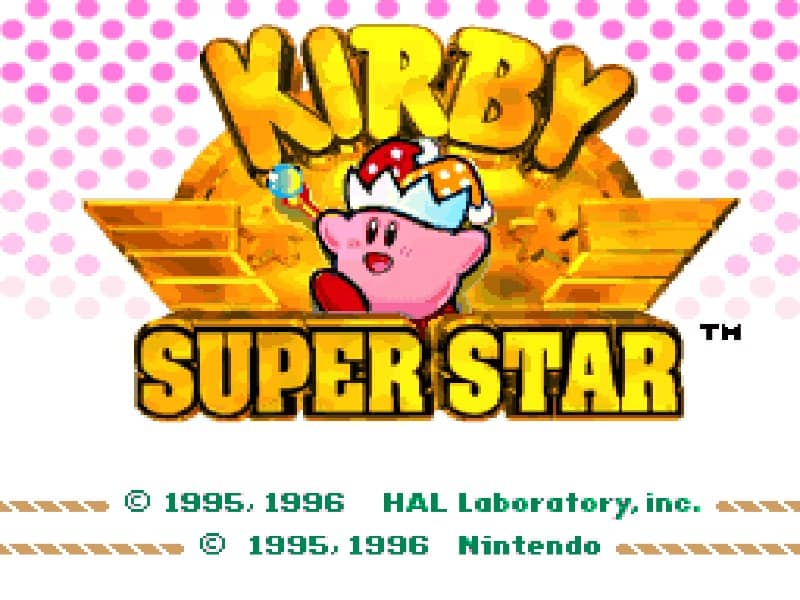
The core gameplay of Kirby Super Star revolves around Kirby's copy ability. Kirby can inhale enemies and copy their abilities, each with unique attack methods. This is the first game in the series where Kirby's appearance changes with the ability, such as wearing a sword hat or turning into a fire form. This intuitive visual feedback lets players quickly identify the current ability and enhances the fun.
The biggest innovation is the Helper system. Kirby can spend a copy ability to summon a helper, controlled by AI or a second player. This design stems from Shigeru Miyamoto's suggestion for two-player cooperation, and Masahiro Sakurai conceived the Helper mechanic based on that. Helpers not only keep solo players company but also make two-player co-op simple and natural, allowing both to tackle stages, solve puzzles, and even team up to defeat bosses.
The game is a compilation with seven main modes and two minigames. Spring Breeze is a condensed remake of the original Kirby's Dream Land, streamlining levels and boss fights, suitable for newcomers. Dyna Blade is a traditional side-scrolling adventure where players must defeat the giant bird Dyna Blade. Gourmet Race is a racing mode where players race Kirby on a food-themed track while collecting food.
The Great Cave Offensive is a Metroidvania-style mode where players explore a vast cave to find 60 treasure chests. The chests contain cameo items from many other Nintendo series, such as the sword from The Legend of Zelda and armor from Metroid. This cross-franchise crossover brings a knowing smile to veteran players. Revenge of Meta Knight is a story-driven mode where players must stop Meta Knight's ship, the Halberd, within a time limit, and finally escape from the crashing ship, creating a tense atmosphere.
Milky Way Wishes is the largest mode, where players travel across nine planets to collect Copy Essences. In this mode, Kirby has no copy abilities; instead, he can only obtain and freely switch abilities by collecting essences. This design breaks tradition and encourages players to experiment with different ability combinations. The Arena is a boss rush mode where players have only one life but can restore health five times; clearing it unlocks a sound test. The minigames Samurai Kirby and Megaton Punch support multiplayer, testing reaction and timing.
Background and release
Kirby Super Star was released in Japan on March 21, 1996, for the Super Famicom. At that time, the Nintendo 64 was only three months away, and the SNES was at the end of its life cycle, but the game still became an important title on the platform thanks to its outstanding quality. The game launched in North America on September 20, 1996, and in Europe on January 23, 1997, with the European version retitled Kirby's Fun Pak.
The Japanese title, Hoshi no Kirby: Super Deluxe, was coined by Shigesato Itoi, creator of the Mother series, who also contributed to the packaging design. The Japanese packaging used a paulownia wood box style, giving it a classic and elegant look that contrasted interestingly with the game's content. The Western versions used more straightforward titles, emphasizing the game's deluxe and rich nature.
The game was a commercial success upon release, selling 141,621 copies in its first week in Japan and 563,806 copies that year. According to the 2021 CESA White Paper, total sales reached 1.44 million copies. This was a strong performance at the end of the SNES era, proving the appeal of the Kirby series.
The game was later re-released on the Virtual Console for Wii and Wii U, allowing new players to experience this classic. Additionally, it was included in Kirby's 20th Anniversary Collection and the SNES Classic Edition, cementing its status as an officially recognized classic.
In 2008, an enhanced remake for the Nintendo DS, Kirby Super Star Ultra, was released, adding new content and improving graphics, with sales nearing 3 million copies, further expanding the game's influence. However, the original Super Star's unique status remains irreplaceable.
Development
The game was directed by series creator Masahiro Sakurai, his third Kirby game after Kirby's Dream Land and Kirby's Adventure. During development, Sakurai established three core pillars: two-player cooperation, fighting-game-like action, and a compilation format. These pillars guided the entire development, shaping the game's structure and gameplay.
Two-player cooperation was a request from Shigeru Miyamoto, leading Sakurai to design the Helper system. Miyamoto believed Kirby games should support two-player fun, so Sakurai conceived the idea of summonable helpers. The Helper system not only met the need for co-op but also gave solo players more strategic options, becoming one of the game's most iconic features.
Development took three years, partly due to the influence of Donkey Kong Country, which prompted the team to redo the art midway. Donkey Kong Country's pre-rendered graphics were stunning at the time, and HAL Laboratory decided to enhance the game's visuals, redrawing all art assets, which extended the development period.
The game originally planned to include a horror mode called 'Kagero Mansion,' but it was ultimately cut due to time constraints. This mode would have brought a different atmosphere and gameplay, but unfortunately it was not realized. The working title was 'Kirby Active,' and the final title was suggested by Shigesato Itoi, who recommended 'Super Deluxe' to highlight the game's rich content.
The prototype was initially developed for the NES, for internal use, and was nearly complete, with some animations identical to the final version. This prototype proved that the core Kirby gameplay was already mature on the NES, but the SNES's hardware allowed the team to achieve richer graphics and smoother action.
Reception and legacy
Kirby Super Star received widespread acclaim upon release. GameRankings gave it a score of 85.74% based on 7 reviews. Electronic Gaming Monthly praised the game's rich content, excellent two-player mode, beautiful graphics, and fun copy abilities, nominating it as runner-up for action game of the year. IGN, GamesRadar, and Complex also listed it among the best SNES games.
Music from the game, such as 'Gourmet Race,' has been remixed in titles like Super Smash Bros., becoming a signature melody for the Kirby series. Meta Knight's ship, the Halberd, has reappeared in several later games, becoming an important element of the series. These elements left a deep impression on players and reflect the game's influence on the franchise.
The 2008 DS remake, Kirby Super Star Ultra, was a huge success, selling nearly 3 million copies, proving the enduring appeal of the original design. The remake preserved the essence of the original while adding new content, attracting a new generation of players.
Super Smash Bros. for Wii U featured a stage based on The Great Cave Offensive, supporting eight-player battles, allowing more players to enjoy that mode. This shows the game's influence within Nintendo and demonstrates the forward-thinking nature of its design.
Overall, Kirby Super Star is not only an excellent action game but also a major milestone in the Kirby series. Through its compilation format, Helper system, and diverse modes, it showcases Sakurai's deep understanding of game design and has influenced the design philosophy of many subsequent games.





