
Gameplay and design
Metal Slug 2's core gameplay carries over from the first game: players guide their character through side-scrolling stages, shooting waves of enemies and facing off against large bosses at the end of each level. Basic controls include jumping, shooting, throwing grenades, and using terrain and cover to dodge enemy fire. Compared to its predecessor, the game doesn't overhaul the system but enriches the experience with new elements, allowing veterans to jump right in while still feeling something fresh.
The most notable new mechanic is the character transformation ability. When players pick up certain items, their character transforms into a mummy or a fat version, altering not only appearance but also attack methods and movement speed. In mummy form, the character can only use melee attacks, while the fat form can throw more powerful bombs but moves sluggishly. This transformation mechanic adds unpredictability to stages, requiring players to adapt their strategies based on their current form, and it also provides plenty of comedic moments.
The number of playable characters increases from two in the original to four, adding Fio and Eri alongside Marco and Tarma. While there are no significant differences in abilities, each character has distinct visual and animation details, catering to players' desire for personalization. Additionally, NPC allies like Hyakutaro and Ichikawa join the fight, following the player and providing fire support. Though their impact is limited, they add to the battlefield's liveliness and make players feel less alone.
Weapons and vehicles remain central to the gameplay. Players can pick up heavy machine guns, shotguns, flamethrowers, and more, each with different trajectories and power, suited for various enemies. The SV-001 tank remains an iconic vehicle, offering strong firepower and protection, but it can be destroyed by enemies. This installment also introduces new vehicles like camels and a flying craft, diversifying movement and combat options. Effectively utilizing weapons and vehicles is key to clearing stages.
Metal Slug X, as a revised version, makes substantial gameplay adjustments. It adds powered-up versions of the heavy machine gun, flamethrower, shotgun, laser gun, and rocket launcher, and introduces new weapons such as the stone, iron lizard, and enemy chaser. Enemy counts increase, new enemy types and boss placements appear, and vehicle and item positions are rearranged. Additionally, stage time-of-day settings change, such as dusk, dawn, or sunset, affecting the visual atmosphere. These changes make Metal Slug X's experience distinctly different from the original, with higher difficulty.
Background and release
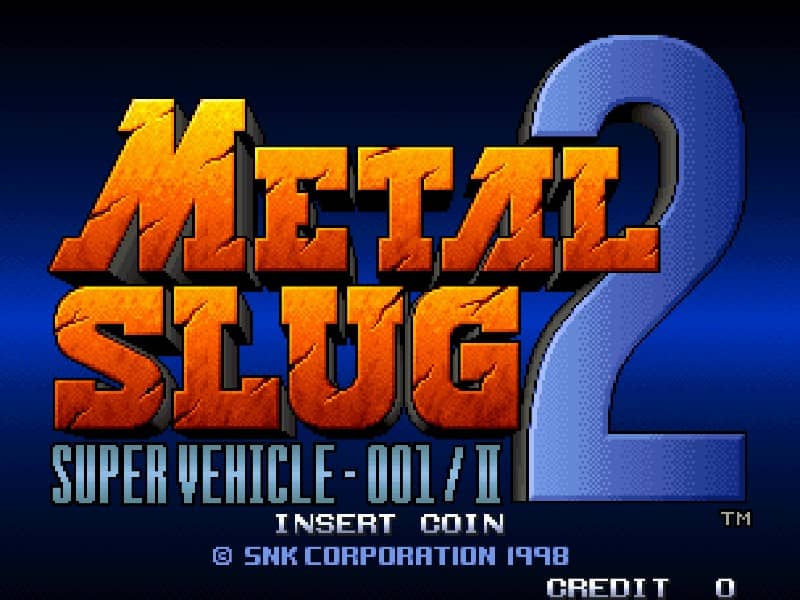
Metal Slug 2 was first released for the Neo Geo MVS arcade platform in 1998, as a direct sequel to 1996's Metal Slug. Developed by SNK, it continues the world and gameplay of its predecessor while expanding upon them. The story is set two years after the first game, with Marco Rossi and Tarma Roving again battling General Morden, but this time Morden allies with aliens, who eventually betray him and become the true enemies. Though the plot is simple, it provides a rich backdrop for varied stages and enemy designs.
The game was first publicly shown at the AOU show in February 1998, creating a stir and being called the "best game of the show" by Sega Saturn Magazine. This reflected the high expectations players and media had for the Metal Slug series. In March of the same year, the game ranked third in Japanese arcade charts, indicating solid commercial performance. As a significant Neo Geo title, Metal Slug 2 solidified the series' position in the arcade market.
The original Metal Slug 2 suffered from severe slowdown and performance issues, especially in scenes with heavy enemy and effect density, causing noticeable frame rate drops that affected control responsiveness. This problem drew criticism from players and media, prompting SNK to release a revised version, Metal Slug X, in 1999. Metal Slug X was not a simple port but was rebuilt using the improved engine from Metal Slug 3, eliminating the slowdown and increasing difficulty.
The home version of Metal Slug 2 was released for the Neo Geo AES in April 1998 and for the Neo Geo CD in June, with the CD version including a "Combat School" mode that offered extra content for practice and challenges. In 2006, the Metal Slug Anthology was released for Wii, PS2, and PSP, including Metal Slug 2 and Metal Slug X among other series titles. In 2008, the AES version came to the Wii Virtual Console, allowing more players to experience this classic.
Metal Slug X was released for the AES in May 1999 and for the PlayStation in January 2001, published by Agetec in North America and PAL regions. In 2009, both games were included in the European release of Metal Slug Anthology PC, and in 2013, iOS and Android versions were released. In 2017, the arcade version of Metal Slug X was released for Nintendo Switch via ACA Neo Geo. These ports and compilations have kept the series alive across various platforms.
Development
Metal Slug 2 was developed by SNK using Neo Geo hardware, known for its powerful 2D graphics capabilities, enabling detailed pixel art and smooth animation. The development team aimed to expand on the original, increasing the number of characters, adding new mechanics, and designing richer stages. However, due to the Neo Geo's hardware limitations, the game experienced performance issues in complex scenes, which became a regret during development.
The slowdown in the original Metal Slug 2 was not accidental; it resulted from the team's pursuit of extreme visual fidelity, causing the hardware to struggle when too many enemies and effects were on screen. This issue sparked widespread discussion among players and prompted SNK to create a revised version to address it. The development team used the improved engine from Metal Slug 3 for Metal Slug X, optimizing code and resource management to resolve the slowdown.
The development of Metal Slug X involved more than just performance optimization; it included substantial content adjustments. The team redesigned the time-of-day settings for stages, altering the visual style of some scenes, and rearranged enemy and item placements. They also added new weapons and enemy types, increasing the difficulty to make Metal Slug X a more challenging game. Additionally, the music was remixed, the announcer was changed, and even Fio's death sound was fixed, showing the team's attention to detail.
In terms of character design, this installment introduced NPCs like Hyakutaro and Ichikawa, who appear as supporting characters, adding fun to the game. The character transformation mechanic was also an attempt by the team to add variety. These designs not only enriched gameplay but also showcased SNK's creativity in 2D action games. However, these new elements also increased development complexity, possibly contributing to the performance issues.
During the credits of Metal Slug X, artwork from the original Metal Slug is displayed, whereas Metal Slug 2 shows a black screen, a detail players have seen as a tribute and easter egg. The development team not only fixed issues in the revised version but also included these hidden touches, delighting veteran players. These production anecdotes reflect SNK's dedication to the series and their willingness to engage with players.
Reception and legacy
Metal Slug 2 received generally positive reviews upon release, with critics praising its detailed graphics, smooth action, and humorous style. However, the original's slowdown became a focal point of criticism, affecting overall scores. IGN's Lucas M. Thomas gave the 2008 Virtual Console version 7.5/10, criticizing the slowdown but praising the game itself. Eurogamer's Dan Whitehead gave it 7/10, also noting the high price. Despite this, the game holds an important place in players' hearts.
Metal Slug X, as a revised version, received higher praise. Eurogamer's Tom Bramwell gave the 2001 PS version 8/10, calling it the best of its kind on the PS. GameSpot's Ryan Davis gave the PS version 8.2/10, praising its humor and gameplay, and nominated it for PS Game of the Year. These high scores indicate that Metal Slug X successfully addressed the original's issues and improved the game's quality, making it the superior version.
Commercially, Metal Slug 2 ranked third in Japanese arcade charts in March 1998, performing well. Metal Slug X ranked seventh in April 1999, also achieving decent results. The PS version of Metal Slug X sold 95,103 copies in Japan and 69,035 in the US, while the PC version sold 229,374 copies on Steam, showing the series' enduring appeal across multiple platforms.
Metal Slug 2 and Metal Slug X have left a lasting impact on subsequent series entries. Metal Slug 3, released in 2000, further expanded on the gameplay, drawing from the experiences of its predecessors and becoming one of the series' peaks. The success of the revised Metal Slug X also demonstrated SNK's responsiveness to player feedback, providing a reference for future development. The series still boasts a large fanbase, with new releases and ports continuing to appear.
Overall, Metal Slug 2 is a crucial chapter in the series' evolution, inheriting the essence of the original and introducing new elements. Despite its performance issues, it remains an excellent game. Metal Slug X, through revision, perfected the experience and became a classic in many players' minds. Together, the two games established the series' position in 2D shooters and influenced later works in the genre.





