
Gameplay and design
The core gameplay of Metal Slug 3 follows the series' established run-and-gun style. Players control a character moving through side-scrolling levels, shooting incoming enemies and facing large bosses at the end of each stage. Compared to its predecessors, the game maintains smooth movement and jumping controls while giving melee attacks a stronger presence. Players can use knives and kicks for close combat, and touching enemies does not instantly kill you, but enemies also have melee capabilities, so getting up close requires careful timing.
The most notable innovation in this installment is the branching path system. In most missions, levels offer forked routes, and players must choose one to proceed. Each path features different obstacle designs and lengths, but all eventually lead to the same boss battle. This design not only adds variety to the levels but also allows players to experience different challenges on repeated playthroughs, significantly enhancing replay value. The introduction of branching paths was a first for the series and left a lasting impact on level design in later titles.
The prisoner rescue mechanic is another core element of the series. Players encounter imprisoned POWs in levels; rescuing them grants random items or weapons and provides bonus points at the end of the level based on the number rescued. This mechanic encourages exploration to find hidden POW locations. Notably, if the player dies before the level ends, the rescued count resets to zero, so balancing risk and reward becomes a defining skill that separates experts from novices.
The destructibility of the game environments is also a key feature. Many walls, crates, vehicles, and other objects can be shot and destroyed, sometimes revealing hidden items or weapons. This design adds interactivity to the levels and gives players an extra layer of exploration amidst the intense action. Hidden items often provide powerful weapons or extra lives, making careful observation as important as firepower.
Overall, Metal Slug 3 does not radically overhaul the series' basic framework but instead introduces details like branching paths, destructible environments, and the POW mechanic to keep every level full of variety. The pacing is tight, and the difficulty curve is well balanced, allowing newcomers to enjoy the game on easy mode while challenging hardcore players on the highest difficulty. This refinement and innovation of the core gameplay are key reasons why the game has become a classic.
Background and release
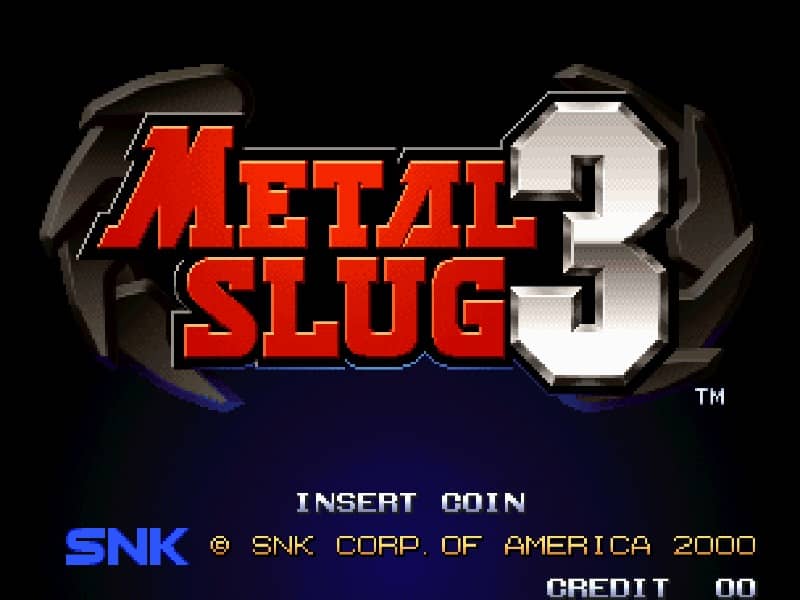
Metal Slug 3 was first released on the Neo Geo MVS arcade platform in 2000, serving as a direct sequel to Metal Slug 2 and Metal Slug X. As the third installment in the series, it continues the established worldview and core gameplay but significantly expands the content and systems. The game was developed by SNK, with music handled by Noise Factory, maintaining the series' high standard of audiovisual presentation.
The story is set several years after General Morden's failed coup. This time, Morden is imprisoned by aliens, and the player characters are also abducted by extraterrestrials. To confront the common alien threat, the protagonists must ally with their former enemy, the Morden army. This plot twist breaks the series' usual "human civil war" framework, introducing sci-fi elements and injecting new life into the series' narrative.
The playable characters include Marco Rossi (Major) and Tarma Roving (Captain), as well as S.P.A.R.R.O.W.S. agents Eri and Fio. Players can choose any character, each with slightly different appearances and animation details, though their core abilities are essentially the same. Multiple character selection is not uncommon in the series, but this installment features more distinct character designs, enhancing player immersion.
In terms of commercial performance, Metal Slug 3 achieved solid results in Japanese arcades. According to Game Machine magazine, the game was ranked as the third most successful arcade game in April 2000. This success demonstrated the series' popularity at the time and laid the groundwork for subsequent ports and re-releases.
The arcade original received generally positive reviews from players and media upon release. Its detailed pixel art, rich level design, and smooth controls are considered among the series' peaks. Although later versions were released on multiple platforms, the arcade original's status remains unshakable, becoming an indelible classic memory for many players.
Development
Metal Slug 3 was developed by SNK as an exclusive title for the Neo Geo MVS arcade platform, fully utilizing the hardware's capabilities to deliver detailed pixel graphics and smooth animations. The development team sought to introduce new gameplay mechanics while preserving the series' signature style, and the branching path system was a result of this effort. This system not only increased level replayability but also reflected the developers' innovative spirit in design.
The game's music was handled by Noise Factory, a company that had worked on soundtracks for several SNK games. The soundtrack retains the series' energetic melodies while incorporating more electronic and rock elements, complementing the fast-paced combat. Sound effects, including gunfire, explosions, and character voices, were carefully crafted to enhance immersion.
After the arcade release, Metal Slug 3 was ported to multiple home platforms. In 2006, Metal Slug Anthology was released for Wii, PS2, and PSP, featuring the series up to the sixth installment but without extra modes. In 2008, the game was released on Xbox Live Arcade with online co-op support, but again without additional content. These ports allowed more players to experience this classic.
Notably, the PS2 and Xbox versions included two mini-games: "Storming the UFO Mothership" and "Fat Island." These mini-games provided extra entertainment, though not central to the core gameplay, they enriched the overall experience. The Xbox version also supported Xbox Live online leaderboards, but that service was discontinued in 2010 and is now replaced by the third-party service Insignia.
Subsequent ports further expanded the game's reach. In 2012, the game was released on Wii Virtual Console, iOS, and Android; in 2014, a PC version launched on Steam; PS3, PS Vita, and PS4 versions followed; and the Nintendo Switch version was released on March 9, 2017. These ports allowed Metal Slug 3 to span multiple generations, continuing to attract new and old players alike.
Reception and legacy
Metal Slug 3 received generally positive reviews upon its initial release, and subsequent ports maintained high ratings. On GameRankings, the PS2 version scored 76.78%, the Xbox version 75.71%, the Xbox 360 version 78.46%, and the iOS version 74%; on Metacritic, the Xbox version scored 76, the Xbox 360 version 78, and the iOS version 76. These scores reflect the game's good reputation among players and critics.
Reviews from major gaming outlets varied in focus. IGN's Hilary Goldstein gave the Xbox version 6.8/10, stating it was a decent arcade shooter but weak as an Xbox game; GameSpot's Ryan Davis gave both the Xbox and Xbox 360 versions 7.5/10, praising the game's detail and animation but criticizing the Xbox version's high difficulty; Eurogamer's Spanner Spencer gave the Xbox version 7/10, finding the game too short, while Patrick Garratt gave the Xbox 360 version 9/10, considering it the ideal home; GameSpy's Darryl Vassar gave the Xbox version 4/5, noting that while individual parts were not outstanding, the combination worked well.
Sales figures also attest to the game's commercial success. The PS2 version sold 47,581 copies in Japan, and the 2014 PC version sold 651,482 copies on Steam, totaling at least 699,063 copies. This number is considerable for an arcade port, demonstrating the series' strong appeal.
The game's port history across multiple platforms underscores its classic status. From the 2006 Metal Slug Anthology to the 2017 Switch version, the game has been re-released repeatedly, allowing players of different generations to experience it. Although some port services have been discontinued, the game's vitality has not waned.
The influence of Metal Slug 3 extends beyond sales and scores, particularly in its inspiration for later game design. The branching path system has been adopted by many subsequent action games, and the alien theme and alliance with Morden opened new directions for the series' story. For many players, this game is not just a childhood memory but a milestone in side-scrolling shooters.





